 Dear Shaded Viewers,
The Grand Palais handed its galleries to an artist who prefers to sabotage our certainties rather than flatter our gaze. Leandro stages crises of reality with the precision of a scenographer and the irony of a magician who never hides his trick.
Born in Buenos Aires in 1973 and now living between Paris, Buenos Aires and Montevideo, Erlich has built a reputation through immersive installations that turn visitors into co‑authors. Everyday architectures – staircases, elevators, façades, shop windows – become perceptual stress tests: you recognise a banal setting, something slips, and suddenly “reality” appears as what it really is, a collective construction rather than a given.
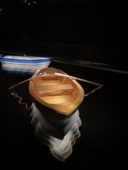
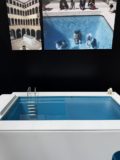
The exhibition opens like a film. You step into dense darkness and onto Port of Reflections, a black basin where small boats seem to float on perfectly still water. Just as you surrender to the hypnotic calm, the mechanism reveals itself: no water, no real reflection, but a hidden system of movement and sculpted doubles that reproduces exactly what your memory expects to see. It’s not the sea that moves here, it’s your belief in the sea that is being staged.
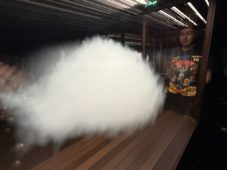
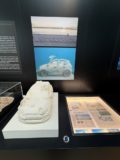
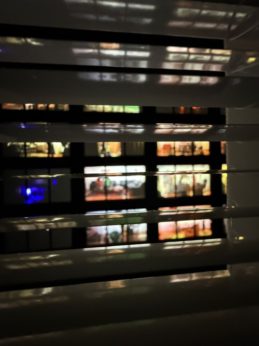
Throughout the show, the ordinary turns itself inside out. The Cloud cages clouds in vitrines, cabinet‑of‑curiosities style: a simple stack of glass and light captures the childhood gesture of finding shapes in the sky and turns it into a meditation on our compulsion to organise chaos. The View positions us behind half‑closed blinds facing a façade where anonymous neighbours dress, cook, argue, live. We catch ourselves savouring this sanctioned voyeurism, all the while knowing everything is carefully scripted.
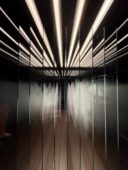
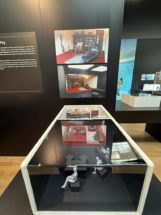
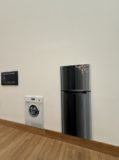
The most unsettling works are those that hijack functional architecture. Elevator Maze lines up elevator cabins whose mirrored walls sometimes refuse to reflect us and instead return other visitors, creating a labyrinth of gazes that transforms a vertical commute into an existential experience. Changing Rooms, with its thirty fitting rooms stitched together by “wrong” mirrors, conjures sudden apparitions of strangers at the exact point where we usually expect privacy. Trying on clothes becomes an endless role‑play, where the fiction of self rubs up against the fictions of others.
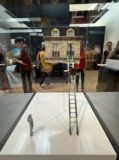
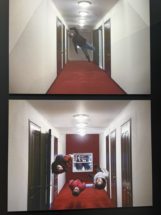
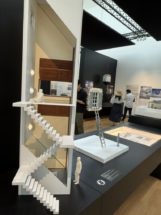
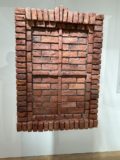
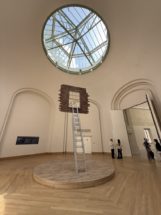
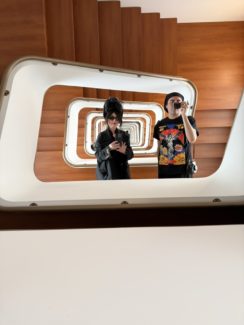
Elsewhere, Staircase – a life‑size stairwell rotated 90 degrees – cuts straight through your sense of orientation: you feel as if you’re peering into a shaft, when in fact you’re facing a wall. Window and Ladder – Too Late For Help, conceived after Hurricane Katrina, condenses into a brick window and a lone ladder all the political weight of catastrophes watched from afar, when it is already too late to act. In Erlich’s universe, wonder always casts a shadow: behind the amusement lurk questions about who falls, who stands at the window, who has access to the exit.
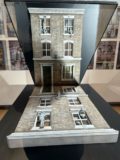
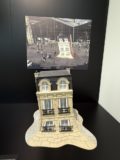
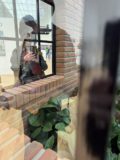
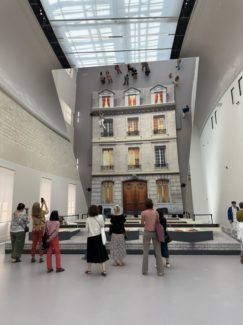
The climax is Bâtiment, the piece that first went viral during Paris’s 2004 Nuit Blanche: a Haussmann façade laid flat on the floor, mirrored by a huge panel tilted at 45 degrees. No instructions, just a device. Visitors lie across balconies, cling to mouldings, crawl along ledges, and discover themselves in the mirror as gravity‑defying stunt doubles. The resulting selfie is not a digital illusion but proof that a slight shift in point of view is enough to make the world flip.
This is far more than a greatest‑hits display of spectacular, Instagram‑friendly installations. At the Grand Palais, Erlich orchestrates a school of joyful doubt. Illusion here is never a gimmick; it’s a method for dismantling the machine of the real, exposing its gears, reminding us that what we see is always contaminated by what we’re willing to believe. You leave the exhibition with the feeling that you’ve walked on water, slipped through walls, climbed façades – but above all that your personal horizon line has been quietly, irreversibly moved.
