
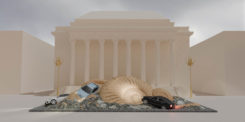
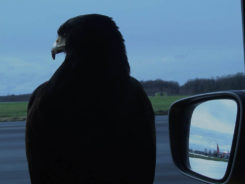
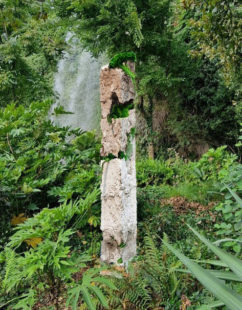
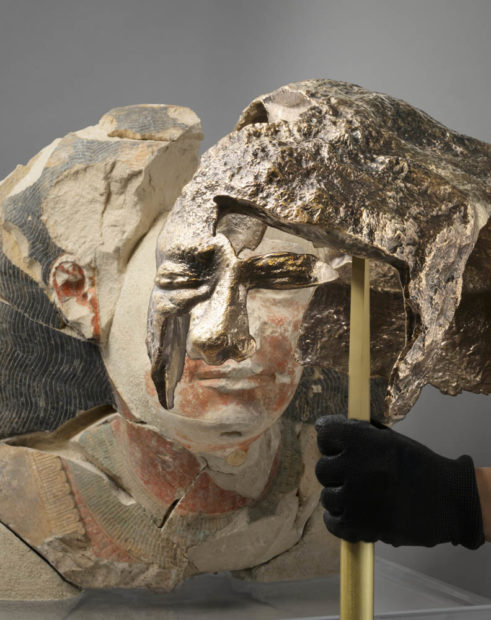
© Théo Mercier, Fossil Opera, Esquisse – Le Voyage à Nantes 2026, Anne-Charlotte Finel, Atlantique, 2026, Barbara Schroeder, esquisse
les Mistériennes, 2026, Ali Cherri, Returning the Gaze (Fragment of a statue of governor Ibu), 2024 © courtesy of the artist, Fondazione In Between Art Film and Galerie Imane Farès
Dear Shaded Viewers,
Nantes becomes, this summer, a city of elements. Between river and ocean, sky and soil, Le Voyage à Nantes opens a new chapter by dedicating four years to a cycle on Earth, Water, Air and Fire, inviting art to measure itself against the very substances that shape the city and our bodies. La Terre, the first movement of this cycle, runs from 4 July to 6 September 2026 and takes Earth as both matter and metaphor, a dense and primordial force that holds the memory of the city while symbolising the fragile vessel we inhabit together in an immeasurable cosmos.
At a time when the urban fabric often appears as an endlessly reconstructed backdrop to modern cacophony, Nantes insists on its own porosity to the natural world. The city is bathed in flux: water and light, air currents and tidal rhythms, a topography that refuses fixed horizons and instead insists on perpetual movement. This context is not anecdotal; it is the very stage on which the works appear, a theatre where the elements are not just themes, but actors.
Under the artistic direction of Sophie Lévy, Le Voyage à Nantes claims itself less as an institution than as an atmosphere, a state of attention that reshapes the way inhabitants and visitors inhabit the city. Arriving in Nantes, one is immediately immersed in a sensual bath of elements, suspended between ocean and river, sky and land, in a landscape that feels fluid, uncertain, and therefore radically open to invention. This indeterminacy is not a defect but a resource: Nantes is described as an “indecisive and uncertain” city whose very instability makes it creative and always ready for adventure.
La Terre, as the inaugural element of the cycle, anchors this ambition in a deliberately material register. Earth here is clay and dust, sediment and humus, but also archive, matrix and promise – the condition for the emergence of every body and every spatial experience. On a microscopic scale, it is what we tread, cultivate and transform; on a macroscopic scale, it is the planet itself, a vulnerable ship that drifts through an unfathomable void and demands a new ethics of attention.
Rather than exhausting the subject, this edition entrusts the theme of Earth to nine artists, offering them complete freedom of interpretation and a wide field of plastic possibilities. Sculpture, installation, sound, gesture and architecture are deployed along the city’s trajectory, composing a polyphonic narrative where the element becomes a common language more than a didactic motif. The works do not illustrate Earth; they test it, inhabit it, and sometimes resist it, turning each encounter into a small act of reorientation.
This desire to move away from a purely spectacular relationship to the city also reframes the notion of “voyage” itself. Against the old opposition between the supposedly noble figure of the traveller and the superficial tourist, Le Voyage à Nantes proposes the idea of an inner journey: a displacement where one leaves behind habits and repetitions to welcome new landscapes, new languages, and above all a different version of oneself. Art becomes one of the most precise instruments of this inner migration, opening within each visitor a space “that is not quite them” and allowing the vagabond in all of us to emerge.
Vagabondage, here, is not aimless wandering but a deliberate renunciation of finality. One sets out without knowing what will happen, accepting that the aesthetic experience cannot be programmed and that its intensity lies precisely in its unpredictability. When a work seizes us – sometimes only for a fugitive instant – what appears is a brief moment of plenitude, a tiny surplus of life that, modestly yet stubbornly, helps us live.
The summer event thus assumes its theatrical dimension. The public space dresses differently for a few weeks: the curtain rises, forms appear, inhabit the city, then withdraw, leaving behind not monuments but memories and the possibility of new surprises. The temporality of Le Voyage à Nantes is that of a play: you see, then you no longer see, but the trace of the apparition reconfigures the way you look at the stage itself.
This dramaturgy of the elements is inseparable from the ecological and social questions that cross our time. Rather than brandishing unattainable absolutes, the project affirms a more modest but perhaps more fertile ethic: doing “a little better” each time, with ever-greater awareness, and making care – for the city, for landscapes, for bodies – into a discreet but persistent guiding thread. To “make society” becomes, here, to offer everyone small spaces of escape, gentler ways of sharing the city, common moments that allow us to inhabit the world differently.
In this sense, La Terre is not merely a theme but a commitment. It asserts that the city can be experienced as a commons, a shared terrain where the elements, art and daily life intersect. Between the solidity of the ground and the uncertainty of horizons, Nantes is betting on a form of collective vagabondage: an invitation to walk, to look, to let oneself be displaced by works that are as fragile as they are necessary, so that from this fertile soil, other ways of living together might slowly take root.
Later,
Diane
