In Paris, À PART brings a fashion publication, PR agency and showroom under one name, connecting fashion designers image-makers and independent publishing.
Credit: Photography by Ovlioxy Vleuryon.
I saw the wall before I even knew the name.
I first came across the space indirectly, through Insta stories reposted by people in my creative circle. The image that got me into it was a wall covered in magazine pages, with sculptural dressed figures positioned in front of it. I forgot to save the screenshots, but the question they left stayed with me. Was this an exhibition? A shop? Wait…had I just missed out on the hottest spot in Paris?
I assumed a PR agency had launched a magazine. Editorial pages and clothes appeared in the same frame under the same name, so I connected them in the order that seemed obvious. I was wrong. From a distance, one name across three activities can look like a single new venture.
The name was kinda familiar too. Though it took me a while to place it. In July 2025 I had written to L’Appart PR asking for an urgent clothing loan for a fashion editorial I was organizing. But the showroom was closing the following week and could no longer arrange releases. The reply was courteous and left the door open for future projects. I took it for another small Paris showroom closing for the season and forgot about it. Only later did I understand that the agency I had contacted and the magazine circulating literally through my feed were the work of the same team, and that the agency had not disappeared.
Credit: Courtesy of À PART.
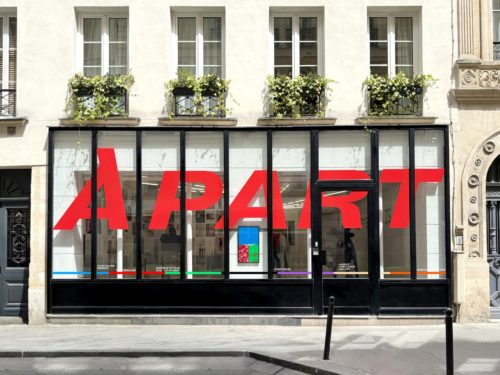
I visited on the 3rd of June 2026. Anjali Soni, PR Coordinator, walked me through the presentation and corrected my assumption. The magazine and the PR agency, as she described it, had been run by the same team for years under two separate names, and many people never realised they were connected. The team decided to bring the publication, agency and showroom under one name, À PART, to present the three activities more coherently. The name was already the magazine’s. They now operate publicly as À PART Publication, À PART Agency and À PART Showroom.
The magazine had not created an agency around itself. The relationship already existed. What changed was the agency’s public name and the way the different activities were presented together. L’Appart PR did not close. It was renamed À PART. The former L’Appart PR web address now redirects to À PART, whose website describes the agency as “formerly known as L’APPART PR.” My July 2025 email shows the PR side still operating under the L’Appart PR name at that time.
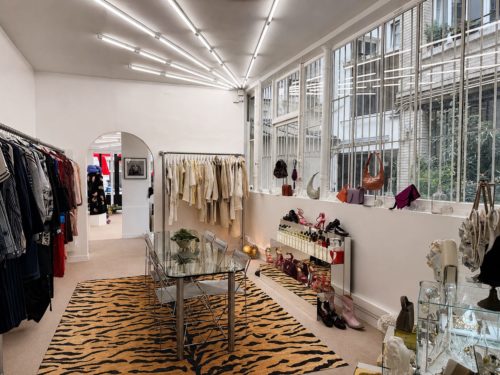
I arrived shortly after a press day. Soni told me the presentation had taken place the previous week and involved roughly seven brands newly brought into the showroom. What struck me was how they had been installed. Instead of giving each label its own rail (the arrangement I am used to, where a stylist works along a wall picking off one designer at a time), the team had mixed the pieces together. Soni said this corresponded to the showroom’s new approach.
It changed the way I looked at the clothes. Walking a rail organised by brand, I look at brands. Here I found myself looking at silhouettes, materials and affinities. The hang, not the client list, was doing the introduction.
Credit: Photography by Ovlioxy Vleuryon.
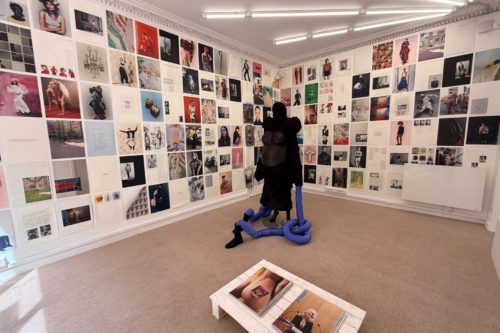
Soni also showed me the wall, assembled from editorials in the newest issue and produced by different photographers and stylists. Seeing it in person clarified why the images I had encountered online were so hard to classify. It reads like a contact sheet for a working network: one issue assembled by many photographers, stylists and makers. A sculptural installation stands in front of it, which helps explain why I first read the room as an exhibition.
One of the most imposing objects in the showroom was an AGGLOMERATI mask. Which got me shook. Soni described it as porcelain and unusually heavy: difficult to transport, delicate to position, unsuitable for just any production. For fragile pieces of this kind, she said, borrowers sign an undertaking accepting responsibility for damage.
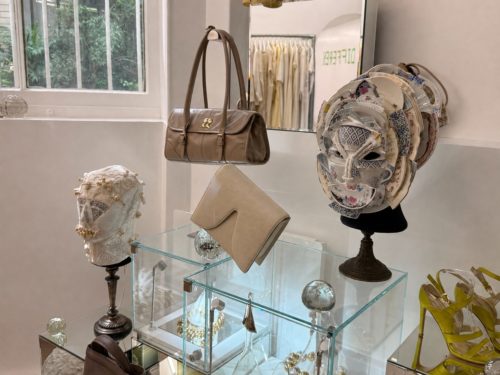
Credit: Photography by Ovlioxy Vleuryon.
That part of representation rarely reaches a reader. A press office decides who may hold a thing, in what context, photographed by whom. Declining a loan because a production does not suit a designer’s work is part of the job, and every showroom I have dealt with does it. Representation involves visibility, but also custody.
I bought Issue No. 16 for fifteen euros at Thierry Presse on the 76 Rue du Château d’Eau, 75010 Paris, taking it from the rack rather than receiving a press copy.
It is reversible. Two covers, two entrances, each with its own title and its own content structure. One side carries an embroidered label credited to Ateliers 2 Paris: Fait main, Magazine N°16, 100% paper, Since 2015. Turn it over and the other side opens with “Zahia par Camille Mompach.” There is no obvious front.
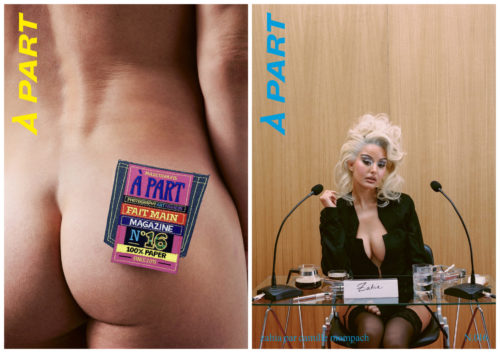
Credit: Courtesy of À PART. Fait main cover: photograph Victor Matussière; model Julien Canches; embroidery Ateliers 2 Paris. Zahia cover: Zahia photographed by Camille Mompach.
The format refuses to name a lead story. In a sector where hierarchy is communicated through covers, page counts and credit size, À PART gives the issue two equal entrances.
The embroidered patch puts the theme on the cover itself. Soni described Issue No. 16 as centred on practices involving the hand: embroidery, glasswork, pastel drawing, collage, physical image-making instead of screen-native production. The patch was designed in-house, fabricated with a Paris-based collaborator, and physically attached to the paper. The theme sits on the object a reader holds before a single page is opened. The words Since 2015 refer to the publication, not the agency or the later consolidation.
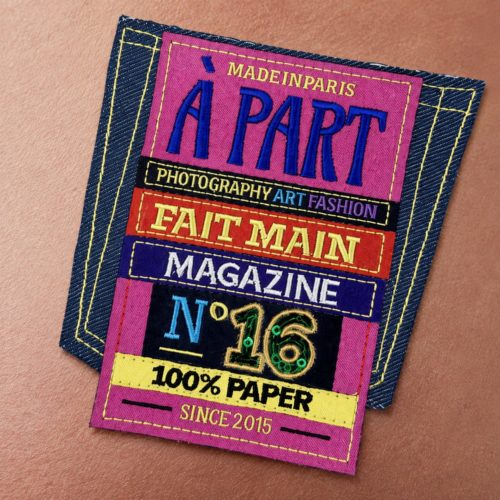
Credit: Photography by Ovlioxy Vleuryon. Embroidery credited in the magazine to Ateliers 2 Paris.
When I asked whether the focus on handwork also positioned the issue against AI, Soni agreed, with a distinction. The publication generally avoids generative AI while still using digital editing, scanning and images first made through Polaroids, cut-outs or collage. The point is not that digital tools are absent, but that the image begins somewhere other than a prompt.
Issue No. 6 makes the former separation easier to see.
Published in Summer 2020, it identifies À PART as a biannual publication edited by Les Éditions Le Bois Viel. Its masthead states that the brands appearing in its editorial pages are presented for information rather than advertising.
The masthead also separates contact addresses by function. Editorial staff are listed at apartpublications.com; PR and marketing staff at lappartpr.com. Caroline Bonnet appears under PR & Communication in both Issue No. 6 and Issue No. 16, not under editorial.
The practical question is how À PART distinguishes independent editorial selection, paid advertising and brands represented by its own agency. The magazine carries advertisements that are identifiable as such. The process behind editorial selection is less visible.
À PART’s internal approval process is not publicly detailed, so the degree of separation between the agency and editorial sides remains unclear.
Independent fashion magazines often rely on income beyond cover sales, including advertising, events and adjacent commercial work. À PART’s mixed structure is not exceptional. What is unusual is that the connection is now visible under one name.
The structure has practical advantages. The agency meets emerging designers early, the magazine can commission from that knowledge, and the showroom lets clothes be experienced as objects, not only as images. The open question is whether readers can tell an independent editorial choice from an existing commercial relationship.
My own confusion may be the clearest evidence of what the new name produces. I first saw the magazine pages online and could not tell whether I was looking at an exhibition or a showroom. I had already contacted the team under the L’Appart PR name without understanding the connection to the publication. One name across three activities settles that much. A reader can now see who is connected to whom. How a page gets chosen is a separate question, and the name doesn’t answer it.
Those are two kinds of transparency and they cost different amounts. The first is a decision about branding, taken once. The second has to be held up on every page, in the credits and in what a magazine is prepared to say about how its editorial is filled. Any publication working alongside a commercial operation has both to answer, and settling the first does not settle the second. The magazine offered the clearest metaphor: after buying Issue No. 16 on the rue du Château d’Eau, I turned it over twice before realising that neither cover was the front.
Later,
Ovlioxy Vleuryon
