











Dear Shaded Viewers,
Light moves differently in Sahag Arslanian’s world. It doesn’t simply bounce off the surface of a stone; it travels through structures so carefully engineered that even the back of a necklace feels like a private constellation, visible only to the person wearing it.
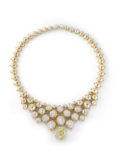
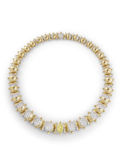
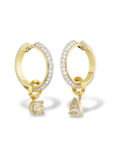
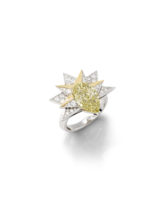
In his new Paris boutique, colored diamonds are not an accent but a vocabulary. Each Fancy Yellow, Purplish Pink, Deep Orange-Yellow or Brownish Pink stone is selected with almost forensic rigor, yet the result feels effortless: warmth, glow, a whisper of color that never screams. He speaks of them as if they were characters rather than materials, each hue carrying its own emotional temperature, its own rhythm of light.
You sense immediately that this is a maison born from diamond culture rather than merely diamond commerce: a seventy-year family history, Antwerp roots, and a lifelong familiarity with rarity that allows Sahag to place an outrageously rare stone in a design that feels almost disarmingly modern and wearable. The colored diamonds are not trophies; they are verbs, shaping how the pieces move, connect, and ultimately live on the body.
The aura of the boutique is charged by a recent milestone: Sahag Arslanian’s recognition as Best New Talent at the Grand Prix de Haute Joaillerie in Monte Carlo. It is an award that validates not only his aesthetic research, but also his insistence on a contemporary reading of high jewelry—one that refuses both nostalgia and cold futurism. Standing in this new Paris space, that accolade feels less like a coronation than a point of departure, a line silently drawn between the legacy of the Arslanian name and this newly assertive, authorial voice in haute joaillerie.
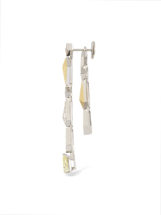
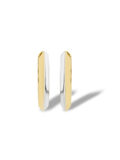
The collections premiered alongside the boutique opening feel like a manifesto in motion: purity of form, graphic silhouettes, bi-color gold, and those mysterious colored stones calibrated with near-scientific precision. The award becomes a lens through which to read every detail; there is a quiet confidence here, the certainty of someone who knows that technical excellence will hold, no matter how daring the line or unexpected the color.
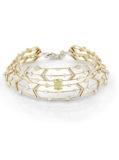
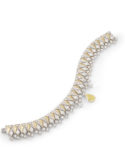
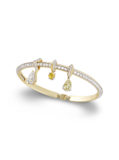
The true revelation, however, happens when the pieces begin to move. Sahag’s jewels are not rigid sculptures; they are choreographed segments of light, engineered so that every link, every micro-hinge, every tiny interval of metal allows the piece to adapt to the topography of the body. Bracelets encircle the wrist with an almost liquid authority, while necklaces rest on the décolleté like an invisible armature of radiance, never fighting the skin, always following it.
This articulation is not spectacle but intimacy. There is the possibility of transformation—concealed interchangeable systems that allow colored diamonds to be added or removed—yet the mechanics never scream “mechanism.” Instead, one experiences a quiet, deeply modern luxury: the ability to recalibrate one’s own light, to shift from white brilliance to chromatic glow with a barely perceptible gesture.
And then there is the back. Turning a Sahag Arslanian necklace over feels almost transgressive, as if you are accessing the private diary of the piece. The hidden architecture is startlingly beautiful: clean geometries, balanced volumes, a discipline of line that reveals how much thought has been invested in what the world is not meant to see.
On the reverse, the jewel abandons performative sparkle and becomes pure structure. The undersides of the settings form a kind of golden topography, negative spaces carved with the same attention as the front-facing surfaces. It is here that you understand that these works are not only about display but about relationship—between light and matter, front and back, public aura and private pleasure.
To wear one of these necklaces is to inhabit both sides at once: the visible, immaculate façade and the intimate, architectural secret resting directly against the skin. The beauty of the back becomes a form of complicity between the jewel and its wearer, a quiet pact that the most refined detail is reserved not for the gaze of others, but for the one who has chosen to carry it.
Later,
Diane
