
At Almine Rech in Paris, the figures I first found frightening began to feel like guides.
At first, I thought they were demons.
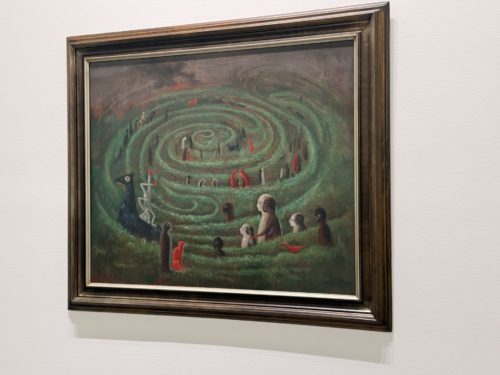
I was standing in front of Laberinto (1991), a painting filled with green paths that seem to go on forever. Small figures in black, white and red move through them. I kept looking for a way out, but I could not find one. Then I noticed the darker figures beside the pale ones. Were they following them, or showing them where to go? The longer I looked, the less frightening they became. I know the feeling of moving forward without knowing exactly where I will end up. Maybe that is why this painting stayed with me.
I visited Almine Rech on September 8, the opening day of its Leonora Carrington exhibition in Paris. It brings together paintings, drawings, sculptures, tapestry and writing from different moments of her life. There are horses, birds, masked figures and beings that are not really human or animal. You might recognise the name Carrington from Surrealism or The Milk of Dreams, the title borrowed from her book for the 2022 Venice Biennale. But I did not want to walk through this exhibition looking for another way to label her. I wanted to understand why these creatures made me uneasy and why I kept returning to them.
During my visit, a gallery team member described some of them as protective characters, figures that protect others. That surprised me. Protection was not the first word I would have used for a face with horns or a body that changes shape. But once I heard it, I started to look again. Who decides that a creature is a monster? Is it what the creature does or simply how it looks?
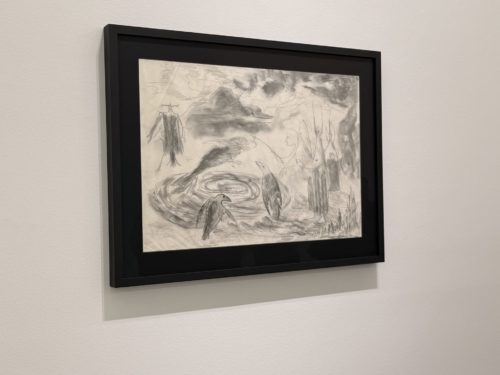
One black-and-white drawing pulled me in because there seemed to be something happening everywhere at once. Birds stood around what looked like a whirlpool. I saw a form rising from it that reminded me of both a fish and a bird. In the distance were mountains and other figures I could not fully make out. I tried to understand what was happening. Was something arriving, or was everyone waiting for it? The drawing did not answer me, and I liked that. It made me stay with the question instead of moving on to the next work.
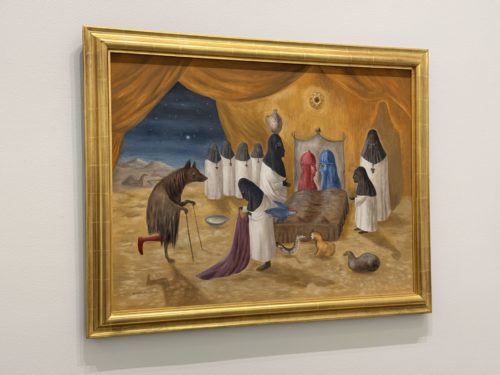
Then I came to The Lovers (1987). The title made me expect an embrace, but that was not what I saw. Figures with covered faces stood in an ochre-coloured room, with animals among them and two bright figures near the centre. It looked more like a ceremony than a love scene to me. I wondered why so many faces were hidden. Were they keeping a secret, or were they unable to speak? These are my questions, but not answers the painting gives. That is part of what I enjoyed about it: Carrington lets me look, wonder and change my mind.
Carrington was born in England in 1917 and settled in Mexico City in 1942 after fleeing wartime Europe. Her life was difficult at times, including a period of confinement that she later wrote about in Down Below. It would be easy to look at every strange creature as an explanation of that pain. But the exhibition shows an imagination that also drew on stories, animals, alchemy and the different traditions she encountered. Her work feels much bigger than any one event in her life.
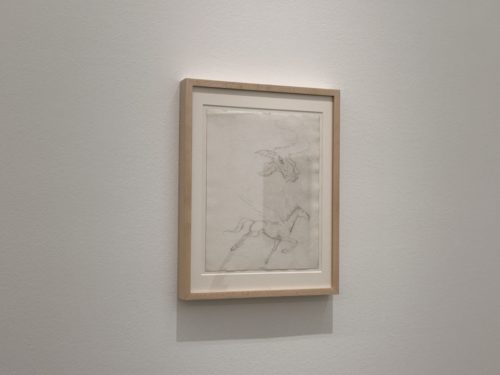
A small drawing of winged horses was one of the quietest things I saw. A gallery team member told me Carrington made it when she was around fourteen. That is a startling age for a drawing with such confidence. The horse would return throughout her work. Seeing it here felt like meeting an idea at the very beginning, before it had grown into the paintings and sculptures around me.
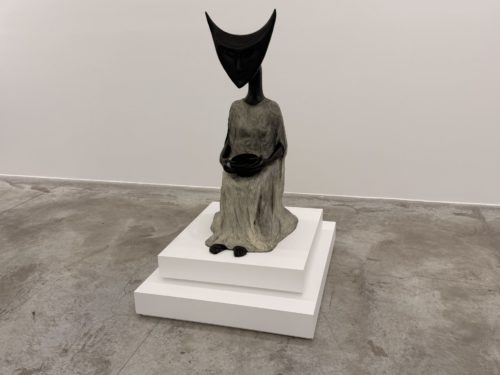
Another work that changed my first impression was a seated sculpture holding a bowl. Its dark face and crescent-shaped head looked almost demonic at first. But the more time I spent with it, the more I noticed the bowl. It was held carefully with both hands. The figure was not reaching for me or standing in my way. It looked as though it was offering me something. I had come close expecting to feel afraid and found myself feeling welcomed instead.
That change in feeling is what connects these works for me. Carrington does not make her creatures soft or easy to understand. The masks, horns and unfamiliar bodies remain. In the exhibition text, her sculptures are described as protective deities and guides between worlds. I can see why now, though I still would not call every one of them friendly. They made me think about how quickly I judge something strange before giving it the chance to show me what it is doing.
When I think back to Laberinto, I still cannot see an exit. The figures are still moving, and the dark ones have not disappeared. But what stays with me is the possibility that they are going through the maze together. Maybe protection doesn’t always mean removing what frightens us. Sometimes it means having someone beside us while we keep going forward.
Leonora Carrington – Almine Rech, Paris Turenne – September 8 to October 10, 2026
Words by,
Ovlioxy Vleuryon
