

Dear Shaded Viewers,
There is a particular kind of beauty that only arrives after something has been ruined a little — a wall that has been rained on for a hundred years, a coat that has been slept in, a man who has stopped checking himself in mirrors. Uma Wang’s Spring/Summer 2027 menswear collection lives entirely inside that beauty. It is dust on linen, salt on cotton, a tie loosened by someone who no longer remembers tying it. It is, in the truest sense, clothing as weather — something that has happened to a man, rather than something he has simply put on.
To understand why this collection feels so unhurried, it helps to know how unhurried its maker has always been. Wang Zhi — the name behind “Uma Wang” — was born in Hebei in the early 1970s, the daughter of a practitioner of traditional Chinese medicine. It is a detail she returns to often, because it explains so much: a childhood spent around herbal paper, hand-brushed characters, the idea that something humble and unglamorous could still be precise, still be exact. She studied textiles in Shanghai at what is now Donghua University, then crossed the world to study at Central Saint Martins in London — and rather than launch into fashion’s usual hurry, she went home again and spent a decade quietly working inside other people’s labels, learning fabric the way a luthier learns wood.
When she finally raised her own name above the door, growth came in the way she seems to prefer it: slow, deliberate, almost reluctant. She became the first Chinese designer admitted to the official calendar of Milan Fashion Week, then moved her house to Paris in 2017, and in time was welcomed as a permanent member of the very chamber that presides over French haute couture — extraordinary thresholds, each one crossed without ever raising her voice. She has dressed film, costuming Jiang Wen’s Hidden Man to an awards nomination; she has lent her name to humanitarian causes through the UN’s refugee agency; and in recent years, those who know her well say her curiosity has wandered toward other slow crafts — vineyards, fermentation, the patience of things that must simply be left alone to become themselves. It is not a coincidence that this is also, more or less, her exact philosophy of cloth.
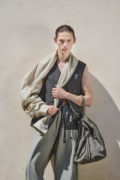
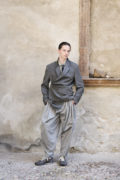
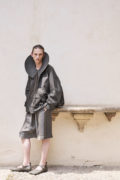
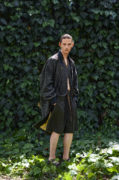
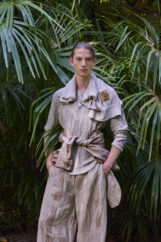
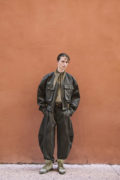
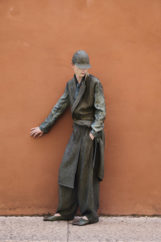
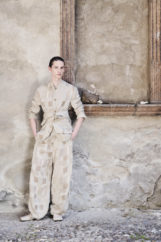
For SS27, Wang’s menswear takes its temperature from Peter Beard — not his photographs so much as his presence: a man so weathered by the field that ceremony simply fell off him. The tailoring underneath is real and rigorous — proper jackets, set collars, the bones of a suit that knows what it’s doing — but everything happens to that tailoring as if despite itself. Sleeves slide down forearms and end up wound around necks like abandoned scarves. Jackets are buttoned, technically, the way a man buttons something he is no longer thinking about. Linen is washed pale and then deliberately marked, as though the wearer walked somewhere he shouldn’t have and didn’t apologize for it. Cotton spots and blooms in irregular, almost botanical patterns, the colour of soil after rain.
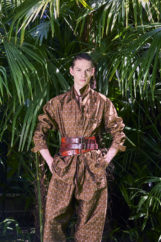
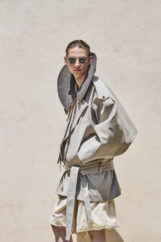
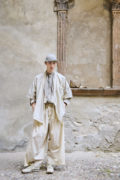
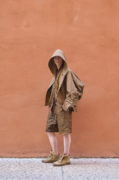
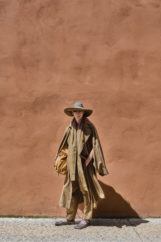
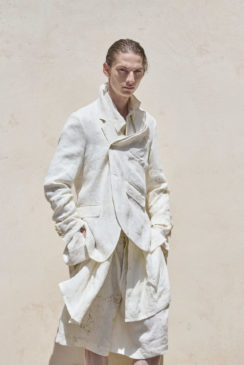
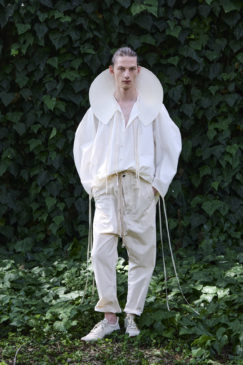
Across the looks, the palette stays low to the ground — bone, putty, olive, rust, the warm grey of old plaster — so that the men photographed against Mediterranean walls seem to be dissolving into the architecture around them, becoming one more weathered surface in a weathered town. The silhouettes swing between two states: trousers ballooned into something almost monastic, pleated and falling like robes, and then, a few looks later, shrunk into proper Bermuda shorts worn with thick socks and canvas boots, school-boyish and strange against an adult, sun-darkened face. Outerwear is where the collection allows itself its most operatic gestures — a caped trench the colour of wet sand, an oversized quilted collar that rises around the jaw like a Flemish ruff reimagined in raincoat fabric, a wide-brimmed hat that turns its wearer into a pilgrim of no particular century. Elsewhere, jacquards patterned like cracked riverbeds are cinched with double leather belts; a houndstooth-on-olive overcoat folds into itself like a kimono left unbelted; and a single white look — frayed cuffs, stained lapels, a relaxed bandana knotted at the throat — reads as the collection’s most honest sentence: this is what a beautiful suit looks like after it has actually lived.
What keeps all of this from becoming costume is, as ever, Wang’s hand with fabric. The “muddying,” the bleach-outs, the scattered dye — these are not effects added on top of the cloth; they are worked into it, the way a good winemaker doesn’t flavour a wine so much as let the land speak through it. Nothing here is distressed for shock. It is distressed the way a favourite jacket is distressed: through use, through years, through being loved carelessly rather than displayed carefully.
This is not a flashy collection, and it does not want to be. It is a quiet argument, made with extraordinary technical confidence, that ease is not the opposite of elegance — that a man can be undone and still be exquisite, that a crease can be a confession rather than a failure. Wang has spent twenty years building a house on patience, on textiles that are allowed to age instead of merely appearing aged, on a refusal to shout in an industry built on shouting. SS27 is simply the latest, most masculine chapter of that same long, deliberate sentence — and it is one of the most quietly confident menswear stories of the season.
Later,
Diane
