
Couture is only the French word for sewing. In 1945 Paris put Haute in front of it and made the pair a legal object, renewed each year by a ministry. Craft was never available for registration. It holds no nationality. It is a precise knowledge passed from hand to hand, each generation pushing the frontier of what patience, talent, and imagination can produce. It is the power to be handed a drawing that cannot be made, and make it. It has been practised in India for as long as anyone has kept count. On Thursday night it surfaced in Hyderabad, where India Couture Week opened its nineteenth edition with Anamika Khanna, the first time in nineteen years the event had ventured beyond Delhi.
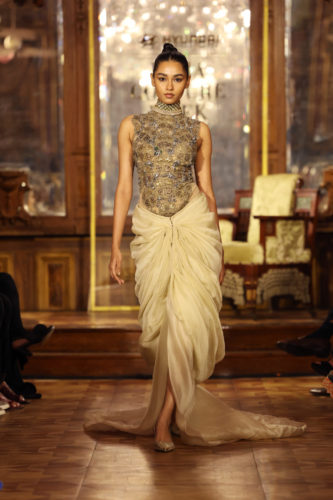
Khanna is self-taught, and it never showed. Her clothes reached Harrods and the pages of Vogue, and in 2024 a polished H&M collaboration took Indian mastery global, from Britain to South Africa to Southeast Asia. And yet the loudest platform of all came from home, when India handed her the opening of its couture week. A classical dancer and a painter by formation, she built her skill garment by garment, until precision became instinct. That instinct built a House. From her base in Kolkata she turned hand embroidery into a signature that needs no label to be recognised, and in 2007 she carried it onto the Paris calendar, among the first Indian designers ever invited there.
That whole history arrived in Hyderabad under one title, Moonlit Palace, her new collection. None of it reads as a designer leaving India. All of it reads as a designer refusing to let India be the size of the story.
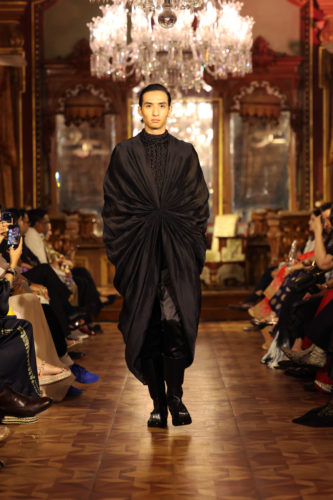
The palette does not spread. It concentrates, pulling back to ivory, bone, pale gold and black, and surrendering its intensity to the cloth, to the cut, to the craft, which is exactly where Khanna wants the eye to go. Then the cloth begins to gather. A black cape breaks into a sunburst at the sternum, a cream skirt spirals down to a single knot and releases, an ivory column is seized at the waist and let go. The same idea returns look after look, a length of fabric summoned to one point and made to open from it, and it reads less as decoration than as proof that draping can be an architecture rather than an afterthought.
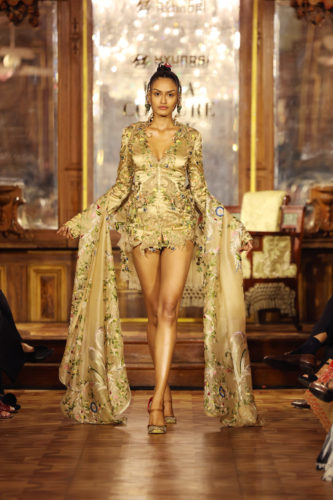
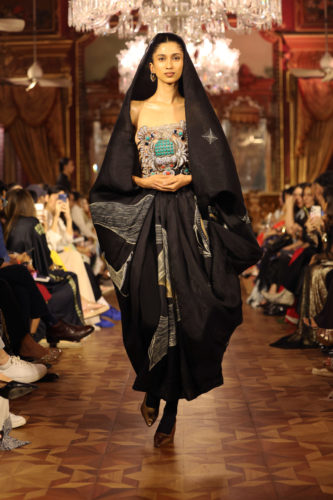
The House builds the collection in movements, two of them tied to particular places. One looks to Barmer, a desert district of Rajasthan whose mirrorwork and vivid applique were carried in by families who crossed the new border when British India was split in 1947, textiles the House says were reworked with women’s craft collectives through dyeing, embroidery and hand painting. The other is named Kalighat, after the quick, bold paintings once sold to pilgrims outside Kolkata’s Kali temple, a form that printing had wiped out by the 1930s. That memory surfaces in the drawing on the clothes, white lines forking across one black skirt like the creases of an open palm, gold tracework climbing an ivory column, embroidery that catches the light and lets it go. Skilled hands, moving again in new thread.
That same sensibility runs through her most recent venture. Alongside the couture House there is now AK|OK, a ready to wear label she built with her twin sons, and its name is a small act of reassurance. Everything is AK OK, the two of them used to tell her, lifting a line from the era of space launches. It suits them. Few designers carry an inheritance this old and aim it quite so high. Between them they hold its opposite ends. Viraj, trained in business before he turned artist during the pandemic, works thread into sculpture and was the first artist named to Forbes’s under thirty lists in both India and Asia. Vishesh took a fashion master’s at Central Saint Martins, pushed the label onto the London calendar last September, and is the one who asks his mother whether she would have worn a piece at twenty, sending it back if the answer is no.
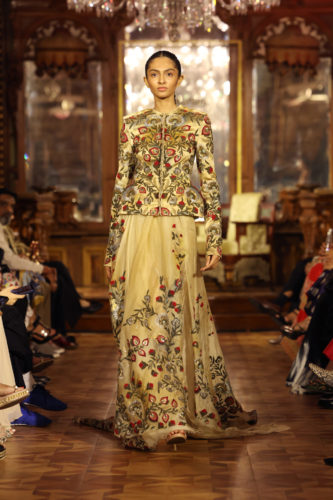
The couture showed at Falaknuma, the ready to wear shows in London, and the same pair of hands drew both. What Khanna is really passing on is not a signature but a permission, to hold the oldest craft in the room and refuse to treat it as fragile.
Heritage, in most hands, is guarded. In hers it is launched. That is the whole distance between honouring the legacy and sending it on, pasr forward.
