

Dear Shaded Viewers,
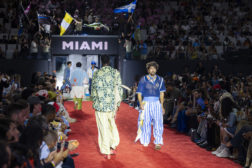
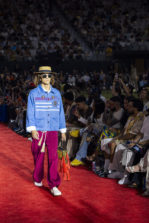
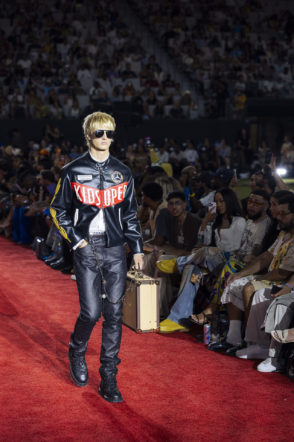
There is a very specific kind of joy that arrives when a designer decides a runway show should also be a love letter, a history lesson, and a football match all at once. Last night at Nu Stadium in Miami, Colm Dillane delivered exactly that. KidSuper’s Spring/Summer 2027 collection — staged for the first time ever outside Paris — landed inside David Beckham’s home turf, sandwiched between two World Cup fixtures, with the whole thing livestreamed back to Paris for the faithful who couldn’t make the flight. One season. Two cities. And, for one night, an entire stadium standing in for a catwalk.
If you’ve followed Dillane’s run on the Paris calendar, you knew this wasn’t going to be a quiet affair — quiet has never really been the assignment. What he does instead, every single season, is find the most unlikely emotional through-line and build an entire show around it. This time, that through-line was football — the sport he played semi-professionally before fashion ever entered the picture, the sport he still plays on a rooftop pitch at KidSuper’s Brooklyn headquarters with his own amateur club. “Football has always had the power to bring people together,” Dillane has said of the project, and you could feel him building the whole evening around that single idea.
Part of what made last night land the way it did is the sheer range of stages Dillane has put himself through to get here. This is a designer who turned his very first appearance on the official Paris calendar into a scrappy, homemade stop-motion film — dolls and figurines standing in for models, animated frame by frame, because that was the budget and the idea was bigger than the budget. From there it only got more unhinged in the best way: a season built around a live on-stage auction, another that handed the runway over to a puppet cast, one that brought in a full Cirque du Soleil troupe to share the spotlight with the clothes, and, most recently, a Fall/Winter 2026-27 show at the Pavillon Cambon that opened with a short film starring Vincent Cassel and a robotic voice announcing “what you are about to see is not real” — forty looks of leather-coated, Matrix-by-way-of-The Usual Suspects paranoia, staged inside a rising white cube.
And in between all of that came the Musée des Arts Décoratifs in June 2025 — Spring/Summer 2026’s “The Boy Who Jumped the Moon,” easily one of the most purely beautiful things Dillane has staged. A giant storybook set inside the museum’s vaulted nave, actor Craig Ferguson narrating over the soundtrack as models stepped out of life-size pages, footballer Mario Balotelli closing the show, and a Mercedes-Benz CLA reimagined as a balloon-lofted “superhero car” parked at the entrance. It’s the season that, for a lot of people, including this writer, set the bar for what a KidSuper show could be.
So no, last night wasn’t a one-off swing for spectacle. It’s exactly the kind of swing Dillane has been taking, season after season, for years — he just happened to take this particular one in a football stadium instead of a museum or a cube.
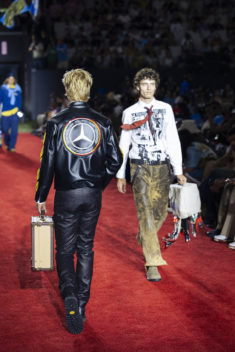
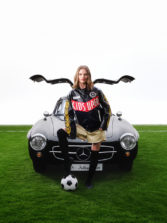
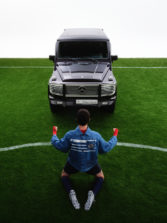
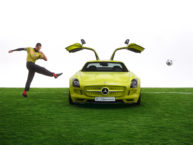
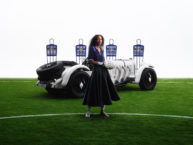
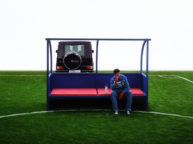
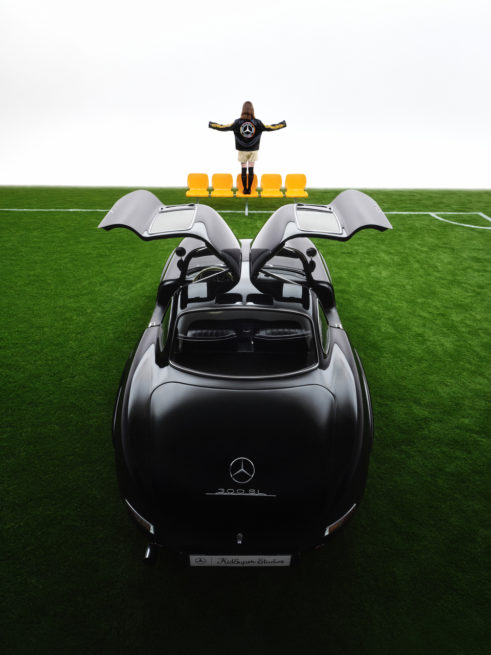
The centerpiece of the collaboration with Mercedes-Benz — now marking 140 years since Carl Benz’s original patent — is one of the smartest concept hooks a car-and-fashion crossover has produced in years. Rather than slap a logo on a jacket, the brand and Dillane went back through 140 years of automotive history and matched seven legendary Mercedes-Benz vehicles to the seven nations that have earned the right to wear multiple stars above their crest — each car tied to the exact year of that country’s greatest football triumph:
- Brazil, 1958 → the Mercedes-Benz 220 SE
- Uruguay, 1928 → the SSK
- Germany, 1954 → the 300 SL Coupé
- Argentina, 1978 → the 450 SEL 6.9
- France, 1998 → the G 500
- England, 1966 → the Grand 600
- Spain, 2010 → the SLS AMG Coupé Electric Drive Concept
It’s the kind of pairing that sounds simple on paper and lands as genuinely moving in execution — each car a rolling monument to a single golden summer, each one handed a bespoke KidSuper counterpart rendered in patchwork, embroidery, and tailoring built to echo the vehicle’s own era and silhouette. Layer that against the wider collection, which reportedly stretched to looks representing all 48 nations competing in this World Cup cycle, and you get a show that wasn’t just about football as a spectacle — it was about football as inheritance, as memory, as something stitched into a country’s identity the way a car can be stitched into a brand’s.
This isn’t even Dillane’s first round with Mercedes-Benz, for what it’s worth — last year’s CLA “superhero car” at the Musée des Arts Décoratifs was part of the same ongoing “Class of Creators” relationship. What’s different this time is scale: instead of one car as a single art piece, the brand handed over seven decades of its own archive and let Dillane build a whole show’s emotional architecture around it.
Dillane has joked that this was just a “Paris Fashion Week off-site show,” and there’s real logic buried in the bit. KidSuper has spent the better part of a decade building unimpeachable credibility on the Paris menswear calendar — the kind of credibility that lets a brand take a one-season victory lap somewhere else without anyone questioning its commitment. Staging this particular collection inside a working football stadium, mid-tournament, with the energy of two World Cup matches bookending it, gave the whole project a charge that a museum nave or a Parisian pavilion simply couldn’t replicate. You don’t tell a story about terraces and pitches and the friendships that get made on them from inside a white cube. You tell it from inside a stadium.
And it is, undeniably, a story Dillane has earned the right to tell. This is a designer who built a rooftop football pitch at his own headquarters, who has designed sneaker collaborations for football culture all year, and who treats the sport less like a marketing hook and more like the actual emotional spine of his creative life. That sincerity is what kept the Mercedes-Benz partnership from ever feeling like a branding exercise. It felt, instead, like two institutions — one 140 years old, one barely a decade into Paris Fashion Week — finding genuine common ground in the idea that some things, a beautifully engineered car, a beautifully won championship, deserve to be remembered with craft, not just nostalgia.
Was it spectacle? Obviously — this is a designer who has never once shied away from spectacle, and a stadium full of football and fashion crowds colliding under World Cup lights is about as spectacular as a runway show gets. But underneath the showmanship was something that felt unusually personal even by KidSuper standards: a designer using his biggest platform yet to talk, quite plainly, about the thing he loved before any of this — fashion, fame, Paris — ever happened to him.
The capsule collection lands in stores this autumn, and on the strength of what Mercedes-Benz has shown of the seven hero pieces alone, it’s worth circling on the calendar.
All of that said: it is genuinely strange to write about a KidSuper season and not be writing about Paris. No giant storybook set under a museum’s vaulted ceiling. No white cube rising out of the floor of the Pavillon Cambon. No Vincent Cassel’s voice cutting through the dark to announce that nothing you were about to see was real, his face filling the screen at the end of the runway like he might step straight off it — and then the first model walking out in the exact outfit he’d just had on, as if the screen had cracked open and let him through, while the real Cassel sat in the crowd watching himself become a ghost. Miami gave KidSuper a stadium, a World Cup, and seven of the most thoughtfully chosen cars in automotive history, and Dillane made every bit of that count. But Paris is where this designer has spent a decade proving a runway can be a stop-motion film, a puppet show, an auction, a circus, a museum, and a simulation, all by the same hand. This writer missed that room more than expected.
One season away was a triumph. Consider this an open invitation for the next one to be back exactly where it belongs.
Later,
Diane
