








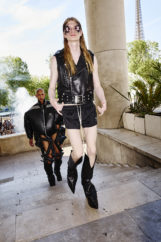



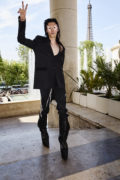
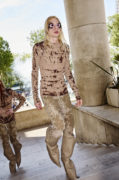
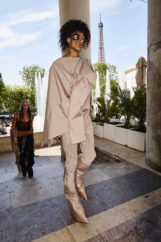
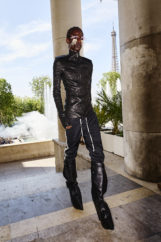
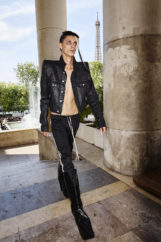
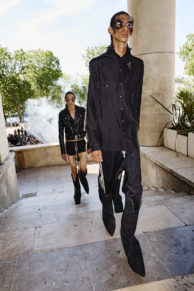


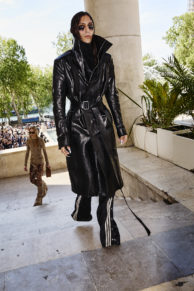
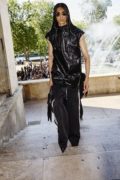
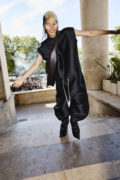
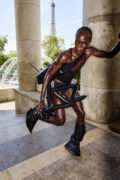
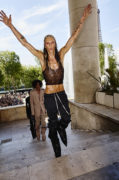
All photos by Sonnyphotos
Dear Shaded Viewers,
The city does not believe in air conditioning. It never has. Paris would rather sweat through a heatwave with the windows thrown open and the shutters half-drawn than surrender to the hum of refrigerated air — a kind of civic stubbornness, a refusal dressed up as elegance. So of course it is here, in a June that keeps getting hotter, sitting outside that keeps getting warmer, that Rick Owens stages a collection about what a body does when the temperature of the world — political, atmospheric, psychic — keeps climbing and nobody will turn on the cold.
His answer, whispered across the show notes like a incantation, is that menace is now ambient. It’s just weather. And there are only so many ways to stand inside it: you arm yourself, you train, you look away, or you let yourself harden completely — go still, go mineral, go to stone. Owens, being Owens, chooses all four at once and somehow makes them the same gesture.
This is the genius that’s kept him essential for three decades: he doesn’t editorialize about the collapse, he tailors for it. SS27 doesn’t flinch from the climate emergency or the creeping authoritarian mood of the decade — it suits up for them, with the kind of grim, glamorous pragmatism of a man who has always understood that the future doesn’t arrive as a costume party. It arrives as infrastructure.
The most quietly radical gesture in the show might be the smallest: a high-performance adidas x Rick Owens running shoe, engineered to be affordable, slated for 2027. Not a luxury fantasy object — a tool. Because if menace is the new climate, then conditioning is no longer optional, and Owens wants the gear that gets you ready for it to actually be within reach. It’s a small, very Owens kind of utopianism: the apocalypse should have decent, attainable footwear.
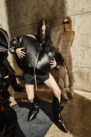
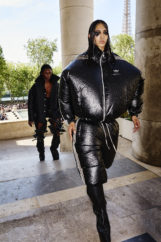
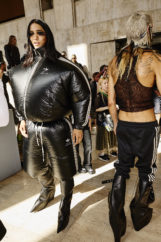
Then the ClimaCool pieces — inflated jackets and shorts rigged with interior fans, designed to pair with an ice vest into something close to a wearable air conditioner, built to chill a runner’s torso in the minutes before a race starts. In a city allergic to refrigerated air, Owens has simply relocated the cooling system onto the body itself. It reads as both a literal climate-adaptation device and a sly, very Parisian punchline: if the building won’t cool you, the jacket will. It’s tech-wear as triage, a personal microclimate stitched into nylon, and it positions Owens — improbably, wonderfully — as a kind of couture climate engineer. The CDP Climate A-list credentials adidas brings to the table aren’t just a sustainability footnote here; they’re load-bearing. This is a collection that wants its survival gear to also be its conscience.
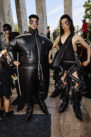
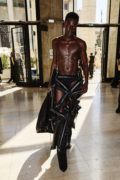
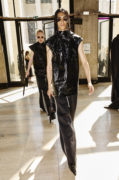
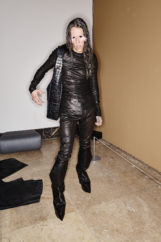
Trim tracksuits slide from honest poly-cotton jersey into lightweight leather, flesh-toned or black, or a nude girdle fabric knit from recycled nylon — sportswear pulled taut until it stops being sportswear and becomes second skin. It’s Owens’s oldest trick, the gym sock reimagined as bondage gear, the utilitarian rendered erotic without ever raising its voice.
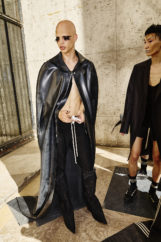
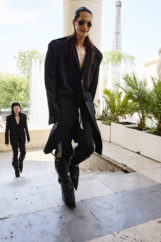
Coats and jackets arrive with removable leather epaulets — that small hardware of command borrowed from the emperor, the airline captain, the man steering the cruise ship. Cut into a silk-cotton poplin from Como, they sit somewhere between uniform and costume, asking, with Owens’s usual dry wit, who exactly has earned the right to wear authority this season — and how easily it unbuttons. Sharper tailoring, meanwhile, is cut in compact silk crepe from Bonotto, the Veneto mill that’s been twisting yarn since 1912 — heritage craft doing the structural work under all that insinuation.
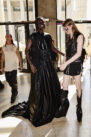
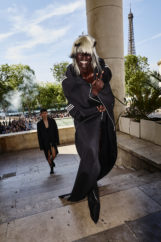
The cabans swell into something almost architectural — duchesse weight in recycled polyester or pale, crisp silk, woven so slowly on vintage looms that Como can only produce twenty-five meters a day. In an age of next-day everything, there’s something quietly defiant about a coat that took its time. Slowness, here, is its own kind of armor.
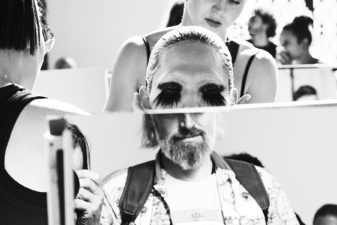
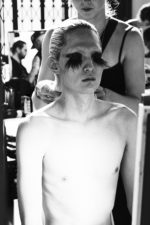
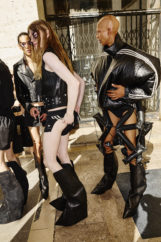
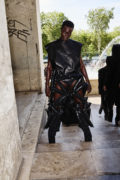
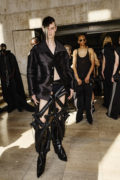
Underneath, sheer tank tops hand-piped in latex by Paris’s own rubber mistress Matisse Di Maggio — each one taking more than thirty-five hours and four hands, decorated like a cake iced by someone with very different intentions. Latex capes from London’s Torture Garden swing like something between a superhero’s cloak and a confession. And then the chaps: foam and latex worked into tensegrity structures by longtime collaborator Straytukay, borrowing Buckminster Fuller’s old architectural principle — components held in compression, suspended inside a net of tension. It’s the most beautiful metaphor buried in the whole show: bone and connective tissue, compression and tension, the exact mechanism by which a body holds itself together under pressure instead of breaking. Stone, it turns out, isn’t rigid. It’s just tension, perfectly managed.
A remix of “Girl in Bed” by Sissy Misfit hums underneath it all, and the lights of the Palais de Tokyo do whatever lights do when they’re trying to look like the inside of a furnace.
What lingers is how unsentimental Owens is about the future — and how seductive that unsentimentality becomes in his hands. He isn’t predicting a better world. He’s dressing us for the one we already live in: warmer, harder, more watched, more armored, and somehow, under his cutting, more beautiful for admitting it. Some designers chase the future. Owens has always seemed to be reporting back from it — calm, a little amused, perfectly tailored, and entirely unsurprised that we finally caught up.
Later,
Diane
