
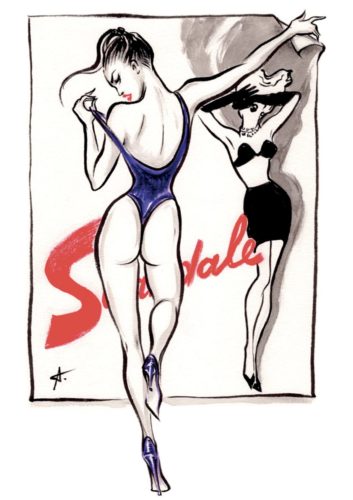
illustration by Antoine Kruk
Dear Shaded Viewers,
There is a particular kind of woman Roger Vadim liked to film: the one who walks toward the camera as if she has already decided what happens next. Bardot on the Saint-Tropez jetty. Deneuve, cool and unbothered, in a car she is not supposed to be driving. Vadim never asked his heroines to be likeable. He asked them to be inevitable. That is the register SCANDALE has always worked in, and it is the register Nicolas Busnel has chosen to make official.
On the 22nd of July, Maison Close, the house Busnel built over twenty years into one of French lingerie’s most photographed names, sheds its own name and becomes SCANDALE. Not a rebrand in the boardroom sense. A succession. Busnel has spent two decades directing a certain kind of femininity, contemporary, unapologetic, made for the camera as much as for the body, and he has now acquired the house that invented the grammar he was already speaking.
SCANDALE was born in 1932, out of Robert Perrier’s conviction, radical for its time, that fabric itself could be a form of freedom. Perrier supplied silk to Chanel, Dior, Balenciaga, before he turned liquid latex into fibre and built the first modern elasticated girdle, unlacing French women a full generation before Lycra existed. The house did not stop at engineering. It understood, instinctively, that lingerie needed an image as bold as its construction. Red became the house’s signature gesture. The leg became its emblem. René Gruau drew the logo that gave SCANDALE its visual voice, and for decades after, campaigns by Pierre Couronne, Diaz and Jean Jacquelin sent that voice across France and America; lingerie staged, theatricalised, refusing to stay backstage. This is the house Halle Berry once bought into, the house Erik Ryd carried forward, and the house Busnel formally acquired last October, with the takeover announced this past January on Maison Close’s own twentieth anniversary.
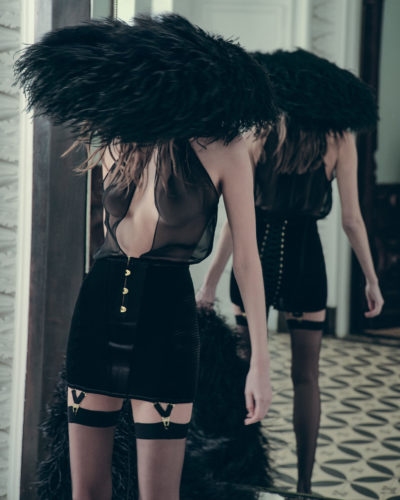
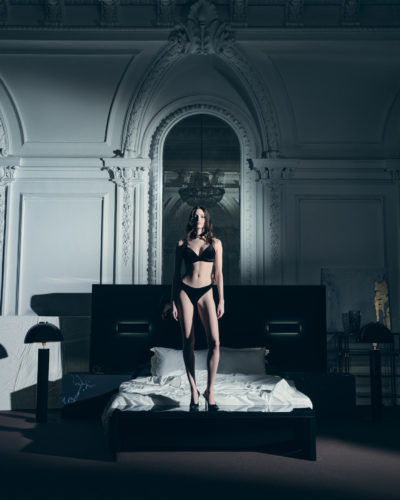
It is a very Vadim kind of inheritance. His camera never apologised for looking. It lingered, it staged, it turned the female form into an argument rather than an object, provocation as intelligence rather than provocation as accident. SCANDALE’s own history runs on the same current: an elegant refusal to be modest about desire. Kate Moss wore Maison Close. Madonna did. Miley Cyrus put it on an album cover. Rosalía let its signature glow, fluorescent, beneath her skirt at the BRIT Awards. A lingerie house that photographers keep reaching for is not selling underwear. It is supplying a mood, the exact mood Vadim spent his career composing in 35mm.
What happens next has a release date. September brings the first permanent SCANDALE flagship, on Rue Cambon, steps from where French couture invented its own myths. Late September brings a private show at the Théâtre du Trianon marking Maison Close’s twenty years, the closing credits before the house’s name changes on the marquee. The final Maison Close pieces will be kept as collector’s items, a proper archive, the way one preserves the early work of a director before the more ambitious films arrive.
“SCANDALE has always been part of my world of inspiration,” Busnel has said of the house, citing Gruau’s illustrated campaigns as a mark left directly on his own image of French femininity. It reads like a director naming the film that made him want to make films. Now he has the rights to the sequel, and a silhouette, red-lipped, unbothered, walking straight at the lens, that has been waiting since 1932 for someone willing to keep her exactly as scandalous as she was always meant to be.
SCANDALE. Coming this July, wherever French women refuse to be quiet about desire.
Later,
Diane
