
The future is coming faster than we can measure it. One Italian designer has decided to measure it anyway in numbers that refuse to behave, in clothes that refuse to finish, in a vision that refuses to be tidy
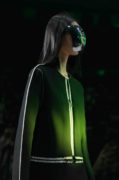
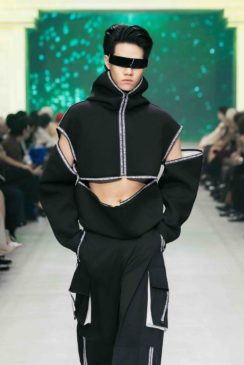
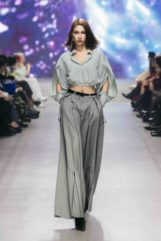
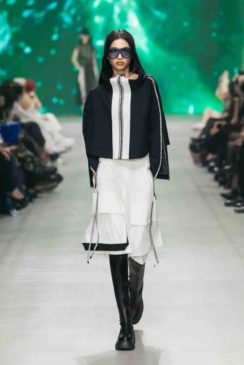
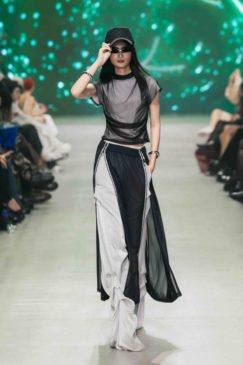
Somewhere in Ho Chi Minh City, a zip is making a decision. Not the decision to open or close—that’s mechanical, predictable, obedient. This zip is deciding which number to betray. Because on the runway of Vietnam Fashion Week, numbers have stopped being counted. They’ve been kidnapped from their ledgers, stripped of their arithmetic, and forced to dance across neoprene and jersey like runaway punctuation. Two plus two no longer equals four here. It equals a sleeve that can become a collar, a trouser that can become a skirt, a woman who can become whatever she decides between the first step and the last.
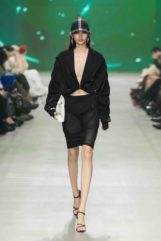
Angelo Cruciani calls this collection Metropolitan Amazones, but the title is almost too neat. It suggests a herd of urban gazelles, comfortable in their daily bodysuits, racing toward a future that hasn’t been programmed yet. But what the show unleashed was something more destabilizing: a wardrobe that questions its own logic.
The Italian Consulate and the Chamber of Commerce bankrolled the spectacle, expecting luxury, expecting diplomacy, expecting a tidy export of Italian creativity. They got lasers instead. Feral beams of light carving up the dark, a giant pulsating cell suspended overhead like a heartbeat that forgot its rhythm, and models walking through it all with the serene indifference of people who’ve already seen the ending.




Renaissance boy
Cruciani grew up in Urbino, where the Renaissance is still taught as a series of correct answers. Perspective, proportion, the divine geometry of beauty. School gave him the tools, but tools are only useful if you’re willing to misuse them. That’s probably why he never dreamed of haute couture. Too precious. Too fragile. He wanted clothes that could survive a subway ride, a street fight, a life.
In 2006, he started painting Jesus on walls. Thirty-three locations across Europe, the US, China. Street Jesus, he called it. Not blasphemy, not devotion, just a face in a place where faces don’t belong. That’s the thread: the sacred interrupting the mundane, the number escaping the spreadsheet, the zip forgetting its job.
“I want to accompany people into a more elegant future,” he says, “with clothes that require awareness to be chosen.” Not desire. Not trend. Not status. Awareness—the exhausting, exhilarating work of seeing yourself clearly and then choosing to contradict yourself.
Performative undoing
The show in Ho Chi Minh wasn’t a presentation; it was a performance. The collection’s cuts reference automotive design and avant-garde architecture. Things that are supposed to be fixed, static, finished. But Cruciani’s garments refuse to finish. They transform. They invite the wearer into a conspiracy of reinvention. Each piece is a kit, not a conclusion.
Vietnamese and global stars packed the front row, but the real star was the soundtrack written and composed by Cruciani himself. The man can’t help himself. He’s working on a new project that will swallow music whole, and the single The Algoritmo is about to drop on streaming platforms like a grenade wrapped in melody.




Solution not found
The Era of the Intellect is overriding our biological nature. Globalisation has sped us up, pushed us toward desires we didn’t choose. His clothes are an antidote or maybe a mirror. They force you to slow down long enough to decide who you want to be today. Not forever. Just today.
At the end of the night, the lasers faded, the cell stopped pulsing, and the models retreated back into the ordinary world. But the question Cruciani left hanging remains: What happens when the clothes we wear stop being costumes and start being equations—not to be solved, but to be rewritten?
