



Dear Shaded Viewers,
There are collaborations that simply make sense, and then there are collaborations that feel inevitable. Arturo Obegero’s costume design for GARBO — the new dance work created by Josepha Madoki for Ballet de Lorraine — belongs firmly in the second category. Premiering this June at the Philharmonie de Paris as part of Concerto Danzante, the production wove Vivaldi (performed live by Les Arts Florissants) through ballet, contemporary movement, and Waacking, the underground dance style Madoki has long championed. Obegero’s task was to dress almost thirty dancers in thirty distinct costumes — and, in doing so, to trace Waacking’s own lineage back to its source: the glittering, larger-than-life iconography of Golden Age Hollywood.
The result, captured across this lookbook, is less a costume collection than a love letter to the silver screen — filtered through Obegero’s instinct for sculptural drama and tactile excess.
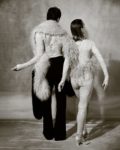
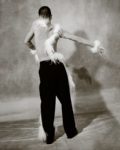
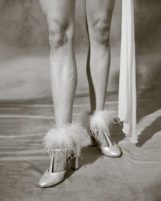
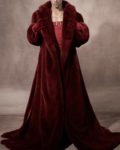
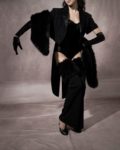
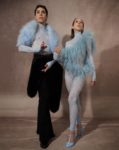
The earliest notes of the production read like a black-and-white film coming slowly into focus. Floor-length stoles of faux fur — in dove grey, powder blue, jet black, and deep burgundy — sweep over lace catsuits so fine they read as a second skin. Ostrich feather trims spill from collars, cuffs, and the hems of micro-skirts, turning every gesture of the dancers’ arms into something plumed and theatrical. Pearlescent t-strap heels, fringed in marabou at the ankle, complete the silhouette with a wink toward the flapper-era stages that first gave rise to this kind of spectacle.
It’s glamour treated as architecture: nothing here is decorative for decoration’s sake. The fur is a frame for movement, the feathers a way of making a turn or an extended arm visible from the back row of a concert hall.
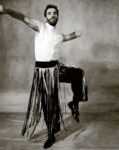
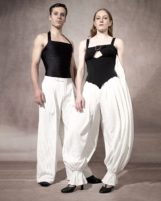
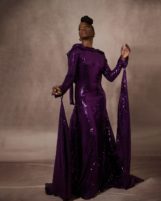
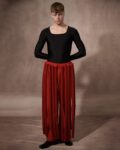
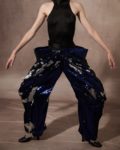
Where the soft pieces whisper, the structured pieces command. A sequined pair of trousers in midnight navy and silver — cut so voluminous they read almost as a second skirt — billows and catches light with every plié, transforming a simple stance into a small event. Elsewhere, rolled velvet collars and cuffs, padded into thick coils, give a crimson gown the silhouette of a body wrapped in ribbon, while a column of red fringe descending from a cropped waistband moves like rainfall with every step.
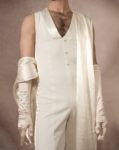
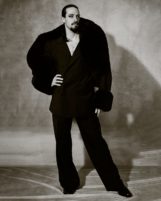
It’s in this section that Obegero’s tailoring background shows most clearly: corseted bustiers with boning and binding worn like armor, double-breasted coats with exaggerated fur lapels, sharply cut trousers in ivory wool paired with satin piping. The vocabulary of menswear and eveningwear collide and, in collision, become something genuinely new for the stage.
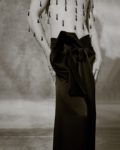
The production’s most striking image may be its quietest: a curtain of black-and-white fringe, printed with a photographic portrait, dissolving a face into vertical strips of fabric that part and reform as the dancer moves. It is a clear and tender nod to the work’s namesake — the screen legend whose own image became shorthand for an entire era of cinematic mystique. As the dancer turns, the face appears and disappears, never quite resolving — a fitting metaphor for a dance style built on imitation, homage, and reinvention.
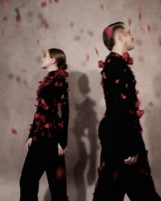
The collection closes on a note of romance: black velvet bodysuits and trousers scattered with loose rose blooms and petals, as though the dancers had simply walked through a fallen garden. Paired against the structured drama of the earlier looks, these final pieces feel like an exhale — intimate, painterly, and quietly emotional after the spectacle that preceded them.
What makes GARBO resonate is not just its scale — thirty dancers, thirty looks, one stage — but its sincerity. Obegero hasn’t simply borrowed the aesthetics of Old Hollywood; he’s used them to honor the very communities who first transformed glamour into a dance language of their own. Waacking was born from watching those stars move on screen and reimagining their gestures as something to be danced, claimed, and made new. GARBO closes that loop beautifully, putting the source material back on stage alongside the art form it helped create.
Two sold-out nights at the Philharmonie de Paris suggest audiences felt that resonance too. It’s the kind of collaboration — between a choreographer, a costume designer, an orchestra, and a company of dancers — that reminds us why live performance still has the power to feel like an event.
GARBO, created by Josepha Madoki with costume design by Arturo Obegero, was performed by Ballet de Lorraine and premiered at the Philharmonie de Paris as part of Concerto Danzante.
Later,
Diane
