
Dear Shaded Viewers,
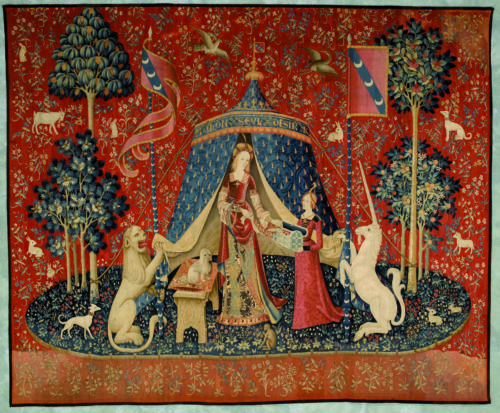
Time does not move in a straight line at the Musée de Cluny. It settles, it loops, it waits. In the quiet presence of The Lady and the Unicorn, meaning feels suspended—never fixed, always just out of reach.
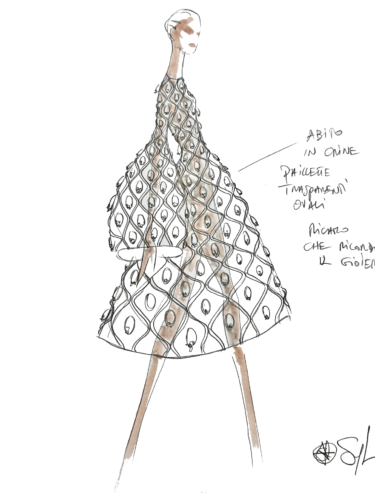
It is here that Sylvio Giardina begins. Not with nostalgia, and not with reconstruction, but with attention. Mon Seul Désir emerges from a close encounter with the tapestries—not as reference, but as a point of tension. What does desire look like when it cannot be fully named? What remains when an image refuses to explain itself?
Ten garments take shape within this question. They do not illustrate the medieval world; they move alongside it. Their language is one of gesture and material, where the hand becomes a bridge between centuries. In the museum’s rooms, they enter into a quiet exchange with the works that inspired them—sometimes in harmony, sometimes in contrast, always aware of the space they inhabit.
The project unfolds in two moments. In Paris, the collection appears within the museum, close to its source. In Rome, at Trinità dei Monti, it opens again—carried into a different light, a different rhythm. The dialogue shifts, but does not break. It continues, as these things do, across places and through time.
Giardina approaches couture as a way of thinking through making. Here, the past is not something to return to, but something to stay with—to question, to listen to, to let remain unresolved. Desire, like the unicorn itself, resists capture.
And so the work lingers there, in that space between image and body, history and presence—where nothing is fully explained, and nothing entirely disappears.
Later,
Diane
