
Suspended between eras, the House of Versace has never been more in need of its own history. The Gianni Versace Retrospective takes over the Musée Maillol in Paris, a museum dedicated to the work of sculptor Aristide Maillol, the right home for a visionary craftsman, until 6 September 2026. After touring Europe over several editions, this travelling exhibition arrives in Paris as the most comprehensive French retrospective dedicated to the designer in forty years.

Gianni Versace changed the visual temperature of late twentieth-century fashion. He was born in Calabria, at the heart of what the ancient Greeks called Magna Graecia, and its sculptural legacy would mark his whole creative path. He founded his fashion House in Milan in 1978 and spent nearly two decades rewriting the rules of glamour before being murdered on the steps of his Miami villa in July 1997. His sister Donatella then carried the creative direction for twenty-seven years before stepping back in 2025, the same year the Prada Group acquired the House. Dario Vitale, appointed to succeed her, lasted a single collection. The fashion gods then turned to Pieter Mulier, the Belgian designer who spent five years rebuilding Alaïa around pure form and architectural precision, as the new creative director and his first Versace collection is not expected before early 2027. This exhibition arrives at this moment, when the House stands between two worlds, and allow us to dive into its roots. It was produced by Berlin-based Dreamrealizer with no involvement from the Versace House or family. It draws entirely from private collectors, people who bought these garments, wore them, and kept them. Fashion history that has been lived in.
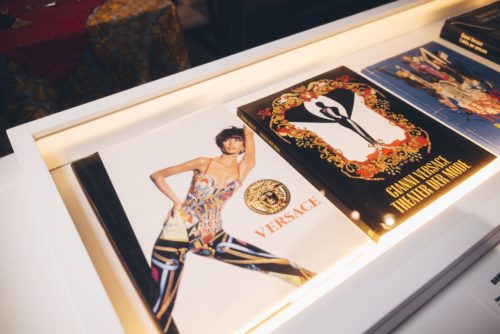
The Barocco prints are here, the bondage pieces, the metal mesh. But because these are collector pieces rather than institutional loans, what dominates is not the most extreme end of the work. These are the clothes real clients bought, loved, archived and preserved. Strong pieces, but wearable ones. The kind that require an attitude to carry, not a costume.
And the craft. Twenty silk shirts displayed on Stockmans, their colours as vivid as the day they were made. Dreamrealizer’s policy of never putting pieces behind glass makes this immediately apparent: the gold hardware untarnished, the prints undiminished. It is easy with Versace to stop at the surface and miss what is underneath. The Oroton chainmail, introduced in 1982, assembles small metal discs on a mesh in such a way that the fabric moves like liquid, mapping the body as it falls. The irregular pleating of the leather pieces, the way a printed silk is cut so that the pattern follows the body rather than merely covering it, these are not decorative decisions. They are structural ones. Versace grew up watching his mother run a dressmaking atelier in Reggio di Calabria. He never stopped thinking like a craftsman.
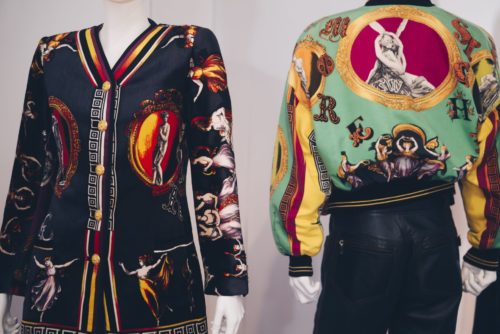
What the pieces ultimately reveal is that Versace was making wearable clothes. Not easy clothes, clothes that demand something from the person wearing them. The garments do not create an attitude. They outline and amplify one that must already be there. The excess is not the point. It is the instrument. Versace understood, with absolute precision, that too much is only too much when the person wearing it has not yet decided who they are. As Pieter Mulier prepares to reinterpret that legacy, the Maillol offers a quiet reminder of what is at stake.
Gianni Versace Retrospective, Musée Maillol, 59-61 rue de Grenelle, Paris 75007. Until 6 September 2026.
