


Dear Shaded Viewers,
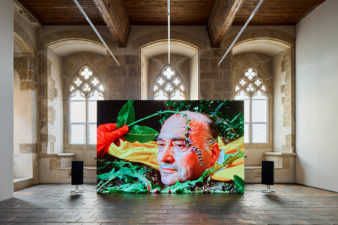
A few weeks into the world premiere at Venice Biennale, Jakub Jansa sat down with me to discuss his creative process behind his latest film “The Silence of The Mole”. Combining film, installation and performance he bravely references an iconic Czech cartoon creature with Franz Kafka and Alejandro G. Iñárritu, while his work is already part of permanent collections of The National Gallery in Czech Republic and Prague City Gallery.
Jakub, you will be representing Czech Republic at the Venice Biennale this year. What does it mean for you?
When we were selected, it triggered an explosion of mixed feelings of joy, anxiety, even a sense of something surreal. The project was selected through a transparent and open call, with a jury composed of experts. The common Czech and Slovak presentation I will be exhibiting together with artists Selmeci Kocka Jusko working with curator Peter Sit.
How does your creative process begin?
It starts with writing a script which then gradually develops further. At the same time, I am shaping the visual language of the film, refining ideas through countless mood boards and storyboards. Casting is, of course, a crucial part of the process.
We spent nearly three months searching for the right performer for the role. I was lucky that we found the excellent actress Daniela Voračková, who embodies Mr. M in a truly breathtaking way.
What lead you to choose the iconic figure of mole as your key character?
The figure of the Mole emerges from several overlapping layers of inspiration. On one level, it draws from a shared cultural memory, the well-known Czech animated character Krtek, a symbol of innocence, imagination, and a kind of quiet, non-verbal worldview rooted in childhood.
At the same time, the work is informed by literary, cinematic, and philosophical references. Franz Kafka’s short story The Burrow resonates strongly here, especially in its sense of interiority, anxiety, and a subject entangled in its own constructed environment.
Alejandro G. Iñárritu’s film Birdman is another important reference, particularly in its portrayal of an aging performer trapped within a role that both defines and consumes him. There is also a loose connection to Marxist thought, especially in relation to labor, repetition, and the gradual transformation of a living figure into a kind of cultural product.
Could you describe your new work you plan to present in Venice and the central idea behind it?
The project deals with the question of representation and at its core is a performer, Mr. M, who has spent his entire life portraying a well-known children’s character – the mole. His neutrality and universal acceptability, once qualities of innocence, are precisely what now make him the ideal figure to represent on the stage of high art at the Venice Biennale, aligning him with current conservative political expectations.
The work explores how imagination can be captured and repurposed by the mechanisms of soft power. At the same time, it creates a tension between the “high” and the “low” and avoids a single fixed interpretation. It can be read both as a critique of conservative politics and of the high art system itself.
Who were your collaborators in this project?
The exhibition was developed through an ongoing dialogue with the entire team of the artist duo Selmeci Kocka Jusko and curator Peter Sit. My primary focus is on the film, while the sculptors are working on a large-scale installation of objects derived from the Mole’s instruments and the situation of silence. Costumes, designed by Karolína Juříková from Overall Office play an essential part of the film. I collaborate with producers Kristýna Kapounová and Matouš Marcinko, who help bring the film to life under fully professional production conditions. It is also a great collaboration with the talented DOP Tomáš Kotas and my favorite composer – the musical genius Oliver Torr.
Can you walk us through your production process, from concept to final installation/screening?
Over the past year, I have had the feeling of being inside one long WhatsApp/Discord/Email communication orgy. Imagine having nine different WhatsApp and a constant
communication with the National Gallery around the production of the exhibition and everything that comes with it.
Which technical or logistical challenges do you face while preparing for the Biennale?
After all that intense communication and logistical madness, the main challenge is not purely technical, but contextual. The weight of representation of my country, the political situation, and the institutional framing all become part of the work itself.
How did the Venice context shape the reception or interpretation of your piece?
Venice is a dense accumulation of ideologies, aesthetics, and ambitions. It’s not a neutral space. I’m not sure whether it offers room for reflection, or if it simply produces another layer of excess.
The work inevitably enters into that condition, rather than standing outside of it.
How did you balance gallery/installation expectations with cinematic or filmic considerations?
I don’t see a strict separation between the two. The project moves between cinematic language and exhibition space. The film is not just screened, it exists within a spatial and sculptural context that reshapes how it is experienced. It’s less about balancing and more about allowing the two to influence each other.
Do you work with any mentor for feedback or dialogue before the Biennale?
I wouldn’t say I work with a single mentor, but I do regularly consult a range of people I trust. So in that sense, yes, I’m in ongoing dialogue with different mentors and peers throughout the process. Their feedback helps me to reflect, recalibrate, and sometimes challenge my own assumptions. I am especially grateful for the support of my gallery KodlContemporary.
How do you see the relationship between contemporary art video and fashion film evolving today?
Both fields increasingly operate within similar visual economies – circulation, branding, and attention. What interests me is how these languages can be appropriated and redirected, rather than simply reproduced.
Are there upcoming projects or exhibitions you are working on post-Biennale?
In the autumn I am preparing a presentation in New York and I have just learned that I have become a laureate of the Paul Thorel Prize, which includes a one-month residency in Naples and a generous support for the production of a new work. I’ll be heading there right after the Biennale, partly to focus on the new project, and partly to avoid reading reviews of my own work at home in Prague.
Later,
Diane
