
Dear Shaded Viewers,
Damien Jalet is back in town. Fresh from staging Willy Chavarria’s last runway, he returns to the Théâtre de la Ville with the reprisal of his Onbashira Dyptic : two pieces of forty minutes each that leave the room altered
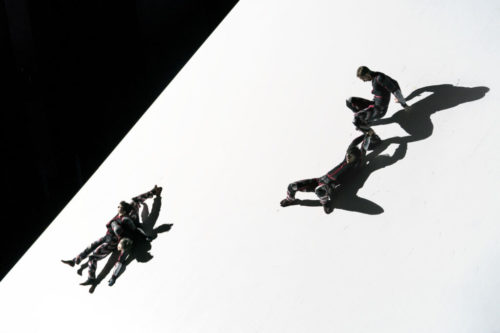
The first part, Skid, unfolds on a 35-degree slope. Dancers emerge from the top, backs to the audience, moving downward in surrender. Bodies are lit by an eerie light that renders flesh almost geological. « I’ passionated by animal birth, I call that the Bambi Effect » says Jalet. Althought the quote sounds amusing, he points something interesting « Force is at the start of everything, you have to have a movement before an animal comes down ». We then get in the performance. Skid, like the verb is about a fall, but in the mythological sense : Passionate by Japan, Jalet observed closely the Onbashira tradition. Every six years, young men offer sacred trees to the divinities of Nagano. They cut them together, ride them down steep hillsides in an act that demands mutual confidence with collective strategy. In real life, some men walk away with fractures. Some do not walk away at all. Risk is not metaphorical here : it is the material. In chaos you can be recentered
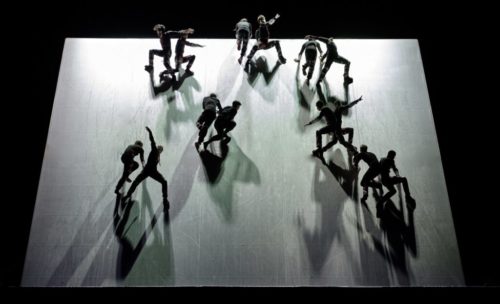
What Jalet extracts from this ritual is a physical grammar: lines, deconstructed falls, sudden collective reorganizations. Bodies fight for their lives through each other. Energy persists even through the most abrupt collapses. Thoses outstanding figures are done in duets, trios, or collectively. The Grand Théâtre de Genève’s company proves remarkably attuned to Jalet’s breathless essence. Thanks to the Vivid eye of Aimilios Arapoglou. Skid is actually about equilibrium. Embracing our paradoxal nature, animal yet millimetric. A vision that the dancers meet with full commitment. The second part, Thr(o)ugh, shifts register while sustaining an unrelenting tension. It introduces a second question rooted in the Japanese tradition: after the trees have fallen, the young men who rode them with courage are honored as pillars of their community. But what does it truly mean to become one? What constitutes greatness ? Is it shaped in darkness or light?
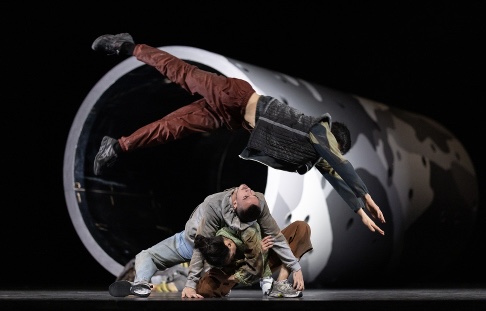
The piece is a quiet exorcism. In November 2015, Jalet was sitting at a café three meters from a terrorist shooting on rue de Charonne. He escaped. For four months afterward, he mentally replayed the scene on loop asking himself endlessly the unbearable « what if ? ». He translated that compulsion into movement: vectors, arm trajectories, push and pull between bodies that might save a life or absorb a bullet. The choreography does not illustrate trauma: it rehearses it, to pull it away . And it works. The audience surrendered entirely: nervous laughter broke through the silence at unexpected moments, but applause was thunderous.The experience across both parts was dreamlike.The kind of trance that keeps pulling you back before sleep takes over, leaving behind images that won’t dissolve by morning.
This clarity of vision was made possible by an unusually cohesive creative team. Jim Hodges and Carlos Martinez Da Cruz conceived unforgetable geometrical sets. Joachim Brink’s lighting underlines the physical effort of the performers while simultaneously exposing their most animal edges.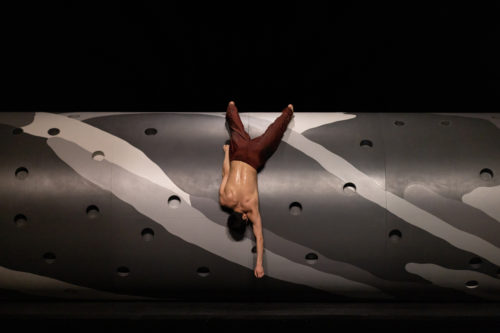
Jean-Paul Lespagnard and Christian Fennesz together form the piece’s second nervous system. Their respective contributions : costume and music, were decisive in navigating the distance between a Japanese ritual and a Western stage without tipping into cultural appropriation. For Skid, Lespagnard designed mesh costumes: flash tops, layered graphic pants, turtle-like and geometric, activating the slope with tradition and LED aesthetics. In Thr(o)ugh, the wardrobe sobers dramatically, until it isn’t: some garments return stained, and one silhouette osilliates between campiness or afigure of death. Fennesz scores left the audience breathless. A sizzling loop with reworked extraits from Mahler’s symphonies imprinted the Universal meaning of rise and fall through our minds.In the second the palpitating score end with a reverbed version of Nina Simone’s Who knows where the Time is going ? As a haunting lullaby that refuses to let go. That dypitic Will be there again because Jalet and his team succeed into a clever strategy in the contemporary arts : Dealing with our human core. Strenght, organic noises and absurdité that résonnâtes in our collective subconscient
Dont miss it until Sunday March 8th
Later
Mael Heinz
