
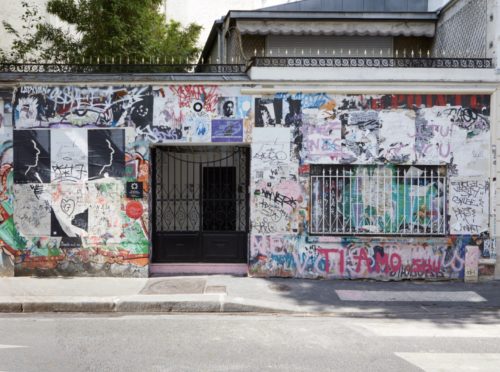
There are court decisions that close places down, and there are those that set them free. On 8 January 2026, Maison Gainsbourg — the long‑awaited consecration of 5 bis rue de Verneuil — quietly entered the second category. With the Paris Economic Activities Court validating the plan led by Charlotte Gainsbourg and entrepreneur Philippe Dabi, the house that shelters Serge Gainsbourg’s myth has just secured something more fragile than its walls: its future.
The story, as often in France when culture meets commerce, is juridical in its form and emotional at its core. Initially, Charlotte Gainsbourg and Philippe Dabi had imagined a continuation plan, designed, as they insist, to repay creditors “as much as possible.” But that scenario depended on the departure of a former associate from both management and the company’s capital, a condition he refused. When governance becomes a stalemate, even the most carefully drawn plans remain theoretical. The solution was therefore to shift the narrative: from continuation to cession, from compromise to a clear transfer of control.
The court chose the solidity of this new transfer plan and, crucially, the proven reliability of Arteum, the operator that has been running Maison Gainsbourg since its opening in September 2023. It is a triad that now defines the institution: the daughter, the associate, and the specialist operator, each with a distinct role. Charlotte Gainsbourg embodies the artistic and filial legitimacy of the project; Philippe Dabi brings entrepreneurial structure and long‑standing personal trust; Arteum anchors the house in the professional ecosystem of contemporary museums.
What is remarkable is the court’s explicit recognition of the familial and artistic dimension of the place. In an “exceptional” move, the judges authorized Charlotte Gainsbourg’s direct participation in the takeover, underlining that her involvement is both “indispensable and decisive.” It is rare to see legal language acknowledge something as intangible as mourning, memory and filiation. Yet Maison Gainsbourg was always conceived as more than a museum: it is a time capsule, a reliquary of cigarette smoke, manuscript drafts and piano keys.
The relief in Charlotte Gainsbourg’s words is palpable. She speaks of ensuring “the future of Maison Gainsbourg, in service of the memory of my father’s work,” while refusing to erase the collateral damage of the turbulence that preceded this ruling, particularly for creditors. The phrase that lingers is stark and almost novelistic: “This dark chapter is finally closing.” For those who queued for hours on rue de Verneuil in autumn 2023, the house has always appeared as a finished story; behind the scenes, it was still in legal suspense. That contradiction dissolves today.
Far from turning inward after this ordeal, Maison Gainsbourg is opening wider. The 2026 programming sketches a house in motion: a film cycle, “La Maison Gainsbourg fait son cinéma”, which folds Serge Gainsbourg’s deep ties with cinema back into his own home; participation in the European Night of Museums, European Heritage Days and Enfants du Patrimoine, embedding the institution fully in the national cultural calendar; nocturnes exclusively for pass Culture beneficiaries, asserting a clear desire to address younger audiences not as a marginal add‑on, but as a central public. Educational workshops for children and teenagers, signings and encounters at the Gainsbarre, and live concerts in partnership with the Conservatoire Erik Satie and the École Normale de Musique — where Serge once studied solfège — complete this living portrait of a house that refuses to be a mausoleum.
The physical device of Maison Gainsbourg already told this story. At 5 bis rue de Verneuil, the historic home preserved intact, labeled “Patrimoine d’intérêt régional” and “Maison des Illustres”, offers visitors an immersive experience guided by an original sound piece by Soundwalk Collective, created in collaboration with Charlotte. Across the street, 14 rue de Verneuil unfolds as a hybrid space: museum, bookshop‑boutique and the Gainsbarre, a restaurant by day and cocktail bar by night. The split is symbolic: the intimate house on one side, the public stage on the other; the preserved silence facing the amplified voice.
Within this architecture, Arteum is more than a service provider. Since opening, the company has overseen the full operation of the site — from ticketing and communication to conservation, exhibitions, retail and off‑site development — drawing on an ecosystem honed across some of France’s most emblematic museums, from the Petit Palais and Musée des Arts Décoratifs to the Mucem and the Tour Eiffel. Its vocation, as president Lorraine Dauchez formulates it, is to contribute to the “rayonnement” of museums while building economic models robust enough to sustain them. In a context where cultural institutions must constantly negotiate between public mission and financial viability, this alliance is not anecdotal; it is structural.
Maison Gainsbourg’s gratitude to Saint Laurent by Anthony Vaccarello, its official partner, and to the Région Île‑de‑France, which supports the project, further situates the house at the crossroads of fashion, music and public policy. These alliances are coherent with the aura of Serge Gainsbourg himself, a figure who always navigated between high culture and pop, the literary and the scandalous, the cabaret and the couture runway.
More than thirty‑two years after Serge Gainsbourg’s death, the house at 5 bis is no longer just a façade covered in fan graffiti and pilgrim bouquets; it is a fully fledged institution with 120,000 visitors a year and an agenda that treats his work as a living repertoire rather than a closed canon. The court ruling does not merely settle a dispute between associates; it reaffirms that certain places, when they crystallize a country’s cultural memory, merit legal, economic and artistic arrangements equal to their emotional weight.
The dark chapter, as Charlotte says, is over. In its place opens a new one, written in the present tense — in screenings and concerts, children’s workshops and late‑night cocktails, in the quiet passage of visitors through a bedroom kept exactly as it was. Maison Gainsbourg, finally, can do what it was meant to do: allow an oeuvre to continue living where it was once lived.
