


Dear Shaded Viewers,
Greeted immediately by the vast atrium, ribbons of colour in various shades of red, blue and yellow hung suspended from above. Soft light streamed in through the skylight, while at the end of the atrium, large arched windows cast their gridded reflections onto the ground. The sun highlighted the vibrancy of the long ribbons, lending them an ethereal glow and a sense of depth, with some strips hanging lower than others, catching more of the midday light.
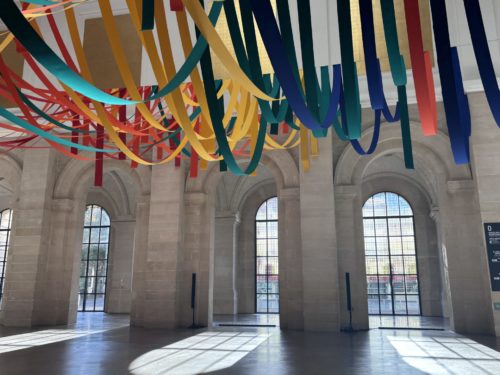
Sheila Hicks, the renowned textile artist, is known for working closely with architecture. For her exhibition Au-delà (Beyond) at the Palais des Beaux-Arts in Lille, she establishes an intimate dialogue with the museum itself. Responding to the sheer volume of the prestigious atrium, Hicks created these powerful suspended strips from Sunbrella, a fabric resistant to sun, rain, and the trials of weather. In a city whose history is so deeply tied to textile manufacturing, particularly in the 19th century, Hicks’ exhibition carries a special resonance. The mayor of Lille stood beside Hicks as she presented this first view of the exceptional exhibition.
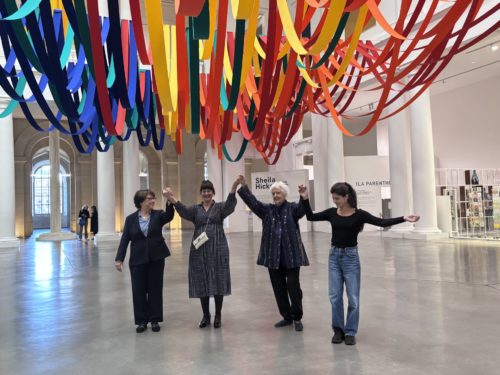
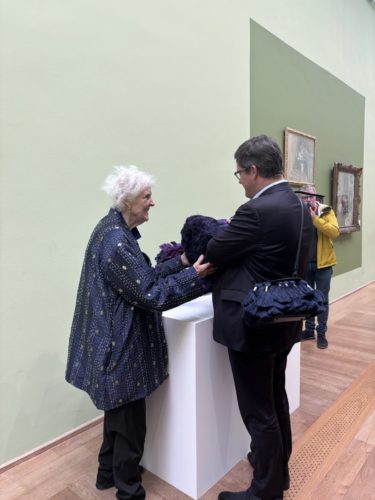
“I create environments,” said Hicks, and this could not have felt more apt. As we stood in the atrium, the daughter of one of Hicks’ close friends, who works at the atelier and is also a dancer, moved through the wide atrium, a dancing particle in this vast space. She leapt gracefully into the air, rolled elegantly onto the floor and rose again, her movement becoming a direct encounter with weightless threads of light, colour, form and fibre. This impromptu dance interlude set the mood for the exhibition.
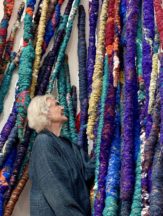
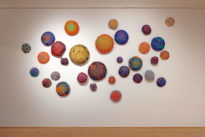
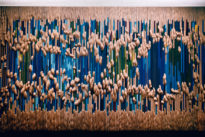
We glided upstairs, where the exhibition continued. More textile sculptures appeared throughout the space: some in circular forms attached to the walls, composed of threads from Hicks’ own archive of materials, built up over many years, or from deadstock fabrics repurposed into this new language. Others were twisted, roped and knotted organisms that stretched from the ceiling to the ground. These resembled giant bundles of yarn, except each mass was made up of countless individual threads, carrying within it an unimaginable labour of love.
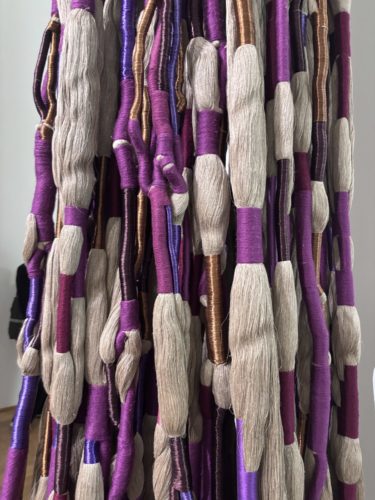
“Textile is a universal language,” Hicks has said. Across cultures, textile carries an ingrained sense of love, memory and story, passed from generation to generation, from mother to daughter, from one home to another. It is one of the strongest and most authentic forms of communication.
Hicks’ interest in pre-Columbian textile traditions began during her time at Yale School of Art, where she wrote her dissertation under George Kubler. She later lived in Guerrero, Mexico, from 1960 to 1964, which helped shape her interest in non-Western textile traditions, where textiles functioned not only as objects of use, but as carriers of ritual, experience and meaning.
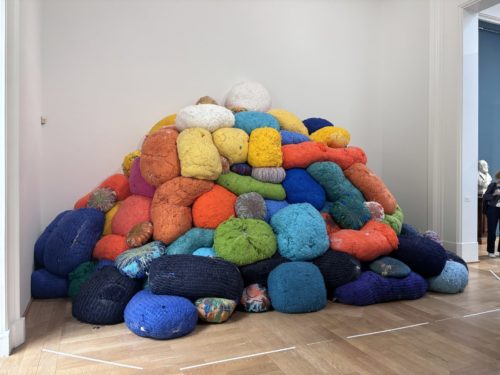
In one large corner of the exhibition was a monumental installation of these unidentifiable mounds of colourful textile. These masses of fibre were piled up tightly together and rose beyond the height of the audience. They were part of the architecture, part of the room itself, and again opened a dialogue between what can inhabit an empty space and what space even means. As you walked around the installation, the body inevitably interacted with the contours, openings and weight of this textile landscape.
It made me wonder how our experience of space is so often grounded on a horizontal axis. I found myself wishing I could lose gravity, suspend myself, and travel upwards into the beyond – into the Au-delà.
Later,
Estelle
