



Dear Shaded Viewers,
History lessons are not always fascinating, and the technical workings of a business can sometimes seem to be a trifle tedious, even to the most engaged. So, a fashion exhibition combining both would not seem to be immediately an immense “must see” but MAD the Musee des Arts Decoratives at the Musee du Louvre in Paris has an absolute winner of an exhibition on until the 4th of April 2027 which any fashionista who truly loves the business from A to B, should make a priority to attend.
Although it is to celebrate the 40th anniversary of the founding of the Musée des Arts de la Mode within its walls, and the Musée des Arts Décoratifs is presenting an exhibition featuring 40 iconic outfits, this is not in some ways the high spot of the exhibition.
Surrounding the main space are a series of small rooms each featuring a specific element of the fashion business. To say it’s dazzling seems an odd choice of word but honestly, from the mannequin’s clothes are made on, to the books and catalogues we collect, from the fragile restoration of highly delicate collector’s pieces from the archives, through to the smallest detail of embroidery or printed textiles, it’s like walking into the best book on fashion ever.
The conservationists have set themselves the task of drawing back the curtain on the secrets of fashion, but without destroying the magic. The exhibition has many exquisite pieces, and also some fashion surprises, but at its heart is this attention to the machine that drives the business but here we can see it taken apart and explained.
Even as a seasoned fashion writer, and exhibition attendee, I was totally immersed in each section and cannot wait to visit again. I was stunned to see a 1929 monochrome, pure Art Deco, Lanvin dress with its contemporary images, original drawings, and a detailed explanation of its provenance, I was fascinated by the restoration image through a radiograph of a 1570-1580 mans doublet, exquisitely made in leather with its wooden buttons and each and every detail, exposed and then explained how this restoration might be carried out. As you walk very slowly from room to room there are lots of huge screens with specially made films showing exactly how some areas of the business and the real workings of fashion happen. It is both the real nuts and bolts side of fashion, and how fashion exhibitions and conservation work. It is also done with love and passion, and the exhibition carries you along, not in a dry dusty academic way at all, but more like a series of spells to make magic or ingredients to make a delicious cake!
There are mood boards, and boxes of samples, and patterns, there are posters, and Theatre de la Mode, and all the minutiae of the making of fashion from brown paper to lustrous silk and satin.
The main vast hall is not cluttered, and it is possible to focus on each piece. It includes a divine white on white Empire gown from the post French Revolution period in the very early 19th century, it is embroidered with pineapples cascading down the front onto the drifting hem, magical. There are pieces by Christian Dior, John Galliano, Thierry Mugler, Valentino, Madeleine Vionnet, and Balenciaga, of course reminding us of past exhibitions here over the past forty years. Some are from exhibitions focussed on a single designer and others which were covering a specific area or concept in fashion.
It is unusual to find so much research and so much information in an exhibition for the general public, yet it is never heavy in detail or over academic. The Musée Galliera is the fashion museum of Paris, so this exhibition is also unusual in that it places fashion history more readily available to a larger public in the rue de Rivoli, and when I attended it was busy and crowded.
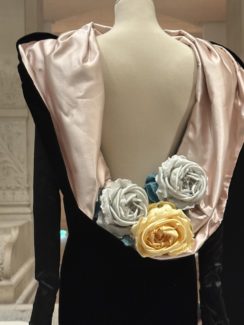
Amongst the main pieces in the vast vaulted ceilinged hall of the Louvre is a sensational Christian Lacroix, reminding us of the truly fascinating exhibition he staged here. Christian Lacroix, Histoires de Mode took place from November 8, 2007, to April 27, 2008, and examined themes through his research into the museums archives plus exploring recurring themes across the centuries of fashion. Stripes, lace, spots etc were all revealed as classics, and this exhibition also reveals how fashion balances the past with the future.
Technology may blast through areas of the business, AI may push itself forward as the answer to everything, but fashion and clothes, how we design and make what we wear remains steeped in history, in expertise and knowledge. The rumours of technology swamping creativity or replacing so many roles in all areas of business of being able to replicate everything the human hand and eye can do is knocked out with a terrific punch by what we witness here in the work and the results of the ateliers and petits mains. This exhibition joyously celebrates this complex and wonderful world with elan and style, so if you love fashion, go!
Tony Glenville
