
Try to bind a mind like his, and freedom will only fight harder to erupt. Born and raised in South Africa, he cut loose at nineteen after two years of military service, and never looked back. The mid-1980s London clubland took him in, where he found his people – above all the wonderful, boundary-shattering Leigh Bowery. That world lit his lifelong fixation, corsetry, which carried him, by chance, into fashion and its boldest minds, sculpting the silhouettes of Mugler, Gaultier, Westwood and Galliano, and still drawing the waist of his faithful friend Dita Von Teese, just to drop a few names. His own body, too, he bound, holding his skeleton in a daily ritualised discipline, as constraint itself became the gateway to liberation. A kind yet incisive wit, a smile behind each quip, the man who gave fashion some of its most extraordinary, era-defining pieces keeps himself in the shadow of his own hand. Mister Pearl is a member of the 20206 ASVOFF jury.
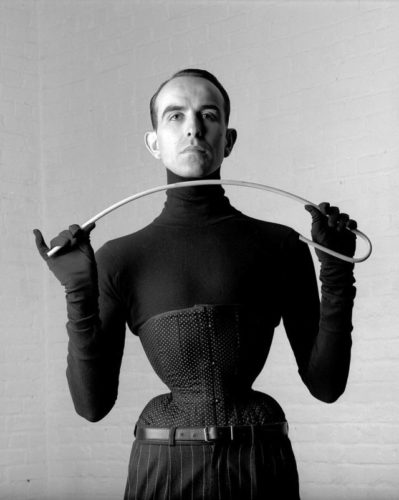
A pearl begins as an intrusion. A parasite lodges in an oyster and is wrapped in nacre, layer after layer, until the wound brings forth a gem. He too found his shell, a space of freedom he made his own, and there he grew into his most accomplished form, in his craft, becoming the ultimate name in corsetry, and in his own cinched, remorphed flesh. His layering process began at three. “I went to live with my grandmother, and she was a force. I’d never seen anything like this before in my life. I became very close to her.” They lived in Vereeniging, a coal mining town whose Dutch name, he admits, “I can’t even really say I pronounce correctly!” She wore a corset every day, and he still remembers its salmon pink colour. “She would let me help her dress in this corset. She was explaining the lacing, and that was a very entertaining ritual that happened every day. My grandmother, in a way, is really responsible for what happened in the end. I have to thank her for planting that seed.” A rigid society and its school system leave little room for a child who does not spontaneously conform. “I was not really well adjusted to normal school,” he admits. But a boarding school in Pretoria gave his sensibility a cocoon and a company. “The subjects were art, ballet, and music. I studied fine art, and the focus was history of art, painting, sculpture. There were some really wonderful teachers, so I did enjoy that period.” Beyond school loomed the army, that great leveller, two years of conscription built to sand every boy down to the same grain. A gentle thought here for all of those soft-hearted boys who dreamed rather of blossoming into pearls. “I had decided at the age of thirteen that I was going to leave. I didn’t know how, but I knew that I would find a way.” What drew him was London, glimpsed in magazines carried home, a fantasized homeland on the other side of the planet. “I was very interested in everything subversive and alternative. It was the end of punk, then the New Romantics, and I just couldn’t wait to get there.” At nineteen, out of the army at last, he left looking forward. “There was no choice for someone like me. The political situation was really extreme. I didn’t agree with it, and if you don’t agree, you get into trouble. And I’ve never looked back since.”
“To many, it was the greatest creative time. Leigh Bowery changed my life, and he always was such an explosion. Human beings need this more than anything else.”
Everything changed: his country, his world, his very name. “My friend Dean Bright gave me my nickname after ‘Pearl and Dean presents’, a famous cinema ad at the time. The two of us made a Pearl and Dean,” he recalls, smiling. He never enrolled at Central Saint Martins, where Dean studied, only circled it through friends, remaining self-taught his whole life. His first wage came from the Royal Opera House. “It was, in many ways, my university.” He stayed three years, the lowest paid on the payroll. “You were allowed to watch rehearsals, you could go everywhere in the building. I saw really incredible productions, exceptional artists, and the study of human behaviour was something in itself.” He had made costumes since fifteen, a black satin shirt trimmed with lace for a Cinderella school production, a mermaid stitched just because he wanted to. “In London, I was living in a squat, walking the streets every day,” and one party changed everything. At Heaven, the vast gay club beneath the arches of Charing Cross Station, he crossed paths with Leigh Bowery, an Australian who had left a strict, church-going family in a Melbourne suburb for London at nineteen, the very age Pearl had left his own. Two men uprooted from closed worlds chose each other as family. “He was everywhere, out all the time. He was hilarious, entertaining, with so much energy!”, recalls Pearl. Bowery soon opened his own Thursday night, Taboo, a Leicester Square basement that became the capital of every extreme London had to offer, and Pearl became his assistant, lacing his corsets before performances, gluing merkins (do not google that, it’s a wig for your own pearls) with the same spirit gum used for theatre wigs, holding costumes together on impossible deadlines. His first corsetry clients came quickly: Pete Burns from Dead or Alive, then Susanne Bartsch in New York, for whom he built the outfit worn to her first Love Ball in 1989. It was there, backstage, lacing Bowery into his corset, that a flamboyant stranger introduced himself.
“That’s how I became involved in fashion, completely by chance.”
The stranger backstage that night was Thierry Mugler, who asked him over dinner later to craft a piece for one of his Paris runway shows. Pearl had never worked at such a scale. The order was immense: a hat, a corset, chaps, gauntlets, shoes, all fully beaded in just two weeks. He knew Mugler only from magazines Dean used to borrow from the Saint Martins library, unable to afford them himself. “It was quite daunting, I must say. With me, Mugler was extremely patient, very generous. There were moments, of course, because everybody has their moments, and he could be very difficult. I saw that often. Luckily, I sort of escaped that side of him.” The method never changed across the years: rough sketches first, then toiles, then fittings, then embroidery samples he was often left to invent himself. “He always wanted more.” La Chimère, the legendary gown from Mugler’s Fall-Winter 1997-1998 haute couture show, came together in a run of twenty-four-hour shifts—six weeks of intense labor, with twenty-five people on the payroll by the end. It was designed by the illustrator Stefano Canulli, a friend still close to him today. “I just realized it was completely insane.” It was through Canulli that Pearl eventually moved to Paris, into a spare flat in his building, offered once, then confirmed two years later with a single phone call. “He said, you have to come tomorrow. So I jumped on the first train.” He worked with Mugler from 1990 to 2002, all while Bowery was still very much in his life. “When you’re younger, you can cope with that. Now, I couldn’t.”
“Corsetry exists beyond fashion. It doesn’t need fashion.”
One woman taught him what no fashion House ever could, and he calls her only Miss R, a lifelong tight-lacer met on one of his visits back to London from New York. She knew things no book could, how a corset should feel. “She has a great knowledge of what is required with corsetry in terms of it being comfortable, healthy and wearable on a daily basis,” he says of her, giving away nothing more, since privacy was the price of her trust. Beside that private education stood the public one, the fashion Houses, and after Mugler came McQueen, by accident once again. “I met him at a nightclub. He came up to me and said, well, I’m doing a show, I’ve just graduated from Saint Martins.” Pearl even agreed to walk, though he had never modelled in his life. “He said, I’ll pay you a hundred pounds. I said, oh really, fine, thanks. And he never paid me. He said, I’ll give you the outfit. He never gave me the outfit!” He made McQueen only one corset, worn by Honor Fraser in the show that followed at a church in Whitechapel, lilac moiré and black Chantilly lace, a piece later shown at the Met’s Savage Beauty. “It was quite complicated working with him, I must say, at that time.” Galliano was different again, a friend of his circle since the Saint Martins’ closest bar, where the future designer spent as much time as anyone. No drawings passed between them, only photographs and long conversations about painting, and two pieces for Galliano’s circus show marked the start of it, tightened further once Galliano crossed to Givenchy, then to Dior.
“It is the constraint, the ritual, that is actually liberating.”
He began lacing himself at thirty, after seeing a photograph of Fakir Musafar, a founder of what became the modern primitive movement, known for extreme practices on his own body, including the tight-lacing that had drawn his waist to nineteen inches. “I wanted to try. I needed to feel this, because I thought it was a certain type of ritual and discipline. I wanted the security of that discipline, of the ceremony.” He built the practice into a rule, the corset changed three times a day, worn even through sleep, the waist drawn tighter by degrees until it settled, over years, near eighteen inches. “The ritual is you would live in the structure. It is very hard to describe. Everybody has rituals. It is like wearing a pair of shoes, similar to gloves. It is a garment that lives on its own. It has its mystery.” He rejects the idea that this was ever dangerous. “There is nothing dangerous with tight-lacing,” he states calmly, though he knows of one illegal, painful procedure that removes the floating ribs to chase a smaller waist, a shortcut he does not recommend as the results, he adds, are rarely as dramatic as hoped. What the corset gave him instead was order. “The liberation came through the constraint.”
“Dita [Von Teese] is a muse to me. Her opalesque beauty blows me away. She has been loyal to me over decades.”
“I do not see enough of Dita, she is such a busy bee. She is in her prime. She continues, the world needs more. She is a dear friend and it adds to the whole exchange because corsetry leads to very intimate situations.” Among other commissions over the years, some passed through more briefly. He made a corseted bodysuit for Kim Kardashian ahead of the 2019 Met Gala, worn under a wet-look Thierry Mugler gown. “For Kim, I made some things,” he says, “and people come, and they go.” The work continues regardless.
His pieces are now scattered across the permanent collections of the greatest fashion museums in the world, the Met, the Victoria and Albert Museum, the Musée des Arts Décoratifs, sealed behind glass, catalogued, consecrated by institutions that spent decades deciding what fashion was allowed to call art. And still, the man remains absolute discretion. He does not do social media. He does not do self-publicity. “When I see a piece I made, I mostly remember the hard work.” Contacted by the Metropolitan Museum’s fine arts and fashion department, about a Westwood beaded corseted jacket they wanted to display, he was struck by its scale, the size of the jewels set over the nipples. “Am I responsible for those?” he asked himself, only half joking.
He never once stepped toward the light, whatever the acclaim. The story of the pearl who made the world his oyster.
