
Dear Shaded Viewers,
Eight days, more than 220 brands from over ten countries and 100-plus shows. The Autumn 2026 edition in Beijing showed that, nearly three decades on, China Fashion Week is no longer asking for a seat at the table. It is hosting the conversation.
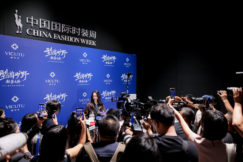
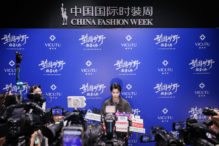
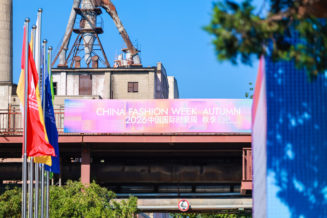
Every September, the old Bauhaus factory halls of the 798 Art District fill with cable runs, rigging and the particular tension of a room being built for something that hasn’t happened yet. By showtime, the machinery of the building, decades old and once meant for electronics, not runways, disappears under the machinery of the event. This year the waiting ended on 3 September, when Sun Ruizhe, president of the China National Textile and Apparel Council, opened the 2026 China Fashion Week (Autumn) before more than 600 guests: officials, diplomats, designers, buyers and press.
The question underneath it all hasn’t changed much since the beginning: what does Chinese fashion look like when it stops asking for permission and starts setting the terms?
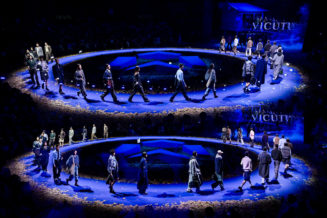
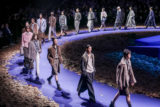
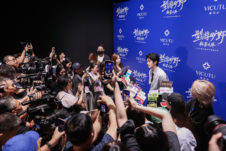
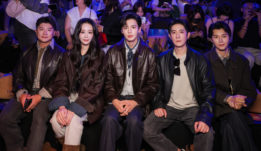
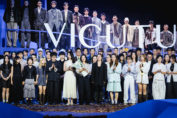
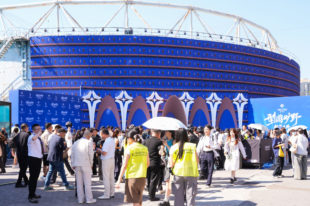
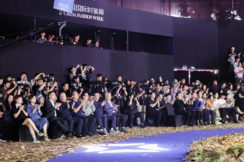
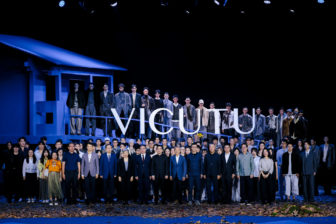
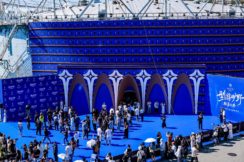
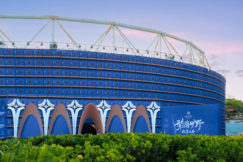
The answer began with Vicutu. The Chinese menswear house, itself marking thirty years of craftsmanship, opened the week with a show titled “型游旷野 · 标签之外”, roughly “Style in the Open, Beyond Labels.” A circular industrial landmark was wrapped in cobalt blue, its entrance framed by soaring white star-shaped arches. Inside, models circled a ring-shaped runway strewn with autumn leaves, in a collection built around mobility, comfort and functional design: relaxed tailoring, supple leathers, textured knits and long, easy coats. This was menswear made to move, and it set the tone for a week that valued ease as much as polish.
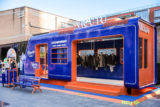
Outside, a blue-and-orange train carriage doubled as a pop-up styling station, one of several spaces across 798 that carried the energy of the shows into the street.
Some fashion weeks are born as spectacle and grow into infrastructure. China Fashion Week did the opposite. It began in 1993 as an idea inside the newly formed China Fashion Association, a modest bet that Chinese design deserved its own stage rather than a seat at someone else’s. In 1997, the first shows walked. That bet has since compounded into something close to an entire ecosystem: a biannual gathering that works less like a single event and more like a nervous system for an industry, sending signals through runway shows, trade exhibitions, forums, awards and, increasingly, screens.
The scale is striking. In a typical season, hundreds of brands and designers present here to some 120,000 people in the room and, by some counts, more than 100 million watching online. Numbers like that can sound abstract until you remember what they represent: a young designer’s very first collection, seen by more strangers in one week than many brands reach in years. Fittingly, the closing night launched the countdown to China Fashion Week’s 30th anniversary with a new official visual identity.
If one idea ran through this season, it was the contemporary life of traditional Chinese aesthetics. Designers drew on the solar terms, silk-making traditions and heritage textiles such as Song brocade and Xiangyunsha, the lustrous gambiered gauze of southern China, and cut them with modern tailoring and structural techniques. Several collections went further, exploring the relationship between clothing, the body and personal identity.
Digital fashion pushed the same materials in new directions, with designers using algorithms and data to present Eastern fabrics in both virtual and physical form. Heritage here is not a museum piece. It is raw material.
798 remains the spiritual center: raw industrial architecture, later colonized by artists, now colonized again by clothes. Walls built to produce the utilitarian at scale now host garments made for the opposite: singularity, expression, the unrepeatable. This season the program spread across the capital, from the Beijing Exhibition Center to the CAFA Art Museum and the Longfu Cultural Center, and even to shopping centers in Taiyuan and Zhengzhou. Still, 798 made the case best: a fashion capital doesn’t need borrowed grandeur when it can build its authority from its own industrial memory.
Ask what China Fashion Week actually is today, and the runway is only the opening chapter. DPARK Fashion Fair, the trade platform founded in 2014, turns creative vision into supply chain and commerce, because a beautiful collection that can’t be produced, ordered or sold is only half a story. This season it gathered more than 60 companies and nearly 100 brands across original design, supply-chain matchmaking, technology and content, alongside more than ten talks on color trends, fabric innovation, intangible cultural heritage and new forms of consumption.
The 10+3 Showroom, now twelve years deep into backing emerging names, has helped 169 brands find their footing when footing is hardest to find. A kids wear platform champions safety, health and imagination for the smallest bodies fashion dresses. And the digital fashion wing, just five years old, has already staged 140 releases in a space that barely existed a decade ago.
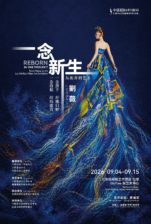
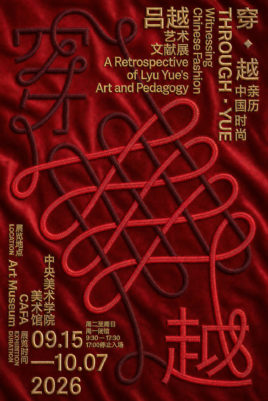
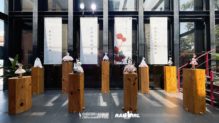
Culture ran alongside commerce. Art exhibitions included “A Retrospective of Lyu Yue’s Art and Pedagogy,” Liu Wei’s eco-fiber show “Reborn in One Thought: From Waste to Art” and “The Dunhuang Culture & Art Exhibition.” Fashion art toys had their moment too, with a trend conference on the collectible IP boom and the RAN GIRL exhibition, where delicate figurines in sculpted tulle and petal skirts stood on raw timber plinths in the afternoon light. Many shows paired their launches with livestreaming and immediate sales online and in stores: the distance between runway and wardrobe has never been shorter.
Look past the front row and the audience is wider than it seems. There are the tastemakers who treat fashion as a lifestyle discipline; the internet-fluent twenty- and thirty-somethings who don’t just follow trends but accelerate them the moment they leave the venue; and the celebrities and creators whose attention is itself the amplification. Three very different audiences, converging twice a year on the same doors, for the same reason: to see what’s coming before everyone else does.
The guest list was international. Brands and designers came from China, Japan, South Korea, Russia, France, Switzerland, the United States, Colombia, Zambia, Malawi and beyond, covering menswear, womenswear, haute couture, contemporary Chinese dress, outdoor apparel, sustainable fashion and digital design.
The week closed on 10 September with a ceremony looking back on three decades of Chinese fashion, followed by shows from Loolayy and Zhu Ziyu that drew gracefully on traditional Chinese dress. Media figure Yang Lan gave the keynote on contemporary expressions of Eastern aesthetics and where the industry goes next.
It would be easy to read China Fashion Week simply as large. The more interesting truth is what the scale is for: a platform built to give Chinese design its own global voice rather than borrow one. Nearly thirty years in, it isn’t asking whether Chinese fashion belongs in the global conversation. It is hosting it.
Fashion weeks, as a form, tend to repeat. What China Fashion Week has built is rarer: an institution that repeats and grows at the same time, louder, wider and more sure of itself each season.
China Fashion Week is organized by the China Fashion Association and held twice a year in Beijing.
Later,
Diane
