
Dear Shaded Viewers,
It is Paris art week. Amidst the aftermath of the previous Satuday’s protests, and talks of a potentially bigger one this coming Saturday, the art fairs go on.
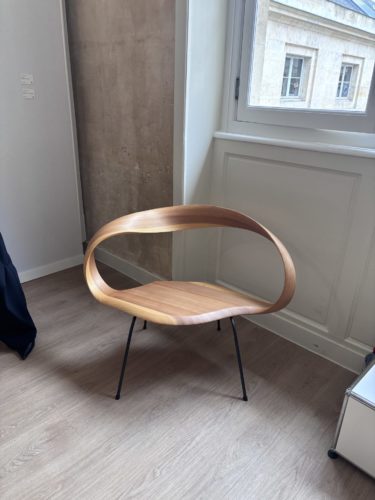
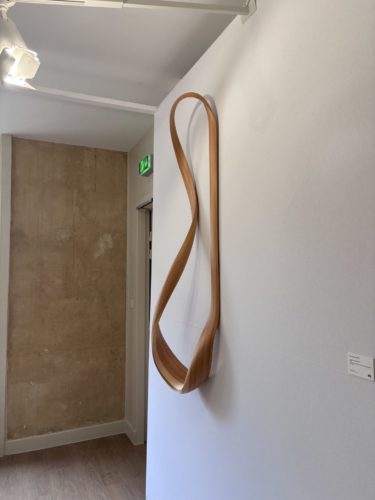
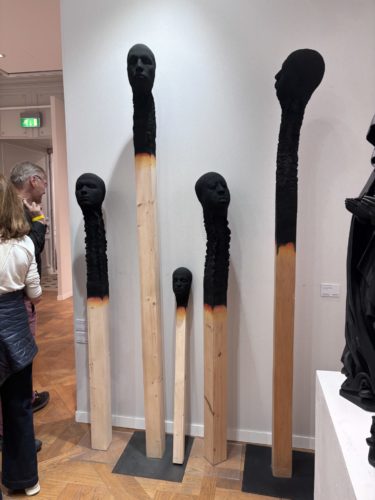
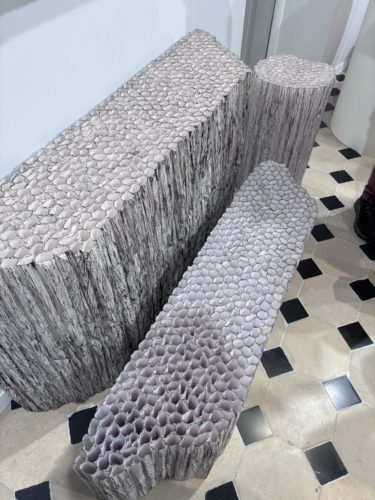
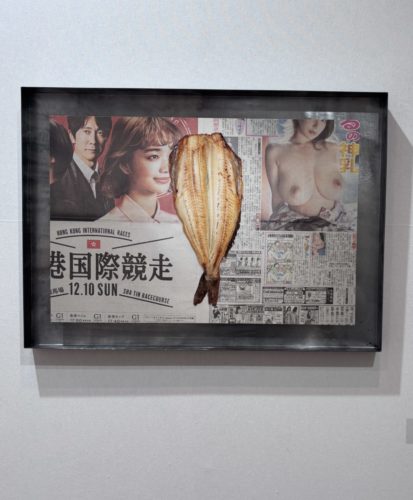
Asia NOW was set in La Monnaie de Paris. Spread across several rooms upstairs and the courtyards, the work varied from natural wood furniture and lighting fixtures resembling gigantic suspended rubber bands, to human-sized matchsticks burning into solemn faces with their eyes closed; from what looked like fragile paper rolls stuck together to form a bench, which I sat on, rather comfortably actually, to a photograph of a fried fish set against Japanese pornographic newspapers.
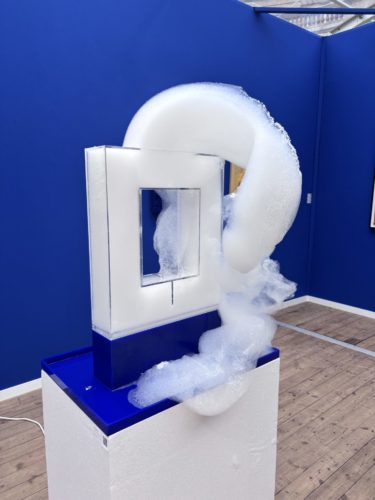
What caught my attention was a rectangular glass case, empty in the middle. Foamy soap filled the case and spilled out, forming what looked like a fluid yet rigid train of foam, like a horse’s mane. It piled onto the ultramarine-blue platform of the plinth, hanging tentatively over the edge. I could not resist verifying whether it was actual soap. I quickly touched the protruding foam. It was indeed soap. A few bubbles clung to my guilty fingers. I left promptly, before I could get caught bubble-handed.
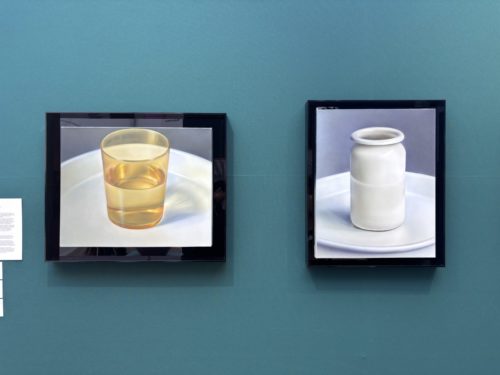
There was a series of still-life paintings by Zhang Yangbiao, named, naturally, Yellow Glass Cup, Enamel Jar, and A Cup of Black Tea. The paintings were a modern Morandi – soft, pastel-toned, with the classic frontal still-life composition and diagonal light falling across the table and casting a soft shadow.
Except that Yangbiao’s still lifes have what I can only describe as an iPhone face. You know, that phrase on TikTok used to describe actors or actresses because you can just tell that they have seen an iPhone. The internet defines an iPhone face as someone whose facial features look too modern, polished, or shaped by contemporary beauty standards. That’s how I would describe Yangbiao’s still lifes.
Despite having an almost photographic visual quality, Yangbiao’s process is meticulous and gruelling. He insists on painting from life, observing the objects in constantly changing light. Through repeated layering, Yangbiao rebuilds the image until it feels as though the painting holds within it every moment of shifting light and colour.
The accompanying description stated: “In an age when images can be produced in an instant and reproduced without limit, Zhang Yangbiao chooses to face reality again through slow and meticulous work.”
I find that in fine art there is a persistent pursuit of the slow and meticulous, of the analogue process, of une vie dure. These are often positioned in opposition to the speed of the modern world, as though choosing the more difficult route is, in itself, an act of resistance.
I found it ironic to be reading this on a pristine white card, against a pristine white wall, inside one of these pristine white boxes. If the slow and meticulous is so much better and more worthy, following the same reasoning, would it not devalue, or smudge away the purity of the toil and hardship of making art, for it to be inhabited in such a space?
White walls, white light, name cards, brochures, leaflets, all ready to be sold.


The following day, in a completely different tone, I caught the Wayang Women performance, part of Asia NOW’s daily program.
Wayang, a traditional form of puppet theatre from Malaysia and Indonesia, unfolded at dusk in a sheltered courtyard. The audience sat cross-legged on the stone floor. I sat amongst a small crowd of children and families, but I didn’t feel like an imposter. In fact, I felt as though I was catching up on my childhood.

Playing traditional cultural instruments, two women switched between making music with their voices and throats and with their instruments. Behind a softly illuminated white screen, intricately cut-out figures appeared, their bodies and faces brought to life through silhouette. One character had a cigarette permanently stuck between his fingers as he huffed and puffed on it. Another had blackened lungs surrounding a red heart, her hair stuck blowing in the wind, and her tongue slithering as she spoke. Voices came from behind the screen, giving life to the story and weaving messages about global warming into Malaysian folklore.
We were introduced to Hantu Tetek, a supposedly terrifying female spirit who, in this tale, became someone we grew familiar with, even affectionate towards, as we summoned her from the depths of the forest.
“When I say ‘Hantu’, you say ‘Tetek’!”
“Hantu!”
“Tetek!”
“She can’t hear you… Hantu!”
“Tetek!”
“Hantu!”
“Tetek!”
It was only towards the end that I realised what Hantu Tetek had been speaking with all along – her literal teteks, her breasts. Long and enormous, they moved as she spoke, threatening to swallow the little children into their folds.
When the story ended, the four Wayang women, who had been laughing and giggling with us throughout the performance, stood up and bowed. There was a small stall selling merch at the end, a reminded that I was still at an art fair. But what stayed with me was the shared experience – the human-to-human connection, from young children to the elderly, all of us held in this moment as it came alive in front of us. A little absurd and a little grotesque, but entirely human. And in this case, what brought us together was a very large pair of breasts.
Later,
Estelle
