
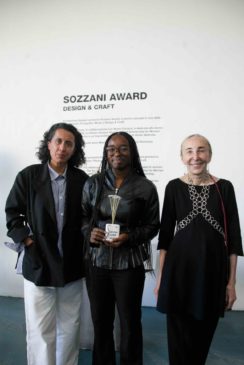
Not a runway, but a prize. Fondazione Sozzani reaffirms its ongoing commitment to new generations by hosting the first edition of the Sozzani Award, titled “Women: Design & Craft” for 2026. Receiving it, at the Foundation’s via Bovisasca 87 venue, was British-Nigerian designer Timisola Shasanya, recipient of the Veuve Clicquot Design & Craft Scholarship for Women: a €15,000 grant.
The new award sets out to support creative paths that combine independence, rigour and responsibility, and will rotate each year across the three disciplines closest to the Foundation: photography, fashion and design & craft. Entry is free and open to young creatives from all over the world. For its debut, the focus fell on women and their role in shaping new cultural languages. The Foundation sums up the approach in what amounts to a manifesto: creativity is an act of responsibility, a choice. The launch came in a particularly busy September for the Milanese institution, which also announced that it has joined the Global Education Coalition, the partnership platform set up by UNESCO.
The Winner and the Finalists
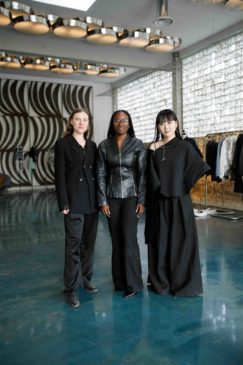
A Central Saint Martins graduate now studying at the Institut Français de la Mode in Paris, Shasanya works across fashion, textiles and objects, exploring where tailored menswear, Nigerian craftsmanship and the theme of migration meet. In her work, traditional weaving and dyeing sit alongside laser cutting and digital embroidery, as she explores the bond between cultural identity and innovation. The two finalists, Canadian Marie-Ève Lecavalier and Japanese artist Mai Suzki, will be offered the opportunity to exhibit in the Foundation’s spaces during 2026/2027. Paris-based Lecavalier builds sculptural works in leather and fabric that probe the relationship between body, material and structure, reintroducing offcuts into new materials and questioning conventional notions of value and luxury. London-based Suzki starts from kumiko, the traditional Japanese woodworking technique, and hybridises it with 3D modelling and the study of anatomy. The results are body sculptures, installations and performances inspired by the aesthetic ideal of iki (an understated refinement that is sober, spontaneous and self-aware, far removed from any display). They were selected by a jury made up of Galib Gassanoff, Veronica Leoni, Fabrice Paineau, Kris Ruhs, Olivier Saillard, Carla Sozzani and Sara Sozzani Maino, who assessed artistic quality, research, social impact and the ability to generate new narratives.




A Week of Fashion, between Tazzoli and Bovisasca
The award was only the final chapter of a week in which the Foundation was active across both its Milan venues. Opening fashion week at via Tazzoli 3 was the second edition of FASHIONPhilippines Milan, a mentorship and exhibition programme produced with CITEM, the Philippine Textile Research Institute, the Philippine Consulate General in Milan, the Philippine Fashion Coalition and LIT Fashion Consultancy. From 22 to 24 September it presented collections by Adam Pereyra, Bagasáo, Calli, Ched Studio, Idyllic Summers, Iñigo, Jun Escario, Orias, Palengke, Renz Reyes, Viña Romero and Ziv Rei Alexi. Fibres took centre stage too: the designers worked with materials such as piña (pineapple leaf fibre), abaca, bamboo, banana and water hyacinth. The theme was “Reimagined Philippine Textiles”, which brings science, traditional craftsmanship and contemporary design into dialogue. Compared with its debut, the 2026 edition takes a more commercial turn: the stated goal is to make Philippine fashion a globally competitive industry by 2035. The brands took part in intensive brand-development sessions with a panel of eight international professionals led by Sara Sozzani Maino.
From Friday 25 the focus shifted to Bovisasca. There, Spanish designer Leandro Cano brought “Un Chien Andalou”, a couture collection first shown at the Foundation’s Paris venue on 7 July. It gives form to an invisible Andalusian heritage, reconstructed in satin, cotton, wool crêpe, lace, natural hair, hand embroidery and antique Spanish textiles. Alongside him, French designer Tidjane Tall presented “Resonance in the Room”, a reflection on identity, blackness and elegance. It is dedicated to his grandfather Baïdy Tall, who in the 1970s founded La Boule Noire in Côte d’Ivoire, West Africa’s most exclusive cabaret club. Rounding out the programme was “Worldrobe” by Vien, Vincenzo Palazzo’s permanent collection: a continuous wardrobe that sidesteps the seasonal calendar, inspired by the great masters of traditional tailoring. In the background, one project lends depth to everything else: “La memoria della moda” (The Memory of Fashion), the permanent programme devoted to the Foundation’s archives. Begun in 1968, Carla Sozzani’s collection now numbers around nine thousand garments and accessories by the leading names of the twentieth and twenty-first centuries. Among its most significant holdings are those dedicated to Azzedine Alaïa, Comme des Garçons and Martin Margiela. Memory and new generations are a theme that runs through the Foundation’s mission. They are also the same handing-on that the Sozzani Award has chosen as its manifesto.
