During Milan Fashion Week, at Kering Italia’s headquarters on Via Senato, ten international designers step outside their comfort zones. Those who design clothes create a bag; those who design shoes create a total look. At the heart of it all are the non-leather materials of Kering’s Material Innovation Lab.
Some curators select, while others move boundaries. Giorgia Cantarini belongs to the second group. A journalist, fashion director and independent curator, she founded S|STYLE sustainable style in 2020 as a platform bringing together fashion, responsibility and new generations of talent. The project began within Pitti Uomo and moved to Milan Fashion Week in 2025. Now it presents its most ambitious edition yet: S|STYLE 2026 – Wardrobe Edition, created in collaboration with the Kering Material Innovation Lab (MIL) and shown during Milano Moda Donna on 25 and 26 September.
The underlying idea is both simple and radical: break down the divisions between product categories and think of the wardrobe as an ecosystem. To make it happen, Cantarini devised a creative swap. Ready-to-wear designers were asked to produce a complete look paired with a bag. Accessory designers, originally chosen for their work in footwear and accessories, were tasked with a full total look. Each had to engage with a language that was not their own.
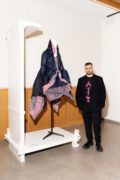

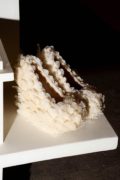
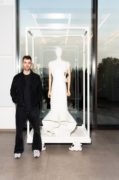
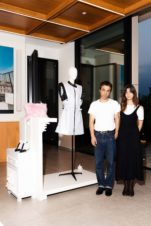
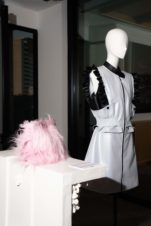
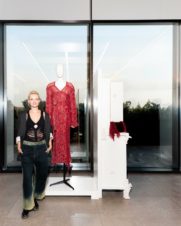
“We often talk about emerging designers as the fashion of tomorrow, but in realitythey are already defining the fashion of today,” Cantarini explains. “Supporting them means investing in the most experimental, curious and courageous part of the industry: the part most willing to explore new materials and to challenge established creative methods.”
The curator openly embraces the decision to unsettle the participants: “For Wardrobe Edition we selected designers from all over the world and invited them to step outside their usual territory: we asked those who work in ready-to-wear to create a bag, while we entrusted footwear and accessory designers with developing a total look. By reshuffling the deck, we wanted to open up new creative possibilities and encourage each of them to engage with a language they had not yet explored.”
Yet this is more than a stylistic exercise. For Cantarini, the curatorial vision must hold experimentation and identity together: “At the same time, the project celebrates the cultural roots and individual identities that define each brand, along with the strong female presence that distinguishes this new generation of talent.”
Ten voices, a global map of references
The line-up reflects this plurality. The designers are Ayham Hassan (Palestine/United Kingdom), BHUMI (the Netherlands), Giuseppe Buccinnà (Italy), Invasive Modification (Georgia), Lorenzo Seghezzi (Italy), MATHO (France), Maximilian Raynor (United Kingdom), OMÔL (France/Cameroon), QUINE LI (China/United States) and Srushti Patil (India). The selection criterion is the same one that has guided S|STYLE from the start: the strength and desirability of the design must go hand in hand with lower-impact choices in research, materials and processes.
The project’s second protagonist is the Material Innovation Lab, the research centreKering established in Milan in 2013. The MIL provided next-generation materials and solutions, with particular attention to non-leather alternatives for bags, footwear and accessories. The line-up of materials is that of a fashion industry looking towards biotechnology. Ayham Hassan and Lorenzo Seghezzi worked with Lunaform by Gozen, a 100% bio-based material made from nanocellulose produced through fermentation. MATHO used Ephea® by Sqim, which is grown from mycelium. QUINE LI and Srushti Patil explored Brewed Protein™ by Spiber, a protein fibre obtained through fermentation. Giuseppe Buccinnà chose Innovera by Modern Meadow, crafted by Pasubio into suede- and nappa-effect finishes. OMÔL adopted Elevate by Uncaged Innovations, a 95% bio-based nappa-effect material derived from cereal by-products. Maximilian Raynor brought to the presentation the organic raffia of Made for a Woman, a women-led enterprise based in Madagascar.
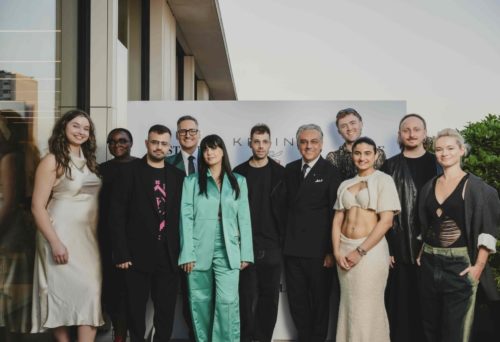
“The wardrobe that emerges is collective, hybrid, sculptural, surprising,” observes Christian Tubito, Director of the MIL. Tubito also places the project within the group’s strategy, which aims to reduce its dependence on leather by 30% by 2028.
A collective walk-in closet – a special set up by artist Mariano Franzetti
The creations were brought together in a presentation conceived as a collective walk-in closet: a wardrobe to walk through, where different identities, cultures and disciplines coexist within a shared vision of fashion as a space for research and responsibility.This is perhaps the image that best captures Cantarini’s work. In six years, S|STYLE has hosted more than 50 designers. Some have gone on to become key players on the global scene, winning awards and securing international distribution. Thanks to its alliance with Kering, the platform increasingly works as an incubator rather than a mere showcase, offering access to materials, mentoring and visibility with press and buyers. With Wardrobe Edition, the curator raises the bar. Showing the fashion of the future is not enough for her: she wants to prove that a coherent vision can run through every element of what we wear.
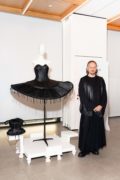
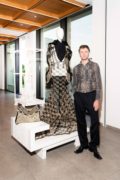
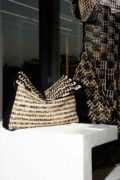
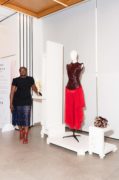
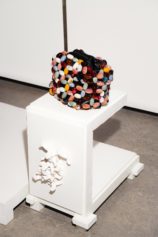
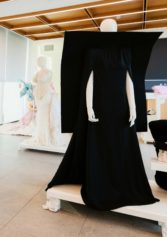
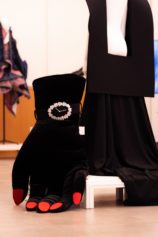
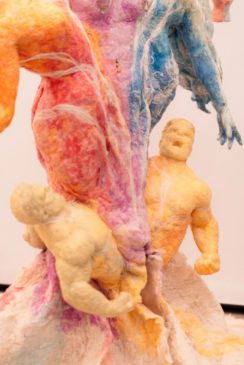
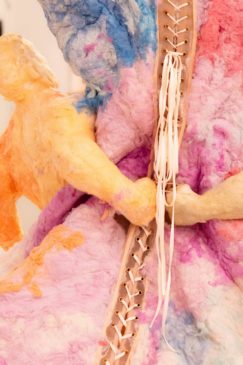
Last but not least the project stands out for the unique set design is by Mariano Franzetti. The walk-in closet is conceived as an open pathway, a shared wardrobe in which the ten proposals sit side by side, with no hierarchy between garment, bag and shoe. The space gives physical form to Cantarini’s curatorial idea: visitors do not look at individual pieces, they walk through a wardrobe conceived as a whole. Born in Argentina, Mariano Franzetti studied Architecture at the Universidad Nacional de Córdoba before moving to Italy, drawn by the masterpieces of the Renaissance. His practice spans ceramics, bronze sculpture, painting, tapestry, bas-relief and textiles, driven by constant experimentation with techniques and materials. In his work, hyperrealism meets irony and the iconography of childhood (puzzle pieces, building bricks, toy soldiers) to explore the contradictions of contemporary life.