
Place an introvert in the spotlight, and he will still find a way to sing from the shadows. Thirty years ago, Jay-Jay Johanson poured Whiskey, his first album, alongside the same stage companions he still tours the world with today. Weaving together a constellation of influences – from trip-hop and vintage jazz to film noir soundtracks – he transforms private ghosts into a universal rhythmic melancholia. Usually sporting his Comme des Garçons uniform, Johanson extends a gentle yet thorny invitation to drift into our own depths. He is a member of the ASVOFF 2026 jury.
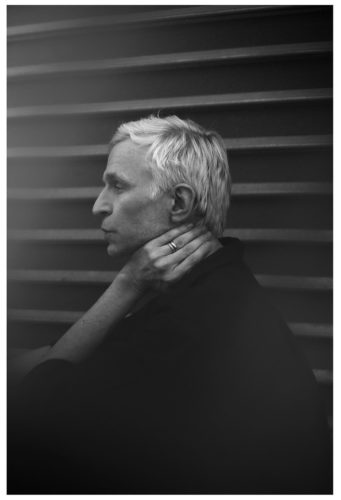
Jay-Jay. A doubled name like a quiet echo, first bouncing off an abandoned piano in an empty flat. Johanson was just a child when his family relocated to central Sweden. “I think that apartment changed the course of our lives. My sister went on to work at the Opera, my brother played the cello, and I entered music.” Lessons started at six, but classical discipline quickly collided with his early, flamboyant aesthetics. A self-proclaimed manicurist, he turned his long nails into canvases for miniature portraits of Marilyn Monroe, the Eiffel Tower, or the Mona Lisa. The constant clicking on the keys exasperated his piano teacher. By ten, swept up by punk, “with classmates, we formed a band called Nej Tack,” (meaning No Thanks). Soon after, MTV arrived, bringing the electric pulse of breakdancing and electric boogie. The teenager spent hours practicing in front of the television until, at sixteen, he was teaching street dance to local kids. “I wasn’t very good, but I was the only one!” he laughs. « It was during one of these classes that he met an eleven-year-old boy named Erik Jansson, who was as obsessed with Chopin as he was with hip-hop. A complementary meeting of minds that sparked a lifelong brotherhood that still drives his band today.
Growing up in provincial Sweden, Johanson spent his teens taking whatever local jobs were offered to fund his escapes: tending graves at the cemetery, assisting at the butcher shop, or developing prints in a photo studio. Saving his summer and winter wages, he and a friend boarded a ferry at fifteen for a grueling, twenty-four-hour crossing of the North Sea. “My parents just said, ‘See you next week!'”. They arrived in London with no map except the pages of i-D, The Face, or Smash Hits. Waiting outside legendary clubs, the tall, fair-haired Swedish boy was always picked out of the crowd and ushered straight past the velvet ropes.
“I never thought of myself as a front figure, until I realized my lyrics were too private for anyone else to sing.”
The decisive shift came in April 1994, with Portishead’s Dummy. Intrigued by its slow, cinematic pulse, he began playing his vintage jazz records at a calmer speed. “I told myself, this is the modern way of playing my music!” he recalls. Working with samplers before home computers were ubiquitous, he hunted for beats and grooves hidden inside old records, horror film soundtracks, and vintage TV shows. Yet when a record deal followed, he had no intention of stepping up to the microphone. “I was never the loud one in the group. When I had the record deal, I even asked who was going to sing.” It was only when he wrote “The Girl I Love is Gone” that he recognized the lyrics were too intimate to hand over to a stranger. Singing in English, which he had learned from the age of seven in Sweden where television was never dubbed, provided a necessary, elegant distance: “If I sang in Swedish, it would be too much for me. With English, I can hide behind this distance.” On Whiskey, he borrowed Chet Baker’s breath on one track and Frank Sinatra’s phrasing on the next, trying on vocal masks before finding his own voice four years later on Poison – and taking another decade to feel fully at ease on stage. Every Friday, he would walk to the record label to collect hand-written letters from listeners, discovering how his private catharsis resonated worldwide.
“My very first stop in Paris was not a tourist monument. It was the Comme des Garçons boutique.”
When Johanson first arrived in Paris at 28 to present Whiskey, he rushed into the CDG store “to breathe in the atmosphere.” That immediate reverence grew into an enduring bond. Years later, he walked straight into CEO Adrian Joffe’s office to introduce himself and handed him a new CD. Joffe answered him with a bottle of perfume, sealing a relationship that turned the brand into Johanson’s permanent, protective daily uniform. And France embraced him immediately, with three sold-out shows at the historic Olympia and the cover of Les Inrockuptibles. This musical trajectory ran parallel to a rich fashion dialogue. Composing music for runway shows back in the 1990s, his first meeting took place in the office of French designer José Levy, who launched his eponymous menswear label in 1989 before later directing menswear at Emanuel Ungaro. There, Johanson struck up a conversation with “the shyest person in the room”, a young Hedi Slimane. The designer once sent him a handwritten letter in such cryptic writing that Johanson couldn’t decipher a word. “One day on tour, I met someone who could read medical stenography and he finally decoded Hedi’s note!” The message was warm, celebrating Johanson’s career and expressing delight at seeing him wear his designs. He performed in Prada for his second album, and for Lemaire during his third tour. In 2023, Demna invited him to walk in Balenciaga’s family and friends show during Paris Fashion Week, where Diane Pernet also walked. Isabelle Huppert recited the voice-over, while fashion critic Cathy Horyn walked too.
“Diane Pernet is a magnet for wonderful minds, and ASVOFF is our shared home.”
Sharing the car ride to the Balenciaga show, Johanson and Diane Pernet discovered a mutual friend in Anita Sarco, the pioneering 1970s New York female DJ turned Interview Magazine journalist. Invited by Pernet to serve as president of the ASVOFF 2023 jury, Johanson reached out to Twin Peaks actor Harry Goaz, inviting him to join his jury. Goaz traveled to Paris after thirty years, spending quiet early mornings walking through the Marais alongside Johanson. “I am very excited to be part of the festival again, to meet other jury members and to discover the films, especially the Black Spectrum category, always incredible.”
Thirty years after pouring his first album, Johanson still tours with the exact same core trio: his lifelong friend Erik on piano, and Fredric on drums, joined on larger stages by Jeff on bass. Their coming months are dedicated to recording their next studio album, set for release next March, with fifteen new songs in progress. Three decades after embarking on his musical journey, Jay-Jay Johanson remains a figure of quiet elegance and modesty, forever translating his private ghosts into a universal shelter.
