
From the desert of southern Israel to Tel Aviv, London and Milan, Avshalom Gur’s career has been shaped by different cultures, cities and creative environments. Trained at Shenkar and Central Saint Martins under Louise Wilson, he has worked with Donna Karan and Roberto Cavalli, relaunched Ossie Clark and is today Creative Director of Maryling. For Gur, creative direction is not about imposing a personal signature, but understanding a brand’s DNA and helping it evolve. We speak to him about the cities and people that shaped his vision, the new global fashion landscape and the role of creativity in an age of AI.



What do you still carry with you from Shenkar and Tel Aviv?
Studying at Shenkar was a very special period in my life. I grew up in a small village in southern Israel, near the Dead Sea, surrounded by the desert, its colours and extraordinary light. I also grew up alongside Bedouin communities and was fascinated by their textiles and embroidery. Those images quietly became part of my visual language. Moving to Tel Aviv was a complete eye-opener. I lived in a converted warehouse in Florentin, surrounded by artists, small factories and an incredible mix of cultures. There were constant juxtapositions between old buildings, the Mediterranean, different social realities and contemporary creativity.Shenkar taught me to research, question and develop narratives around ideas. The energy of Tel Aviv and the curiosity Shenkarencouraged are still at the heart of what I do.
You studied under Louise Wilson at Central Saint Martins. What remains with you from her teaching?
Louise Wilson was a visionary. I still remember my interview with her when she looked at me and said, “I must be crazy, but I’ll give you a place.” She taught us never to accept the word no, to question everything and push further than we thought possible. She also taught me that perfection isn’t about endlessly chasing an impossible ideal. It is about giving something everything you have and then having the confidence to let it go.Most importantly, she changed my understanding of the Creative Director’s role. It isn’t simply about designing collections; it is about creating a vision that an organisation can believe in and build upon.
You also relaunched Ossie Clark. What did that experience teach you?
It taught me the difference between being an artist and being a designer. I wasn’t trying to express myself; I had to understand somebody else’s vision. I was given vintage garments, archive photographs and fragments of history. I spent months studying them, putting them on models, drawing them and watching how they moved. It became almost like solving a beautiful puzzle.Sometimes the designer’s role is to respectfully enter somebody else’s world, understand its philosophy and reinterpret it for a new generation without losing its soul.
London is often seen as the capital of experimentation, while Milan is more commercially driven. Do you still see that distinction?
I still believe London is the capital of experimentation. It is an extraordinary melting pot where talented people from around the world come to study, exchange ideas and challenge each other.When I started in the early 2000s, young designers could work with very limited resources and still make an impact. London felt like an ideas factory. Milan represents something different. It combines creativity with Italy’s extraordinary manufacturing heritage, craftsmanship and technical knowledge. It is a more organised and commercially focused ecosystem, but it has also become increasingly open to experimentation.For me, every city has its role. London is where ideas are born. Paris refines luxury. Milan combines craftsmanship with industry. New York understands how to build brands.
You worked with Donna Karan and Roberto Cavalli. What did you take from those experiences?
They were very different worlds, but I actually saw important similarities. Both had enormous respect for women and the female body. Donna taught me to look beyond fashion, at museums, sculpture, architecture, ceramics, craftsmanship and different cultures. Roberto taught me the emotional power of colour and print. What stayed with me was the understanding that every brand has its own language. My responsibility has never been to impose my own style, but to understand that language and help it express itself in the strongest possible way.




How does your approach change when you are the Creative Director rather than a consultant?
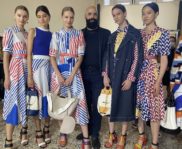
Actually, not very much. I always begin by listening, researching and immersing myself in the organisation. I want to understand the founder’s vision, the product, the customer, the culture and, above all, the people.As Creative Director, the responsibility is obviously greater. At Maryling, for example, around two thousand people are connected to the decisions we make, from product development and production to merchandising and retail.
I’ve often been described as a “brand doctor”, but I believe in evolution rather than revolution. Every organisation has its own DNA and strengths. My role is to understand those strengths, bring talented people together around a shared vision and help the brand evolve without losing its identity. Ultimately, designing collections is only one part of the job. Great brands are built by people, not by one individual.
What have you learned from working with Maryling about Asia and European luxury?
When I started working with Maryling around fifteen years ago, Europe still tended to see Asia primarily as a manufacturing destination or emerging luxury market. That has completely changed.Asian customers today are highly knowledgeable. They understand quality, craftsmanship and authenticity and expect much more than simply a European label. European luxury has to have meaning, integrity and a genuine story. I have also seen a new generation of Chinese entrepreneurs, designers and creative leaders emerge. Many studied in London, Milan, Paris or New York before returning home to reinterpret their own culture and craftsmanship. That meeting between global education and local heritage is what makes China such an exciting creative force.
What do you think about other growing markets like India for fashion and craftsmanship?
I think India is becoming one of the most important players on the global fashion map. Whatinterests me most is the investment in home-grown designers and their international development without asking them to abandon their identity. India doesn’t need to invent craftsmanship. It already has extraordinary textiles, embroidery, weaving and artisanal knowledge. The challenge is finding contemporary ways to present that heritage to a global audience without compromising its authenticity. For the first time, we’re seeing serious investment in home-grown Indian designers and helping them grow internationally without losing their identity.Designers like Anamika Khanna are a wonderful example. The ambition isn’t to turn them into Western brands. It’s about giving them the infrastructure, partnerships and licensing opportunities to scale while remaining true to what makes them unique.
How do you see the role of the Creative Director evolving in the age of AI?
I actually think human creativity is becoming even more valuable. People are no longer simply buying products; they are buying into a world, a culture and a point of view. That makes the role of the Creative Director increasingly important. Craftsmanship, cultural knowledge, travel, observation and understanding how products are made cannot simply be replaced by technology.Technology will continue to evolve. But imagination, craftsmanship and human generosity will always remain at the heart of great design.
You have been closely connected to the British fashion scene for many years. Are there talents you supported or worked with early in their careers whom you have seen grow and establish themselves internationally?
Bora Aksu is a particularly meaningful example. We studied together at Central Saint Martins, and he has remained completely loyal to his own language for more than two decades. He has created a very distinctive world without being distracted by trends. Fashion is full of highs and lows. To maintain a strong voice and build a career with real longevity is, to me, the greatest success.I have also taught at Central Saint Martins, PolyU in Hong Kong and Aalto University in Helsinki. Seeing young people discover where their talent belongs is one of the most rewarding parts of what I do.
How do you compare Milan and London today?
I love both cities, but they represent very different fashion ecosystems.London remains an extraordinary place for ideas and emerging talent. When I started, you could make a collection with almost nothing — some fabric, an idea and a lot of energy. There was something wonderfully raw and inventive about it. Milan offers a much deeper connection to manufacturing, craftsmanship and technical expertise. Its fashion system is highly professional, from production and casting to backstage and show execution. London gives you permission to invent, while Milan has the machinery and expertise to transform that invention into a global proposition.
