
Jordana Guimaraes and Christopher Hunt talk about the birth of a community that wants to redefine the way fashion engages with art, sport, film, philosophy, and business.
It’s often said, when discussing the future of fashion, that the industry’s biggest shifts rarely originate from within fashion itself — they come from outside it. From music, film, art, sport, philosophy. It’s from this premise that *Fashion Forward* was born: a new cultural community founded by *Jordana Guimaraes, co-founder of the global network Fashinnovation, and **Christopher Hunt*, artist, musician, and creative director.
Not an event. Not a networking club. Not another industry conference with a beginning, an end, and a list of sponsors. Fashion Forward positions itself instead as a long-term cultural institution, designed to keep alive the conversations that usually fade out once Fashion Week ends or the lights on a panel go down.



THE PROJECT: THE HOUSE OF FASHION FORWARD
The project revolves around a concept that is as simple as it is ambitious: continuity. Guimaraes and Hunt describe having long asked themselves what would happen if the most interesting conversations — the ones that happen by chance, between people who on paper should never have met — didn’t have to end. That’s how *The House of Fashion Forward* came to be: the community’s digital and physical home, officially launched in the summer of 2026. The program runs along two tracks. Online, with monthly Founding Conversations and the magazine Around the Table, conceived as a space for reflection rather than reporting. Offline, with intimate dinners held in cities around the world: the first in New York in September, followed by Milan and London — not crowded conferences, but curated tables where every presence has been chosen for the contribution it can bring to the conversation, not for its title.
The Fashion Forward community spans eleven disciplines — fashion, art, film, music, sport, media, business, academia, philosophy, architecture, and culture — held together not by an affinity algorithm, but by a deliberately human criterion: a person’s ability to make a conversation richer. Among the first to join as Founding Advisors are *Sara Sozzani Maino* (Sozzani Foundation, for decades one of the most authoritative voices in discovering new talent), *Oskar Metsavaht* (founder of Osklen and UNESCO Goodwill Ambassador, a pioneer of sustainable luxury), and *Gabby Gabriel* (founder and CEO of GAB Inc., global cultural strategist) — three very different paths, chosen precisely for the distance between their perspectives rather than for their fame.
More recently, *Leonardo Lawson*, founder of BOND Creative MGMT, has joined them, while the Honorary Founding Members include profiles ranging from sport to art, from design to academic research — confirming that the stated ambition isn’t to build a club of fashion insiders, but a place where fashion is just one voice among many.
Just a few months after launch, the community’s growth has already exceeded the project’s initial expectations: the founding voices have reached 50, spanning fashion, art, sport, music, media, business, design, education, philosophy, manufacturing, and wellbeing. To mark the milestone, Guimaraes and Hunt are launching *50 Voices. 50 Connections*, a program of personally curated introductions between members across disciplines.
The calendar fills out further in the fall: on September 2, *Behind Closed Doors — 001* debuts — a format with no audience, no stage, and no recording, bringing together eight members from eight different worlds around a single question: what are we pretending isn’t changing? On September 17 in New York, the community will gather around a physical table for the first time for the inaugural *Founding Dinner*, exploring the evolution of culture: what happens when industries stop evolving on their own.
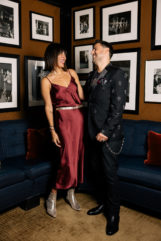


IN CONVERSATION WITH JORDANA GUIMARAES AND CHRISTOPHER HUNT
How did the project come about?
“The starting point of Fashion Forward is that the future of fashion is shaped through culture.” Why are traditional fashion spaces no longer enough, and why is cross-industry collaboration necessary today?
One of the things I’ve realized over the years is that fashion has never evolved in isolation. When you look back at the moments that truly changed our industry, they were almost always influenced by something happening outside of fashion — art, music, architecture, film, philosophy, sport, even politics and science. Fashion has always been a mirror of culture. The challenge today is that many of the places where we come together have become temporary. We meet during Fashion Week, at conferences, at events, we have wonderful conversations, and then everyone goes back to their own world. Those conversations often end before they’ve had the chance to become something meaningful.
Christopher and I kept asking ourselves, “What if those conversations didn’t have to end?” That’s really where Fashion Forward began. We wanted to create a permanent home where people from different disciplines could continue learning from one another throughout the year. Because I genuinely believe the future of fashion won’t be shaped by fashion alone — it will be shaped by culture.
You emphasize that Fashion Forward “is not another conference, networking platform, or exclusive club.” How do you define a cultural institution, and what innovation does Fashion Forward bring?
For me, a cultural institution isn’t defined by the size of its audience or the number of events it hosts. It’s defined by its ability to bring people together around ideas that continue to evolve over time. There are already wonderful conferences and networking events in our industry, but they naturally have a beginning and an end. Fashion Forward wasn’t created to replace them. It was created to exist in the spaces between them.
The innovation isn’t technological. It’s human. We’re creating continuity. A place where conversations don’t disappear after one evening, where relationships have the opportunity to deepen over months and years. I think that’s something our industry has been missing.
In concrete terms, what will your online and offline programming include?
Today we’ve officially opened *The House of Fashion Forward, our digital home. Every month we’ll host *Founding Conversations, bringing members together around topics that extend well beyond fashion itself. We’ll also continue publishing our editorial journal, Around the Table, because we believe reflection is just as important as conversation. Offline, we’ll host intimate dinners and gatherings around the world. Our first dinner takes place in New York in September, followed by Milan and London. These won’t be large conferences or networking receptions. They’ll be thoughtfully curated evenings where everyone in the room has been invited because they bring a unique perspective to the conversation.
The community brings together 11 distinct disciplines. How do you select members to ensure genuine chemistry?
We never start with titles. We start with curiosity. When Christopher and I discuss inviting someone, we rarely ask, “How influential is this person?” Instead, we ask, “Will this person make the conversation richer?” Sometimes that’s a globally recognized CEO. Other times it’s an emerging designer, an educator, a filmmaker, or an artist. We aren’t trying to gather people who all think alike. We’re trying to create an environment where different perspectives naturally inspire one another. I’ve found that the most interesting conversations usually happen between people who, on paper, would never have been expected to meet.
Your manifesto puts relationships before transactions. How do you create that environment?
I think culture is shaped by what you choose to reward. If people walk into a room believing they’re expected to promote themselves, that’s exactly what they’ll do. If they walk into a room where curiosity is valued more than self-promotion, the entire dynamic changes. From the beginning we’ve wanted Fashion Forward to feel more like someone’s home than a networking event. That’s why we call it “The House.” It’s a place where people can arrive as themselves, listen generously, ask thoughtful questions, and allow relationships to develop naturally. Ironically, it’s when people stop trying to network that the most meaningful collaborations begin.
Why these particular Founding Advisors?
We weren’t looking for advisors with the same background. We were looking for people who each represent a different way of thinking about culture. Sara Sozzani Maino has spent decades discovering and nurturing new creative talent. Oskar Metsavaht has shown that fashion can engage deeply with sustainability, philosophy, and environmental responsibility. Gabby Gabriel understands the power of storytelling and community. Each brings a completely different perspective, and together they reflect exactly the kind of interdisciplinary thinking we hope to encourage throughout Fashion Forward.
How do you plan to scale globally while keeping the experience intimate?
I don’t think about growth first. I think about quality first. There will always be opportunities to make something bigger. The harder part is preserving the feeling that every person belongs in the room. That’s why our dinners will remain intentionally intimate, regardless of the city. I’d rather host ten meaningful conversations around the world than one enormous event where people leave without truly connecting.
Jordana: how do you shape the project’s cultural narrative?
Throughout my career I’ve realized that bringing the right people together is one of the most meaningful things I can do. As Chief Curator, I don’t see my role as simply inviting remarkable people. My role is creating an environment where those people feel inspired to share generously, to challenge each other respectfully, and to keep showing up because the conversations truly matter. To me, curation isn’t about exclusivity — it’s about intentionality. Every person inside the House influences the culture we’re creating together.
Christopher: how do you translate imagination into experience?
Creativity isn’t something you add at the end — it has to exist from the very beginning. Everything we’ve designed, from the visual identity to the language we use to the spaces we’re creating, is intended to encourage people to slow down, become present, and remain curious. We hope every interaction inside Fashion Forward feels thoughtful rather than rushed, intimate rather than transactional. Design, in this case, isn’t decoration. It’s part of the experience of bringing people together.
