Dear Shaded Viewers,
A love letter, of sorts, to an old friend — and a look at his new mural for Historic New England
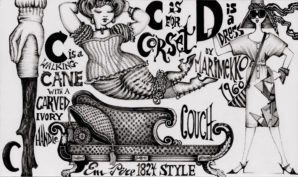
There is a particular kind of New York artist who seems to have arrived fully formed — pencil in hand, eye already trained on the absurd poetry of everyday objects — and Ruben Toledo was that artist even in the 1980s, when I first crossed paths with him in a downtown scene that was smaller, scrappier, and somehow more serious about beauty than it is today. I was designing my own line then; Ruben was already drawing the world the way he still draws it now — fashion not as commerce but as a private mythology, corsets and couches and eyeglasses rendered with the same reverence a medieval scribe might give a saint.
So it means something to me, watching from Paris decades later, that Ruben has taken on the role of Historic New England’s first ever artist-in-residence — because what he is doing at the organization’s new Center in Haverhill, Massachusetts, is exactly what he has always done: turning an archive into a living thing.
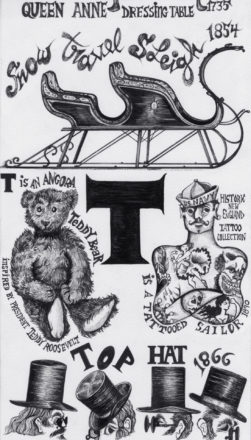
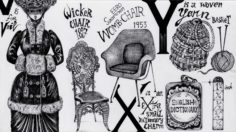
An A-to-Z of everything
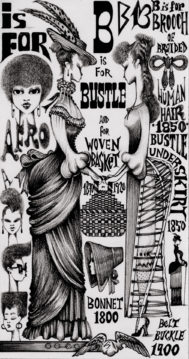
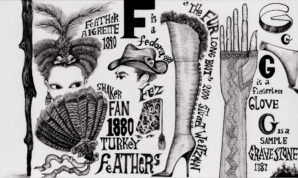
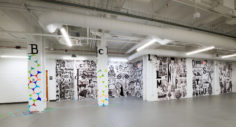
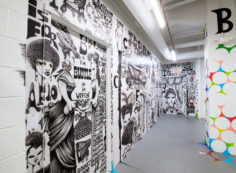
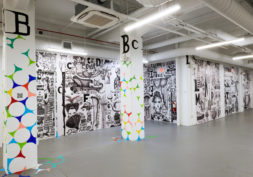
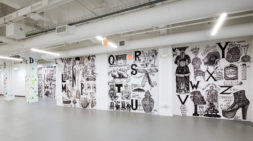
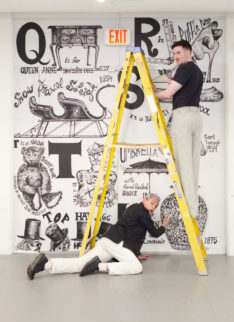
Historic New England holds the largest collection of its kind in the world — more than a million objects tracing the region’s design history, from Empire-style settees to Eero Saarinen’s Womb Chair. Rather than let that collection sit “behind glass,” as the organization puts it, Ruben has spent months working with curators Nora Ellen Carleson and Michelle Tolini Finamore to build an immersive, floor-to-ceiling mural: a visual encyclopedia running literally A to Z, in which a corset becomes “C,” a lighthouse becomes “L,” a Marimekko dress becomes “D.” It is, unmistakably, the same alphabetical instinct that animated his 1997 book Style Dictionary — an artist’s compulsion to catalog the world by the objects that define it, and to find something tender or funny in every one of them.
The mural unveiled to the public on July 25, following four days of workshops, master classes, and open community painting sessions — because Ruben has never believed a mural should belong only to the artist who starts it. Local residents, including artists Jennifer Arndt and Mark Hayden, are painting alongside him, turning the piece into something the whole town of Haverhill will have a hand in. It’s a generous, almost old-fashioned idea of what public art is for, and it suits him.
A longer memory
I’ll admit my interest here isn’t purely journalistic. Back in the early 2000s, when I launched my very first fashion film festival, You Wear It Well, in Los Angeles, one of the films in that inaugural program was Ruben’s own ABC of fashion — his alphabet, already, years before Haverhill’s. Watching him return to that same structure now, at this scale, on behalf of an institution as venerable as Historic New England, feels less like a new project and more like a long private idea finally finding the room it always deserved. I remember, too, that Italian Vogue gave his work a warm notice around 2006 — I haven’t been able to track down the clip itself, so if anyone has it tucked away, I’d love to see it again.
Ruben and I also share a memory further afield: his and Isabel’s first trip to Japan, which I was lucky enough to be part of. Watching him encounter Tokyo for the first time — a city already so attuned to the graphic, exacting eye he draws with — was its own kind of education in how he sees.
And, gently, the other half of the story
It is impossible to write about Ruben without writing, at least briefly, about Isabel — his wife, his collaborator, and for thirty-five years the other half of an artistic partnership that both of them always described as inseparable. Isabel passed in 2019, and anyone who knew them, even a little, knew that theirs was not a marriage that produced separate careers running in parallel — it was one long conversation, conducted in fabric and ink. I won’t pretend to know what the years since have been like for him, and I don’t think it’s my place to ask him to describe it. But I don’t think it’s wrong, either, to say plainly that the loss must have been enormous, and that there is something quietly moving about watching him keep building — murals, residencies, new alphabets — in a city that isn’t New York, for a public that never knew the Toledos in their downtown heyday. It reads, to me, like a way of keeping the conversation going.
The Haverhill mural opens to the public on July 25. Full program details are available at historicnewengland.org.
Later,
Diane
