


















Dear Shaded Viewers,
There is a particular kind of quiet confidence in a brand that spends a decade dressing hotel staff, hospital teams, and event crews before it ever thinks to call itself fashion. WANSIE is exactly that brand, and its SS27 collection, Ephemeral Currents, is the clearest statement yet of what happens when uniform-making is treated as a discipline rather than a category.
If the name is unfamiliar, that is by design as much as by geography. WANSIE began in 2014 in Tokyo as WANSIE UNIFORM, founded by Masahiro Hirota and Shogo Kurihara to design and manufacture corporate workwear — the clothes worn behind the scenes at hotels, hospitals, construction sites, and by event staff for luxury maisons. That experience, watching how real bodies move through real working days, became the foundation for WANSIE’s ready-to-wear line, launched in 2019 with Tokyo- and Paris-based art director and stylist Shinya Kuraoka at the head of design.
The result is a label fluent in technical tailoring but uninterested in costume: garments built from the logic of uniforms — reinforced pockets, drawstrings, zip closures, collar constructions borrowed from service wear — reworked into something loose, wearable, and quietly directional. In Japan, WANSIE has built a genuine following on that premise. In Europe it remains something closer to an insider’s name, shown in Paris and represented by Autrement PR, stocked in pockets rather than everywhere, which is precisely what makes it worth writing about now rather than after everyone else has caught on.
Ephemeral Currents takes its cue from the dragonfly — a creature born near water, its wings translucent enough to carry light through them, moving without apparent effort between rice field and open sky. WANSIE reads the insect as a kind of proof of concept: something light, agile, and enduring, built for both stillness and sudden movement. Translated into clothing, that becomes workwear loosened for urban life — functional without being severe, playful without losing its structure.
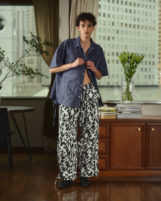
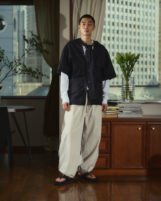
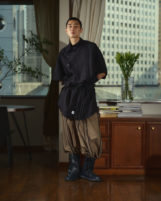
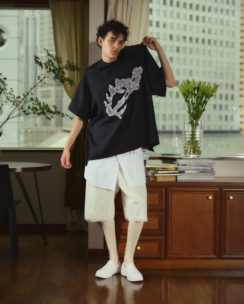
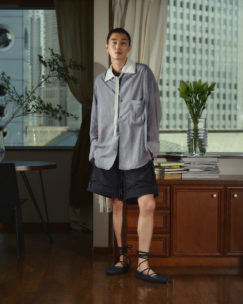
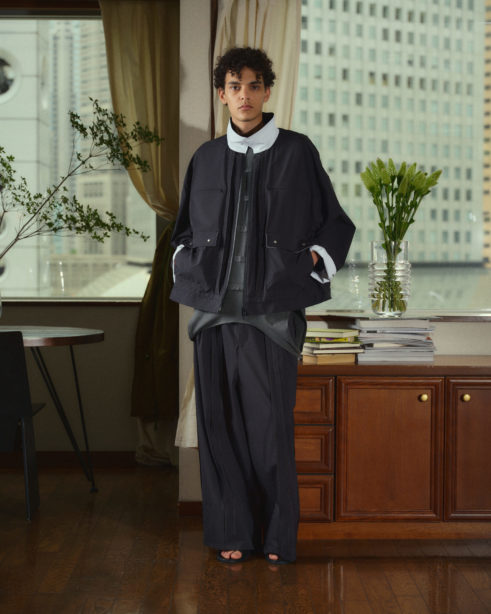
The palette stays disciplined — khaki, ecru, charcoal, navy, black, with a single black-and-white botanical graphic doing the work of pattern — so that the ideas show up in construction instead of print. Drawstrings gather and release at hems, hoods, and side pockets like something being cinched mid-motion. Sheer mesh grids and voile shirting let the body show through the way light passes through a wing. Oversized zip jackets, apron-front shirting, and drawcord-hooded pullovers sit on top of wide, drop-crotch trousers, ballooned cargo shorts, and pleated wide-legs, most of them finished with a drawstring or toggle at the ankle — the kind of detail that reads as pure uniform logic until you notice how deliberately it has been softened.
Footwear tracks the collection’s on-duty/off-duty premise almost literally: polished loafers and lace-up ballet flats for the tailored moments, rubber rain boots and clog-slides for the utilitarian ones, flip-flops in between. It is a small detail, but it is the one that makes the whole thing legible — this is a collection about the wardrobe of someone who moves between registers in a single day, and dresses for the transition rather than for either extreme.
There is a lace eyelet bandana that turns up on more than one look, tying the collection’s most technical pieces — crinkled nylon jackets, sheer mesh shorts, drawstring tunics — back to something handmade and almost domestic. It is a good shorthand for WANSIE as a whole: a brand that can cut a technical jacket with real precision and still wants you to notice the knot.
WANSIE is not chasing workwear as trend — it has been living inside workwear’s actual function for over a decade, and Ephemeral Currents reads like the payoff of that patience. For a European audience still discovering the label, this is a good season to start paying attention: the ideas are fully formed, the craftsmanship is unmistakably Japanese, and the price of discovery, for now, is still low.
Later,
Diane
