
Paris Photo 2026 — On ancestry, memory, and the art of being seen.
A photograph holds the fragments of memory that time leaves behind. A gesture, a face, a segment from ancestry. It can preserve the tenderness of a fleeting moment, carry the weight of an inherited history, or give form to memories we never lived but somehow recognize as our own. Somewhere between the visible and what seems tangible, photography becomes more than an image. It becomes a language of belonging, a conversation with our ghosts, a way of reclaiming what history has conveniently forgotten. Preach.
And then, of course, there is Paris Photo. Every November, the Grand Palais becomes a fascinating ecosystem of collectors, artists, curious wanderers, and people whose primary artistic pursuit appears to be locating the champagne—an art form in itself. Abundance as a form of ultimate motto, certain images seemed to follow me from one booth to another. Moral of the story: five hours later, I was still there, haunted by the profusion of visual episodes of subtle defiance.
From Tunisia to Kenya, South Africa to the Democratic Republic of Congo, with detours through Réunion and the Caribbean, a remarkable chorus of voices emerged across the fair.
Not one narrative, not one aesthetic, and certainly not one convenient definition of African identity. Thankfully, an entire continent and its diasporas remain far too complex to fit into the art world’s favourite categories. Yet, across these different visual languages, I kept finding unexpected connections. Ancestry transformed into ornament. Colonial histories confronted through humour. Black femininity reclaiming the frame.
8 artists, countless visual contradictions, and a recurring fascination with the politics of being seen. These are the works that made me stop, look twice, and occasionally forget the time.


01 — Shourouk Rhaiem
A touch of bling is never enough.
193 Gallery
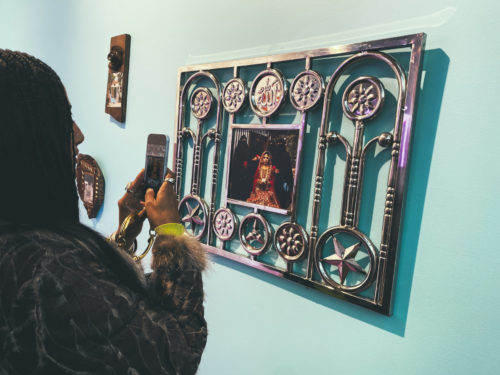
The woman in Shourouk Rhaiem’s portrait has the composure of someone who has kept the entire room waiting and knows the room will forgive her. I kept returning to her headdress. It has the grandeur of a royal portrait and the radiance of a devotional icon. When the Swarovski crystals catch the light, she becomes a glamorous apparition, your aunt’s stunning aura.
In her related series Nuptiae Neapolis, Rhaiem works from wedding photographs kept by her Tunisian family. That detail changed how I looked at the portrait. A wedding photograph keeps the instant everyone was ready. What makes Rhaiem’s approach compelling is the tension between ornament and identity. It becomes a form of storytelling, a way of reconstructing heritage through an aesthetic refusing to separate tradition from contemporary popular culture.

02 — Silina Syan
God, gold, and the iPhone.
Made in Bangladesh — Galerie Fahmy Malinovsky
Among the discoveries in the Emergence sector, Silina Syan stood out for her exploration of belonging and cultural hybridity. Her series Made in Bangladesh originates from her relationship with her family’s country of origin. Photography becomes a means of communicating across linguistic and cultural distance, allowing her to approach a heritage that is simultaneously familiar and foreign.
The image that particularly caught my attention depicts a woman dressed in black, holding a smartphone adorned with decorative details. What fascinates me is the coexistence, overlap, and transformation of one another – a traditional dress meets contemporary technology, while the carefully composed portrait challenges simplistic assumptions about modernity and cultural identity.
03 — Brandon Gercara
Queer ghosts from the Indian Ocean.
Joseph 83, Conversations, 2019 — DS Galerie
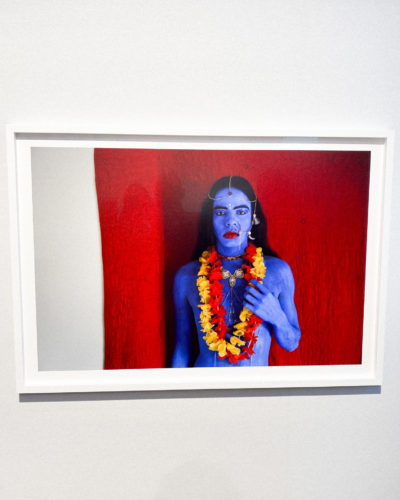
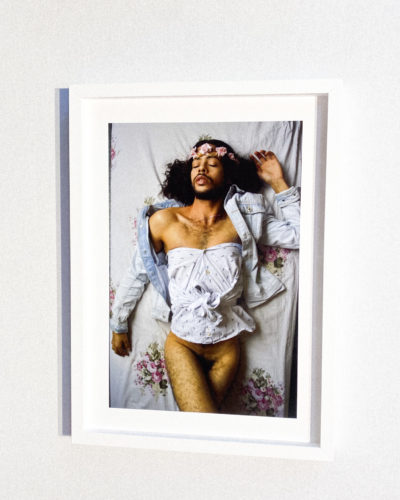
There is a particular kind of violence in being told that your existence is incompatible with your culture. Brandon Gercara responds by inventing new ways of existing within it. Through drag, photography, and performance, the artist explores queer identities in Réunion Island. In Joseph 83, a green figure adorned with pearls appears almost extraterrestrial. What interests me is this refusal of documentary obligation. Why must marginalized communities constantly present their suffering as proof of existence? Gercara proposes fantasy as an archive, transformation as testimony. Sometimes the most powerful way to confront reality is to become something reality cannot classify.

04 — Léonard Pongo
The violence of looking.
The Uncanny, 2011–2017
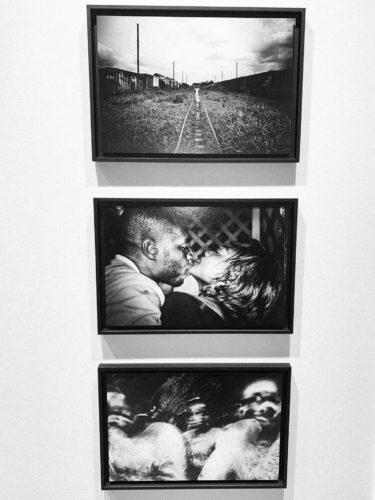
A boxer emerges from darkness, his gloves thrust toward the camera. The grain is heavy, the shadows unforgiving. The image feels like an encounter. Léonard Pongo’s photographic investigations of the Democratic Republic of Congo challenge the conventions of documentary representation. His photographs refuse to explain everything. They preserve uncertainty, movement, and the complexity of realities too often reduced to familiar narratives.
In a world that has made an industry out of explaining Africa to outsiders, Pongo offers something refreshingly uncomfortable: opacity. Not everything needs to be illuminated to exist.

05 — Zanele Muholi
Blackness, beauty, and the politics of being seen.
Aphelile X, Durban, 2020 — Ron Mandos
Zanele Muholi has never been particularly interested in asking for visibility. Their photographs take it. In Aphelile X, an arrangement of toilet-paper rolls becomes an extraordinary sculptural composition. The everyday is transformed into something monumental.
Muholi’s practice challenges the historical erasure of Black LGBTQIA+ communities, turning portraiture into an act of affirmation. What moves me is the coexistence of beauty and confrontation. These images refuse to remain passive objects of admiration. They stare back, give you a chill. And suddenly, the question is no longer who deserves to be seen, but who believed they had the sovereignty to decide.


06 — April Bey
Colonialism, but make it couture.
Colonial Swag — Textile and mixed media
April Bey has imagined a world where the vocabulary of colonial power becomes a luxury commodity. In Colonial Swag, a sharply dressed Black man stands beneath a Royal Crown hair-dressing label, surrounded by purple textiles and monumental golden lettering. Bey transforms the language of colonial power into something glamorous, absurd, and deeply political.
Her Afrofuturist universe imagines Black identity beyond the historical structures that have attempted to define it. After centuries of having their histories written by others, her characters appear to have taken over the marketing department. And the revolution, apparently, comes in purple velvet.
07 — Thandiwe Muriu
Camouflage, chocolate, and the art of refusing to disappear.
The Colour of Chocolate, 2026
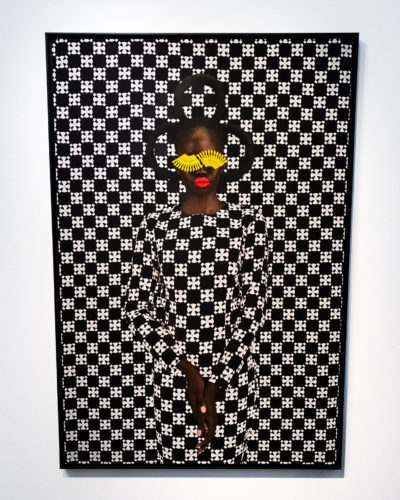
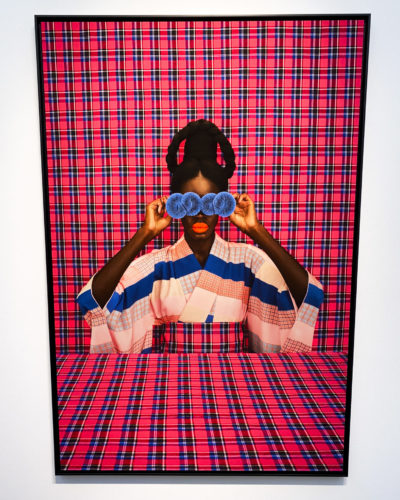
Thandiwe Muriu has mastered the art of hiding in plain sight. In The Colour of Chocolate, a woman disappears into an explosion of red and blue checks. Her clothing merges with the background, while sculptural blue glasses conceal her eyes.
Drawing from African textiles, fashion, and Black hairstyling, Muriu explores the tension between camouflage and self-assertion. The subject appears absorbed by her surroundings, yet commands the entire composition. There is something beautifully ironic about this visual contradiction. After centuries of being made invisible, the Black woman becomes impossible to ignore.
08 — Dimakatso Mathopa
The mirror remembers what history tried to erase.
Individual Being Reclaimed, I & III
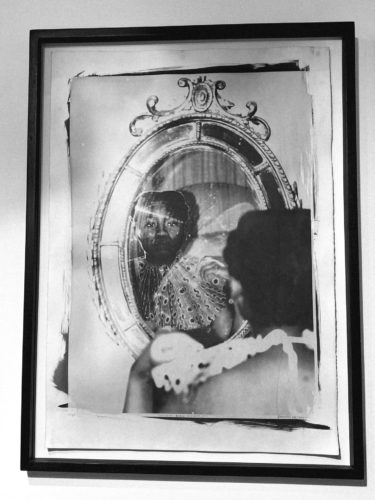
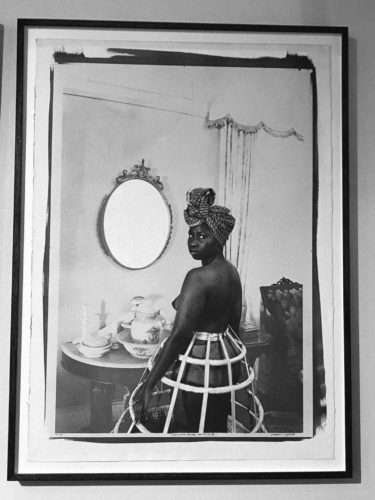
History has a peculiar habit of remembering the furniture and forgetting the people who polished it. Dimakatso Mathopa revisits the visual codes of historical portraiture, placing Black femininity at the centre of interiors reminiscent of colonial domesticity.
A woman stands enclosed within a sculptural cage-like skirt. In another photograph, her reflection appears in an ornate mirror. The compositions are delicate, yet quietly confrontational. The garment becomes both decoration and confinement, while the mirror transforms into an instrument of self-recognition. Mathopa keeps the traces of the past visible. She inhabits it, unsettles it, and reclaims the right to be represented.
Photo Credit Aljaz Babnik
