
Dutch painter extraordinaire Rembrandt gifted the world The Anatomy Lesson in 1632. Seven surgeons in black crane forward, white ruffs, all ears on the good Doctor Nicolaes Tulp, laying bare the tendons in the opened forearm of a pale, sallow corpse. Anatomy lessons were public spectacles then, ticketed, seated, sold out. Almost four centuries later, his compatriot Duran Lantink staged his own in Paris. For his first Haute Couture collection at Jean Paul Gaultier, the Dutchman took the silhouette apart in public, chopped, dislocated, deconstructed, before an audience as riveted as Tulp’s surgeons.
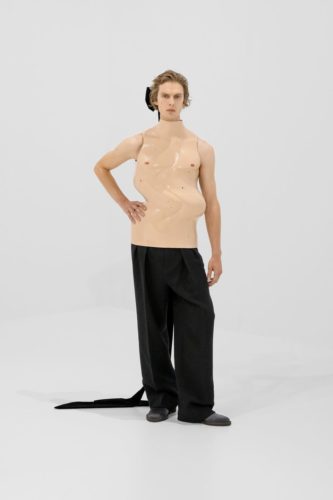
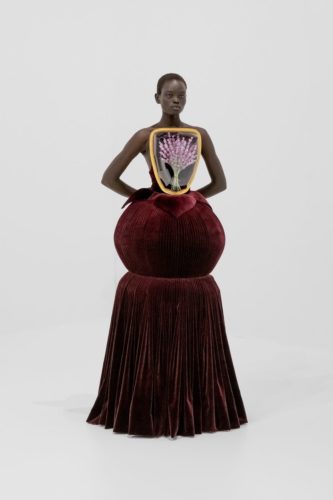
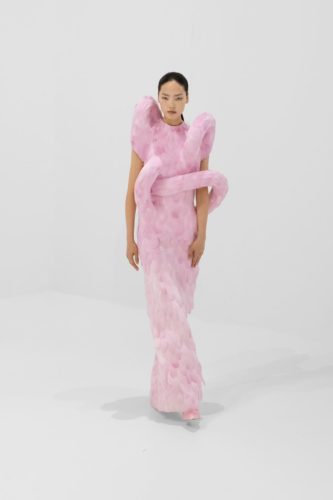
Lantink and his team gave their very own unearthly anatomy lesson. A torso came glitched, gowns split at the hips and let their insides loose, tulle pouring through where the seams gave way. A column of flamingo pink feathers grew tubular coils that wound around the shoulders like limbs of its own. And one burgundy velvet gown wore a gilded glass case over the sternum, a bouquet of lavender sealed inside, the chest turned display cabinet, the organ on show. “I want to challenge the garment itself,” Lantink explained in a statement, “to push it to the very limits of its sculptural potential.” And there lies the true definition of Haute Couture, the one this House has always defended. Couture is not (only) the most expensive way of making clothes. It is the luxury of experimentation itself, the only place where the greatest savoir-faire on earth is put in service of asking what a garment even is, and how far it can be pushed before it becomes another creature.
Every distorted silhouette in Paris this week has earned the same tired caption, a reflection on artificial intelligence. The reflex is starting to grate, as though our collective imagination had shrunk to the size of a chatbot window. As though a garment could no longer be strange without a machine taking the credit. Using AI to make things has already become second nature. Let us at least spare ourselves the habit of using it as a reference for everything we cannot immediately explain. On Lantink’s desk throughout the making of the collection sat a book of the costumes Gaultier designed for choreographer Régine Chopinot, among them the graphic, topiary silhouettes of her 1985 piece Le Défilé. Drawn forty years ago, by hand, for dancers. The strangeness never needed an algorithm. It was in the House’s bloodstream all along.
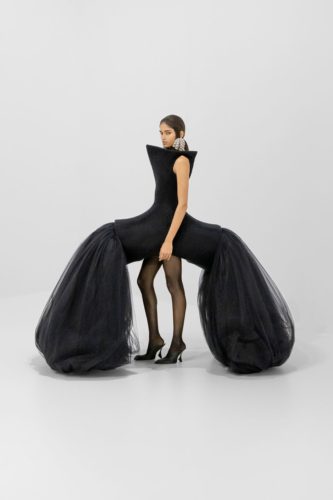
The other ghost in the room wore panniers. Lantink’s main reference was Marie Antoinette, who perfected the art of taking up space, and the collection takes her at her word. Hips stretch sideways into rigid horizontal arms that burst into burgundy tulle at their tips. A sphere of pleated velvet swells around the waist like a planet with a woman passing through it. A stiff bell of a gown, 3D printed then flocked and laced entirely by hand, stands on its own architecture. Tulle spills from bustles, from under a padded coat, the inside of the wardrobe escaping into the room. Nothing here apologises for its footprint. In an age that keeps asking women to take up less space, couture remains the one place where a silhouette may legitimately demand three seats.
Then Jean Paul Gaultier stood up. It is always moving to watch the founder, monument of fashion and patron saint of the enfants terribles, beam, applaud, and hug his successor. One anatomist saluting another. Some Houses hand down archives. This one hands down nerve. Never tulle much.
