
Dear Shaded Viewers,
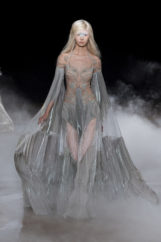
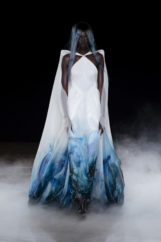
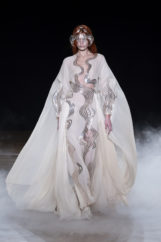
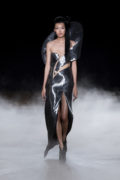
There is a moment, about a third of the way through most Iris van Herpen shows, when the fog machines and the strobing light start to feel like set dressing for an idea rather than a distraction from one. Sonic Starquakes, her latest couture collection shown today in Paris, earns that moment early and holds onto it.
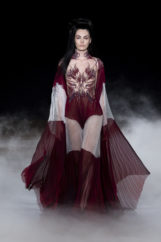
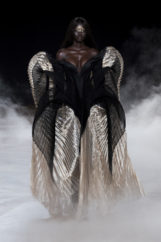
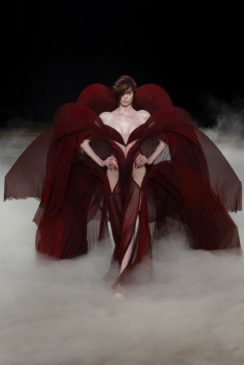
The premise, on paper, is classic van Herpen: an unlikely marriage of hard science and old folklore. This time it’s astrophysics — the discovery that stars “sing,” their surfaces rippled by pressure waves the way an earthquake ripples the ground — crossed with the story of Margaret Watts Hughes, the Victorian inventor who built a device to turn her singing voice into scattered patterns of powder. It’s a very van Herpen kind of pairing: a 19th-century curiosity and a 21st-century instrument, both trying to make the invisible visible. On the runway, that translated into a collection that felt less like garments referencing space, and more like garments trying to behave like the phenomena themselves — plasma, lightning, sound waves given a body to move through.
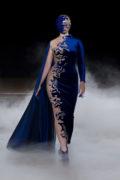
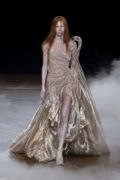
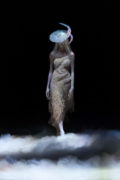
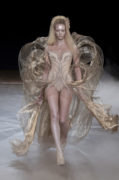
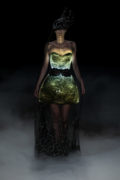
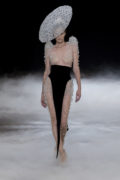
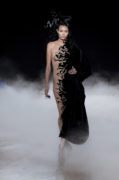
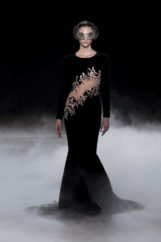
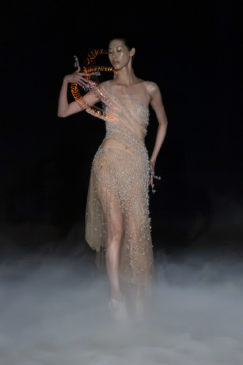
The clothes back it up. A one-shoulder gown crusted in cascading crystal drops looked like starlight caught mid-fall. Elsewhere, laser-cut velvet was sliced into rippling channels that continued straight onto the skin as fine embroidery — a trompe l’œil trick that made the body itself look charged, like current running under the surface. The gowns built from thousands of individually hand-blown glass spheres, drifting on illusion tulle, were a genuine feat of patience as much as design, and they read that way: not showy so much as slow and deliberate, which is very much the point with van Herpen’s atelier work.
The strongest idea in the show, and the one worth remembering, was the so-called Fractal Universe piece — a dress charged inside a particle accelerator and cryogenically preserved beforehand, intended to discharge its stored energy on the runway. According to the house, the dress had other plans, etching its own lightning-like channels into its surface in the days before the show rather than waiting for its cue. Whether you take that as a literal account of an unruly physics experiment or as van Herpen’s typically poetic framing of an uncontrollable process, it’s a good story, and it fits a designer who has spent over a decade insisting that her materials are collaborators, not just substrates.
None of this is new territory for van Herpen — this is, after all, a woman whose retrospective has now toured five continents’ worth of major museums, from the Musée des Arts Décoratifs in Paris to the Brooklyn Museum, with stops through Brisbane, Singapore, and Rotterdam along the way, and whose garments already sit in the permanent collections of the Met, the V&A, and the Palais de Tokyo. That institutional weight could easily calcify into repetition. It’s to her credit that Sonic Starquakes doesn’t feel like a designer replaying old hits; it feels like someone still genuinely curious about the same questions — where does the body end and its environment begin — and still finding new collaborators, in this case astrophysicists and glassblowers, to help her ask them differently.
If there’s a note of caution, it’s one van Herpen fans will recognize: a collection this rich in concept can occasionally outrun its own editing, and a handful of the more sculptural closing looks pulled focus from the quieter, more wearable pieces earlier in the show that actually did the most interesting work on the body. A slightly tighter edit would have let the strongest ideas — the plasma dress, the eidophonic embroidery — breathe a little more.
Still, this was a confident, coherent outing from a house that continues to treat haute couture as a genuine research practice rather than a marketing exercise, and that alone puts it ahead of most of what else is on the Paris calendar this week.
Later,
Diane
