

Dear Shaded Viewers,
Before fashion embraced gender fluidity. Before drag entered the mainstream. Before runway shows became theatrical spectacles. There was Leigh Bowery.
Few figures have left such an indelible mark on fashion, performance and queer culture while remaining so impossible to categorise. Australian-born and London-made, Bowery was never simply a designer, performer or club kid. He was all of those things at once—and something else entirely. His body became his medium, his wardrobe his manifesto, and the nightclub his stage.
More than thirty years after his death, Bowery remains one of the most influential figures in contemporary fashion and queer culture. His radical vision continues to echo through avant-garde design, nightlife, drag performance and the ever-evolving conversation around identity.
Born in suburban Melbourne in 1961, Leigh Bowery grew up feeling alienated by the conservatism surrounding him. Fascinated by London’s New Romantic movement and the promise of reinvention, he left Australia at the beginning of the 1980s with little more than ambition and curiosity.
“I was so itchy to see new things and to see the world that I just left,” he later recalled.
London was buzzing. The city had become a laboratory for self-invention, where fashion students, musicians, artists and outsiders transformed nightlife into a living performance. Bowery quickly immersed himself in the underground club scene, arriving dressed in increasingly elaborate outfits of his own making.
Alongside artist Gary Barnes, better known as Trojan, and David Walls, the trio became famous as the “Three Kings”, instantly recognisable in London’s clubs for their spectacular handmade costumes and fearless performances of identity.
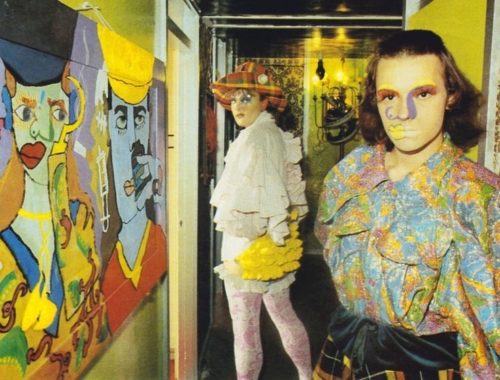
Fashion was beyond clothing.
While Bowery briefly enjoyed success as a fashion designer, showing collections internationally, the commercial industry never interested him for long.
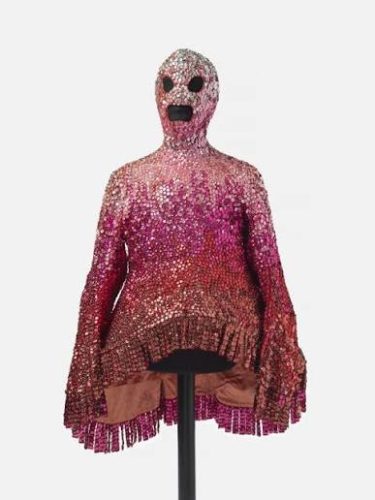
He wasn’t interested in designing clothes that flattered the body. He wanted to challenge the very idea of what a body could be.
“Flesh is my most favourite fabric,” he famously declared.
His garments functioned less as clothing than as sculpture. Layers of latex, sequins, padding, prosthetics and exaggerated silhouettes transformed his body into something entirely unfamiliar. Sometimes beautiful, sometimes grotesque, often both simultaneously, Bowery manipulated his own figure into surreal forms that questioned conventional ideas of beauty, gender and sexuality.
Every appearance became a performance. Every costume was a new character.
Rather than using traditional runways, Bowery turned London’s clubs into his catwalk. Nightlife became the perfect setting for experimentation, allowing fashion, performance art and self-expression to merge into one.
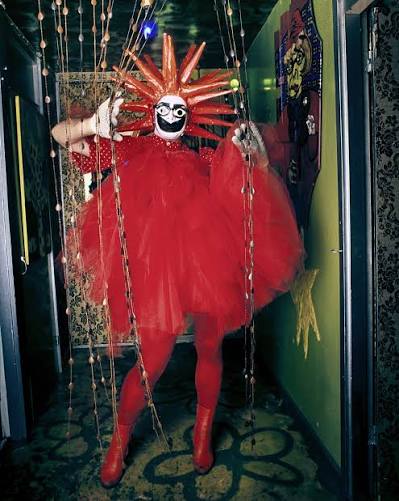
Taboo: Where Rules Ceased to Exist
In 1985 Bowery co-founded Taboo with promoter Tony Gordon inside Maximus nightclub in Leicester Square.
For just eighteen months, Taboo became London’s most legendary queer club.
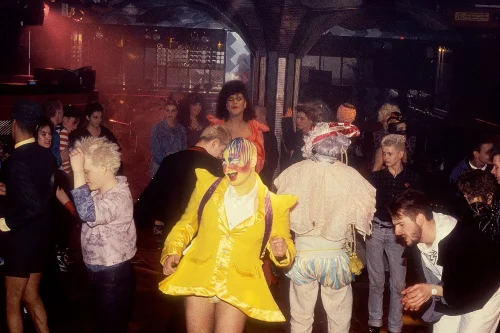
Long queues formed outside every night as artists, drag queens, fashion designers, musicians and outsiders gathered inside a world where conventional ideas of identity simply dissolved. Polysexuality was embraced, gender became fluid and dressing up was practically mandatory.
Its resident DJs included Jeffrey Hinton, Rachel Auburn and Mark Lawrence, while regular guests ranged from Boy George and George Michael to John Galliano, Judy Blame, Michael Clark, John Maybury, Cerith Wyn Evans and the designers behind BodyMap.
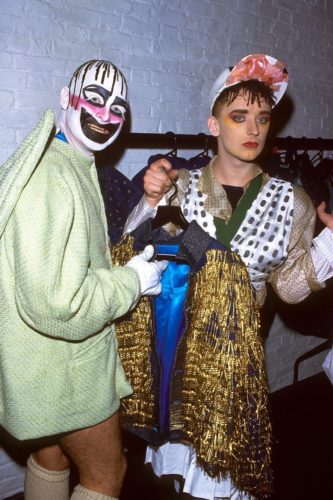
Taboo was excessive, theatrical and unapologetically hedonistic. Although media scrutiny and allegations surrounding drug use contributed to its closure in 1986, its cultural impact far outlasted its brief existence.
Its legend would shape club culture for decades.
Turning the Body Into Art
Bowery constantly blurred the line between fashion and performance.
His infamous “Birthing” performance, first presented at Kinky Gerlinky in 1990, remains one of contemporary performance art’s most shocking moments. Appearing heavily pregnant, Bowery slowly “gave birth” on stage to his collaborator Nicola Bateman, who emerged from beneath his costume covered in theatrical blood.
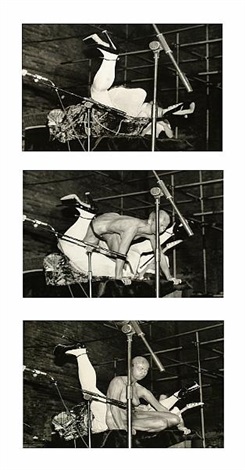
Equal parts grotesque, absurd and strangely beautiful, the performance perfectly encapsulated Bowery’s fascination with transformation.
His work rejected neat categorisation. Masculine and feminine. Attractive and monstrous. Humorous and unsettling. Nothing existed as fixed or absolute.
Instead, identity itself became something to construct, exaggerate and reinvent.
Fashion’s Ultimate Outsider
Bowery’s influence extends far beyond the underground clubs where he first became famous.
At a time when fashion largely celebrated idealised bodies, Bowery deliberately distorted them. Oversized silhouettes, exaggerated proportions and confrontational beauty became tools for questioning social norms long before conversations around gender identity entered the mainstream.
Alexander McQueen, John Galliano and Vivienne Westwood all absorbed elements of London’s radical club culture into their work. Later generations—including Rick Owens and Charles Jeffrey—have openly embraced Bowery’s legacy of theatrical self-transformation and fashion as performance.
His influence can also be seen in performative runway presentations, sculptural garments and the increasingly blurred boundaries between fashion, art and identity.
Bowery fundamentally expanded the possibilities of fashion itself.

The Artist as Muse
Bowery’s creative influence wasn’t confined to fashion.
His friendship with painter Lucian Freud resulted in a series of monumental nude portraits that revealed another dimension of Bowery’s relationship with the body. Painted without costume or disguise, Freud captured the vulnerability beneath the spectacle while preserving Bowery’s extraordinary physical presence.
These paintings remain among Freud’s most celebrated works, demonstrating that Bowery himself had become a work of art.
Creating Through Crisis
Bowery’s most prolific years unfolded against the backdrop of the AIDS epidemic.
Throughout the late 1980s and early 1990s, queer communities faced devastating loss alongside increasing political conservatism and widespread fear.
Diagnosed with HIV in 1988, Bowery continued creating until his death on 31 December 1994 at just thirty-three years old.
His illness never diminished the radical optimism embedded within his work. If anything, it reinforced its urgency.
To transform yourself became an act of resistance.
From Taboo to Today’s Queer Underground
Although Bowery died in 1994, the creative world he helped build never disappeared.
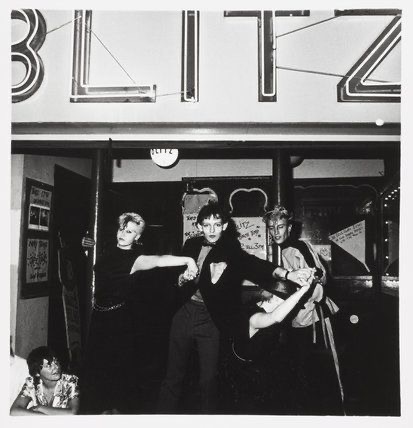
If the Blitz Kids transformed London nightlife into a stage for self-invention during the early 1980s, later club nights such as Kinky Gerlinky pushed those ideas even further. Founded by Michael Costiff in 1989, the legendary party attracted fashion students, drag performers, artists and provocateurs who approached dressing as an artistic practice in itself.
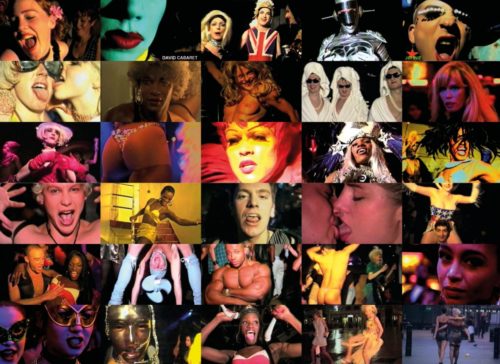
Bowery’s influence loomed over the entire scene. His belief that fashion could function as performance, and that the nightclub could become a site of artistic experimentation, permanently altered London’s creative landscape.The same energy travelled across the Atlantic, finding expression among New York’s Club Kids, whose flamboyant aesthetics and performative identities owed much to the path Bowery had carved.
A Legacy That Continues to Evolve
Today’s queer nightlife exists in a different political and cultural landscape, yet many of Bowery’s ideas remain remarkably relevant.
Across London’s underground, parties such as Wraith, founded by Parma Ham, and INFERNO, created by Lewis G. Burton, continue to treat nightlife as a space where fashion, music, performance and community collide.
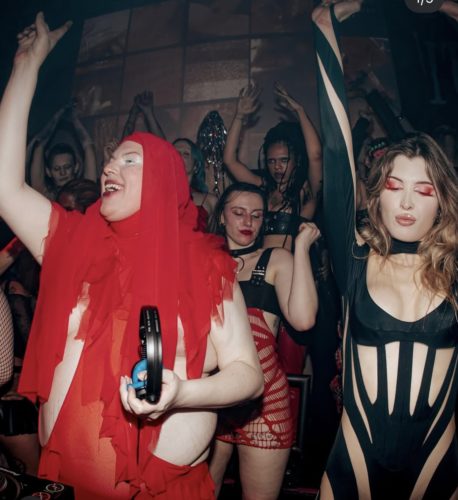
Hard techno replaces house music, contemporary queer politics inform the performances, yet the underlying philosophy remains strikingly familiar: identity is never fixed.
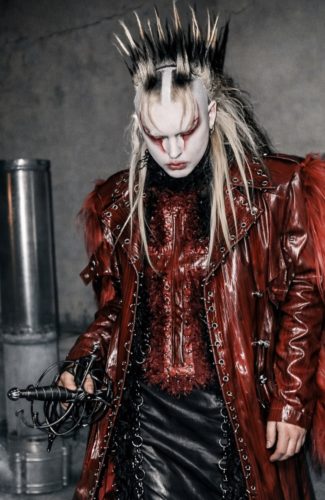
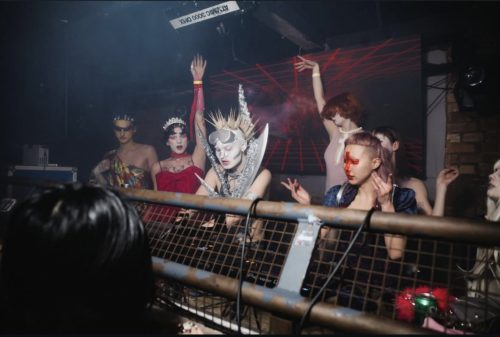
In Conversation With Parma Ham
What is the core vision behind your work, and how does Wraith embody it?
« A lot of my work plays with binaries: masculine and feminine, human and machine, attraction and repulsion, sacred and profane. I’m interested in the tension between opposites, because you can’t understand one without the existence of the other. Rather than resolving those contradictions, I prefer to hold them together simultaneously. This manifests through performance, sculpture, and music. My work and the rave that I put on are intertwined as I only founded Wraith because I needed a place to showcase radical work of my own, which because of censorship is often difficult to place in public spaces like galleries or post to social media. »
This theatrical club culture of 1980s London — especially around Leigh Bowery — blurred fashion, performance and nightlife. How does your work relate to that legacy today?
« I was always quite inspired by legacy London parties such as The Blitz, The Batcave, and Taboo when it came to creating a space. They are Melting pots of culture, they are symbols of entire aesthetics that flex explorations in music and fashions. They are often seen as birth places of subculture that builds an entire world, and have gone on to creatively inspire art, fashion, and music for generations, and inspire the main stream pop. For me, Growing up in England meant exposure to goth culture as a teenager, so it became part of my DNA, and now that language is part of the toolbox I use to create. I like that taking inspiration from the past is continuing that lineage of creativity, and I feel a familiar bond with our predecessors. »
You talk about creating immersive, transformative spaces… When I see Wraith, I’m reminded of the radical energy of 1980s London nightlife with the Kinky Gerlinky parties.
« The immersion comes from that it is an artist-led platform, created by and for people within the same subculture, a kind of gothic, posthuman hybrid identity, so it’s like entering a world. Over the years, I’ve encouraged artists to present their work within the rave setting, which was once almost exclusively centred on music. Since then, we’ve incorporated live music, exhibitions, performance, dance, theatre, poetry readings, and writing through our zine, allowing it to evolve into something much more world encompassing. I think raves are inherently ritualistic in their function, but Wraith, because of its distinct aesthetic and atmosphere, feels more ceremonial; and that sense of ceremony is what makes it transformative. »
Parma concluded : « I think it’s important to not be too nostalgic though, as recreating the past flattens new developments, it’s important to keep exploring new ideas and pushing boundaries – both creatively, but also in the sense of how to make a space, and what community looks like. »
Bowery’s influence also lives through a new generation of artists who use fashion as both performance and protest.
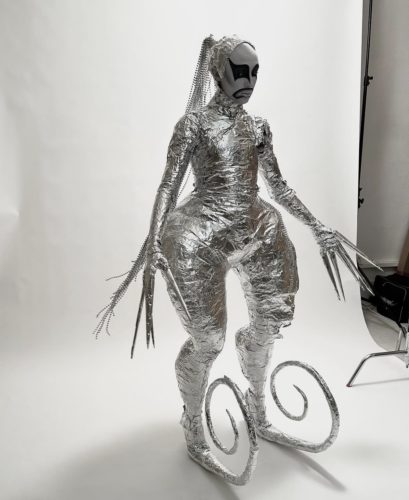
Russian-born artist Jenna Marvin has built an international following through elaborate handmade costumes constructed from everyday materials, creating performances that blur activism, endurance art and theatrical self-transformation. Like Bowery, she weaponises exaggeration and disguise to question social conventions.

Meanwhile, performer Chad Curry, now known as Dahc Dermur, continues club culture’s tradition of transformation through a practice that exists between drag, sculpture, and live performance. Dahc Dermur was never intended to be a separate project; it emerged simply as a name change at a certain point in Chad’s journey. “Dahc” is “Chad” spelled backwards, while “Dermur” is a reworking of “murder,” symbolising transformation, rebirth, and the idea that we continually shed former versions of ourselves in order to become who we are.
Rather than representing alternative identities, characters, or alter egos, Chad and Dahc are one and the same—an authentic expression of the same person, lived fully every day. The performances are not fictional personas but an extension of Chad’s truth, embodying a commitment to living openly and authentically 24/7.
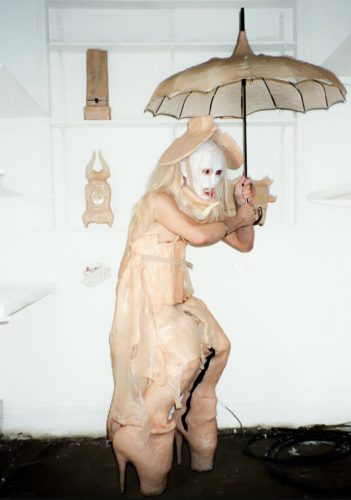
The costumes have changed. The politics have evolved. But the desire to reinvent oneself remains the same.
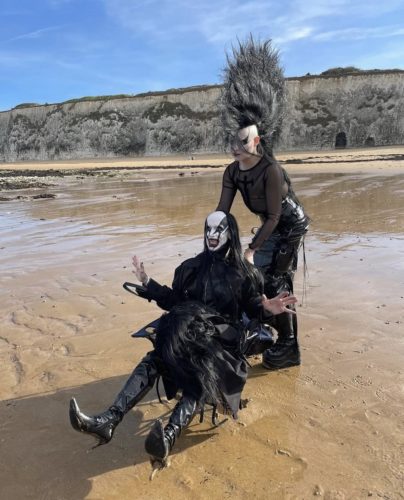
The Freedom to Become
Leigh Bowery never wanted to fit into fashion. He wanted to explode it from the inside.
Long before conversations around gender fluidity, body politics and performative identity entered the mainstream, Bowery demonstrated that clothing could be more than decoration. It could become sculpture. Protest. Theatre. Transformation.
His greatest legacy is not any single costume or performance, but the permission he gave generations of artists, designers and queer people to invent themselves without limitation. In an age where identity is increasingly understood as something fluid rather than fixed, Bowery feels less like a historical figure than a prophet.
His body may have disappeared in 1994, but the artwork he created out of living continues to inspire every runway that embraces the unconventional, every underground club that celebrates radical self-expression, and every person who understands that becoming yourself can be the most revolutionary performance of all.
Lately,
Eva
