
Credits : ©︎ CAMPER / ISSEY MIYAKE INC.
Dear Shaded Viewers,
Anna is the moment when Camper’s grounded craftsmanship meets ISSEY MIYAKE’s poetic vision of movement, turning a shoe into a sculptural second skin.
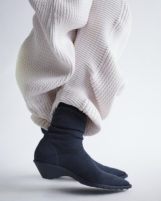
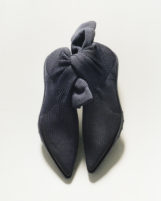
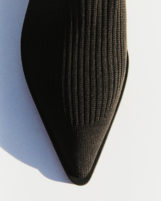
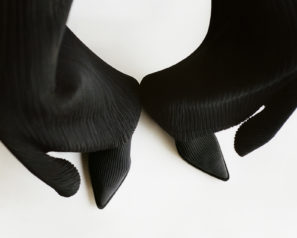
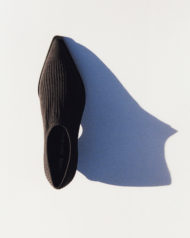
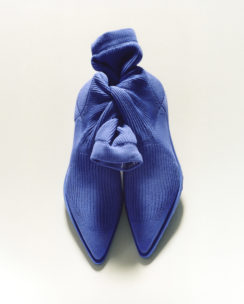
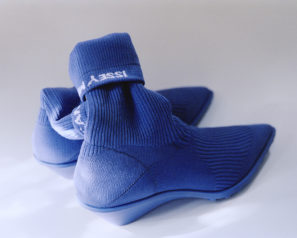
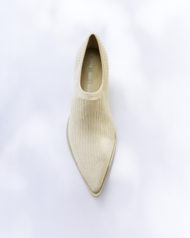
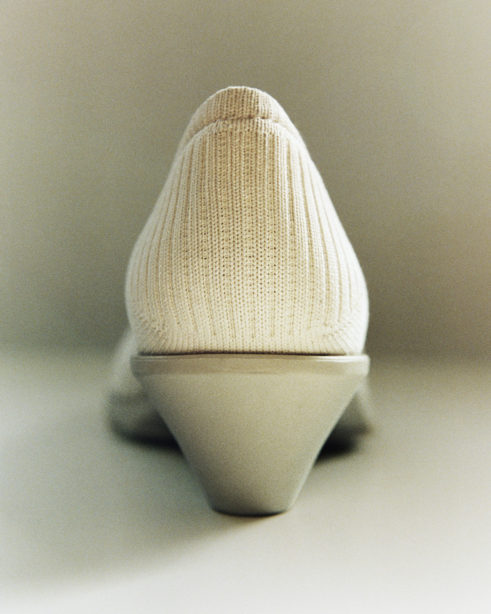
Anna is introduced as a sculptural footwear concept that reimagines the idea of “wearing shoes like socks,” stripping away ornament to focus on sensation and silhouette. The pointed, streamlined base and low heel support a precision‑knit upper in a soft TENCEL™ blend, a material derived from sustainably sourced wood fibres that carries ISSEY MIYAKE’s quiet commitment to innovation with responsibility.
Designed to wrap the foot and lower leg like a second skin, the breathable knit doesn’t merely cover but traces the body, amplifying the curve of the ankle and the length of the leg. The tension between the supple sock‑like upper and the structured outsole creates a subtle choreography: the shoe appears fluid yet firmly grounded, inviting ease without sacrificing intent.
The silhouette was conceived by Camper in Mallorca in dialogue with Satoshi Kondo, designer of ISSEY MIYAKE’s women’s line, and you feel this dual authorship in every line. Camper’s shoemaking expertise gives Anna its engineered stability and tactility, while ISSEY MIYAKE’s exploratory approach to garments pushes the shoe into the realm of body‑conscious sculpture rather than simple accessory.
Both houses share a belief in innovation through design: a shoe is not an object but an experience; a knit is not a surface but a space between body and world. In Anna, that philosophy becomes literal—the “unfulfilled space in between” that ISSEY MIYAKE has explored since 1971 is translated into the volume between knit and skin, heel and floor, a micro‑architecture for movement.
ISSEY MIYAKE’s legacy lies in treating a piece of cloth as a field of possibility, challenging East/West binaries and conventional tailoring to create a universal ease. Anna extends that inquiry downward: instead of leather cut and stitched, you have a continuous knit that behaves like clothing, allowing the foot to be dressed with the same freedom as the body.
By focusing on the physical and sensuous theme of the partnership, the shoe becomes a kind of wearable punctuation mark—sharp at the tip, soft at the touch, editing the line of the body without dominating it. The result feels consistent with the house’s ethos: technology serving tenderness, structure serving movement, always returning to the human form as the ultimate measure.
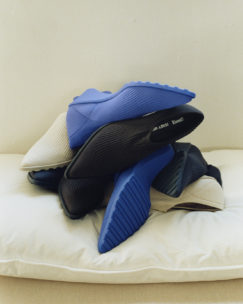
Anna debuts in two archetypal forms: a low shoe in black and beige, and a boot in black, blue, and dark navy—chromatic decisions that speak to both utility and nuance. Black and dark navy offer the familiar ISSEY MIYAKE shadow play, while beige and blue introduce a lighter, almost sky‑bound softness that underscores the knit’s tactility.
The pointed toe and low wedge heel are calibrated for daily wear, but they also carry a certain cinematic sharpness—the kind of shoe that can slip under pleated trousers or a fluid skirt and still hold its own in a close‑up. Versatility here is not a marketing term; it’s embedded in the construction, where comfort and support are engineered so thoroughly that the shoe can disappear and yet quietly change how you walk.
At its core, the collaboration works because both brands approach design as a dialogue between body and environment rather than a hierarchy of logo over wearer. Camper brings decades of pragmatic shoemaking, the knowledge of how a foot lands and grips; ISSEY MIYAKE brings an almost philosophical sensitivity to space, motion, and the emotional charge of cloth.
Anna becomes the meeting point: a shoe that treats the foot as part of the garment, and the ground as part of the silhouette. It is innovation that refuses spectacle, a quiet revolution in how we imagine the border between sock and shoe, clothing and object, movement and rest.
Later,
Diane
