
Before Kandinsky, before Mondrian, before abstraction had a name, Hilma af Klint was already painting the invisible. She began in 1906, in Stockholm, guided by spiritual séances conducted within ‘De Fem’, a collective of five women whose automatic drawings gave her the freedom to quit the conventional naturalism of her portraits and botanical studies. She painted for a temple that did not exist, for a future she knew she would not see. Then she sealed the works away, stipulating in her will that they not be shown until twenty years after her death. The world waited until 1986. France is only seeing them now. Until 30 August, 2026, at the Grand Palais.
© Luc Castel, 2026
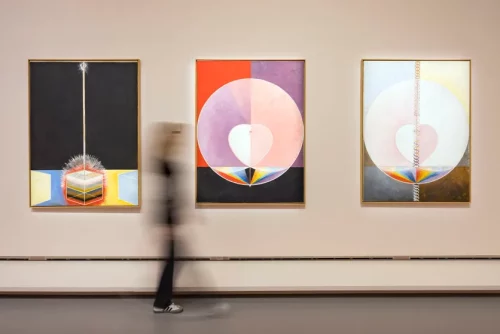
What hits you first, standing in front of her canvases at the Grand Palais, is not their scale, though The Ten Largest are vertiginous, but their radiance. Light seems to move through the paint rather than rest on it. Sometimes you feel less like you are contemplating a painting than entering one, as though af Klint had found a way to compress the structure of living matter itself, something molecular, closer to the secret architecture of DNA than to anything the early twentieth century had produced in art. The forms are abstract and yet feel urgently alive.
This is inseparable from who she was. Af Klint lived a double artistic life: publicly, a trained portraitist and botanical illustrator; secretly, a visionary whose imagination was nourished by theosophy, spiritualism, and a conviction that art could make the invisible forces of the cosmos perceptible. She built a visual language to reach it, one drawing on Nordic folklore, natural science, esoterism, and the new geometries and atomic theories of her time. The spirals and circles and chromatic beams that fill her canvases are not decoration. They are a theology.
© Luc Castel, 2026
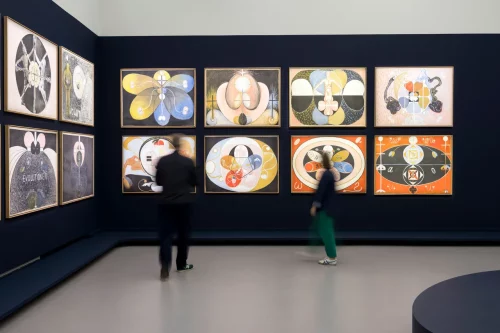
The Grand Palais presents more than a hundred works spanning the full breadth of the Paintings for the Temple cycle, from the primordial chaos of the earliest series to the gold-leaf triptych of the Altarpiece that closes it. Co-produced with the Centre Pompidou, this is the first monographic exhibition devoted to af Klint in France, an astonishing fact, given that the rest of the world has long recognised her as one of the founding figures of modern art. To stand there is to understand why. And to wonder, not for the last time, what else history forgot to tell us.
Hilma af Klint. Paintings for the Temple (1906–1915). Grand Palais, Paris. 6 May – 30 August 2026.
