











Dear Shaded Viewers,
On the morning of its unveiling at the Musée des Arts Décoratifs, La Mode en Majesté: Royal Thai Dress from Tradition to Modernity arrives not merely as an exhibition, but as a gesture of continuity—an intricate weaving of heritage, diplomacy, and personal vision.
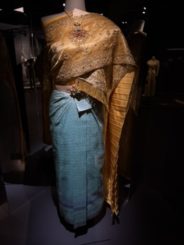
In the hushed galleries overlooking the Tuileries, silk seems to breathe. Threads of gold and lacquered brilliance trace histories that are at once ceremonial and deeply alive. Thai royal dress, with its disciplined elegance and symbolic precision, has always been more than adornment—it is language, codified and luminous, articulating hierarchy, identity, and grace. Yet here, that language unfolds across time, revealing its capacity for reinvention without rupture.
At the heart of this dialogue stands Her Royal Highness Princess Sirivannavari Nariratana Rajakanya, whose presence bridges the ancestral and the contemporary with rare fluency. A designer in her own right, educated in Paris and shaped by the rigor of European couture, she inhabits a unique duality: both custodian and innovator. Her work does not seek to modernize tradition in the reductive sense, but rather to listen to it—attentively, almost reverently—before allowing it to evolve.
Her relationship with France is neither incidental nor symbolic; it is deeply embedded in her formation. Paris, with its ateliers and its exacting standards, offered her a framework through which to reinterpret Thai sartorial codes. It is here that the dialogue between Thai royal dress and French haute couture becomes most resonant. Not a collision, but a calibration.
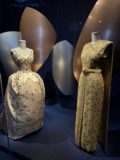
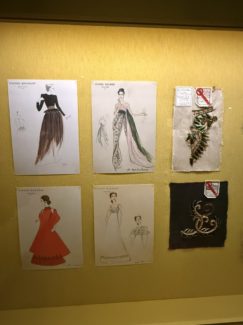
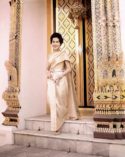
The figure of Pierre Balmain hovers like a quiet axis within this story. His historic engagement with Thai court dress in the mid-20th century—most notably through his collaboration with Queen Sirikit—established a precedent for cultural exchange rooted in respect and precision. Balmain did not impose Parisian form onto Thai tradition; he studied it, absorbed its proportions and gestures, and translated its spirit into a vocabulary that could travel. In doing so, he set the stage for a relationship between France and Thailand that continues to unfold today.
Princess Sirivannavari extends this lineage, but with a distinctly contemporary authorship. Where Balmain approached Thailand from the outside, she moves fluidly between both worlds, embodying their intersections. Her designs often reveal this dual inheritance: the architectural clarity of French tailoring meeting the suppleness and ornamentation of Thai textiles; the discipline of couture infused with the narrative richness of royal costume.
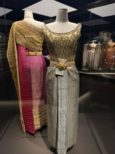
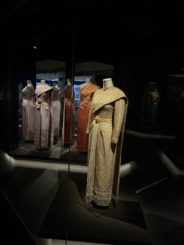
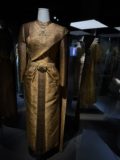
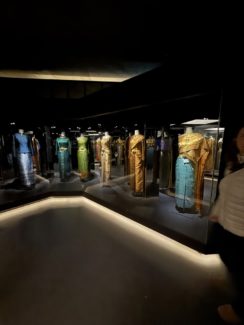
What emerges in this exhibition is not a static archive, but a living continuum. Traditional chut thai silhouettes converse with newly imagined forms. Embroidery carries memory, yet refuses nostalgia. Each piece seems to ask: how does one honor the past without becoming beholden to it?
There is also, inevitably, a question of majesty itself. In an era that often resists the language of royalty, this exhibition reclaims it—not as spectacle, but as stewardship. Majesty here resides in detail, in craftsmanship, in the quiet authority of garments made to endure beyond the moment.
Béatrice Quette is a French art historian and curator who oversees the Asian collections at the Musée des Arts décoratifs in Paris. This morning at MAD, she walked me through “La Mode en Majesté – Royal Thai Dress: From Tradition to Modernity,” the exhibition she curated, patiently unpacking its historical and aesthetic threads as we moved from gallery to gallery.
Trained in Asian art history at the Sorbonne, the Institut National des Langues et Civilisations Orientales and the École du Louvre, Quette has, since her appointment in 2018 as conservatrice of the Asian collections, been responsible for the conservation, study and interpretation of these holdings. Her curatorial work consistently foregrounds the dialogue between Asian craftsmanship and European decorative arts, from Japanese art to the long history of exchanges along the Silk Roads.
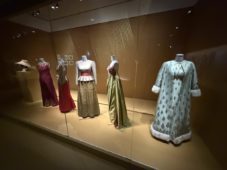
With La Mode en Majesté, she orchestrates an ambitious narrative that runs from court tradition to contemporary couture, bringing together more than one hundred royal garments and accessories from the Thai royal wardrobes, including creations by Pierre Balmain and leading Thai designers. As visitors progress through the show, they are drawn into a choreography of time and place—moving from ritual to runway, from Bangkok to Paris and back again—where each contemporary silhouette quietly reverberates with older forms, and each tradition is subtly refigured by its encounter with modernity.
In this sense, La Mode en Majesté is not simply about Thai dress. It is about transmission: between generations, between cultures, between ways of seeing and making. And in Princess Sirivannavari, that transmission finds a compelling voice—one that speaks with elegance, authority, and an unmistakable sense of purpose.
On the threshold of its opening, the exhibition feels less like a retrospective than a proposition: that tradition, when approached with intelligence and sensitivity, does not constrain creativity—it deepens it.
Later,
Diane
