

Earlier this year, Paris-based studio Services Généraux released their latest short film, Sisyphe. Spanning visual and audio art as well as fashion, the project forms part of the studio’s annual personal series, a refreshing approach that allows them to step outside the commercial sphere, reconnect with their identity and inspirations, and keep their creative pulse authentic and alive with original ideas.
Sisyphe draws on the Greek myth of Sisyphus, condemned to the underworld and forced to spend eternity rolling a rock up a hill, only for it to fall back down again. This relentless task was famously described by Albert Camus as living in the face of absurdity while still choosing to live. Here, the concept is reworked to reflect contemporary life, not as punishment but as a reflection of the endless cycles and pressures that shape modern existence. In this context, Sisyphus becomes a figure of burnout, a condition many of us recognise, as Services Généraux neatly summarises: “it is working to pay for the car one has just bought in order to get to work.” As an allegory, Sisyphe captures the feeling of a long, exhausting journey that never quite progresses.
Visually, the film is precise, composed of clean, super-wide shots set against otherworldly landscapes. The protagonist is repeatedly positioned at the centre of the frame, where ultra-wide compositions emphasise his insignificance against the vastness around him. These are interrupted by ultra-zoomed-in shots, creating a visual rhythm that mirrors fluctuating pressure, suggesting movement without real any advancement. The figure embodies a numbness, stripped of future ambition and focused only on enduring each day, with the sole aim of “feel[ing] pleasure in the most empirical way,” as Services Généraux describes.
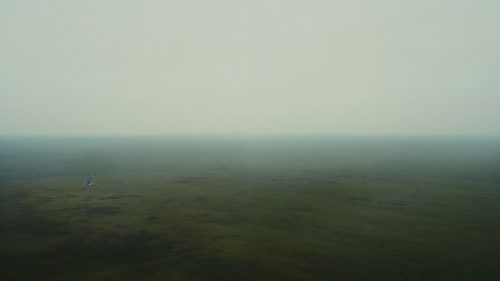
The narrative loosely follows Maslow’s hierarchy of needs, moving from basic survival to self-actualisation. Yet each time a new level seems within reach, the structure collapses, returning the protagonist to the base of the pyramid. The result is a frustrating, cyclical journey that seems to feel both deeply personal and widely recognisable, where control and submission remain in constant strain.
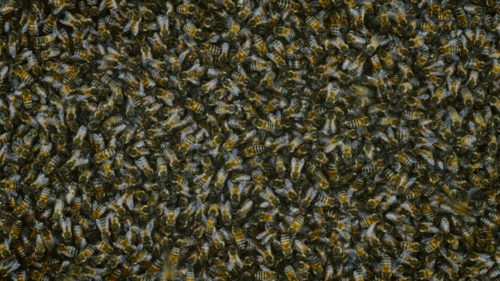
Throughout the film, interruptions act as markers of this hierarchy. A swarm of bees engulfs the protagonist, evoking the second level, safety, and reinforcing a sense of persistent vulnerability. A solitary horse appears as a symbol of the third level, belonging and social connection. Though it could serve as food, empathy prevails, revealing an instinctive social consciousness. Flocks of birds correspond to the fourth level, self-esteem, while self-actualisation appears only fleetingly through a burst of fireworks, visible and aspirational yet ultimately out of reach.
Returning to Camus’ reflections on free will and the act of choosing to live, death enters the film not as resignation or defeat but as a final attempt to reclaim agency. “Does the awareness of life’s senselessness and absurdity necessarily lead to suicide?” Camus asks, a question Sisyphe echoes, as Services Généraux probes why life continues to be considered ‘sacred’ within an increasingly secular society.
Both visually striking, offering a series of beautifully shot, almost painterly scenes, and intellectually provocative, Sisyphe achieves a rare balance of cinematic, structural, and conceptual excellence.
