
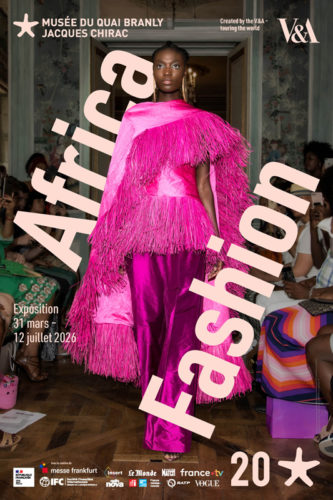
Africa Fashion, conceived in collaboration with London’s Victoria and Albert Museum, is on view until 12 July 2026 at the Musée du Quai Branly in Paris. From the independence movements of 1960 to the most boundary-pushing designers working today, the point is made firmly and early: Africa is a continent gathering 54 countries, each one carrying a history of independence, aspiration and identity. What follows is the sustained proof of that statement.
A white cotton sweatshirt stops you. Two words are stitched across the chest in muted grey letters: “HEAR ME.” Below, a hand-crocheted skirt carries the word “ENU”, “mouth” in Yoruba, one of Nigeria’s major languages. The piece belongs to Nigerian designer Adebayo Oke-Lawal, born in 1990, founder of the Lagos-based label Orange Culture, whose work sets out to challenge the stereotypes that imprison masculinity, in society and in fashion alike. This silhouette condenses into a single look the argument the exhibition will spend its entire length making: that clothes are never merely clothes, that African fashions speak in many languages simultaneously, and that they have been asking to be heard for a very long time.

That request is also embodied, from the very first room, in a fuchsia silk silhouette by Imane Ayissi, Cameroonian-born couturier and member of the Chambre Syndicale de la Haute Couture, woven by artisans in West Africa and cut in Paris. The piece, from his Mbeuk Idourrou collection Fall-Winter 2019/2020, was selected by lead curator Christine Checinska after months of conversation with the designer about his practice, his childhood memories of Cameroonian fashion magazines, his rapport with African textiles. Ayissi only learned later that this particular silhouette would open the show. “It was a good surprise,” he says. “It mixes references to the cultures of Central Africa with raffia, a material still used in many traditional ceremonies, the reference to the boubou with the rectangular cut of the cape, the attention to volume on the shoulders, this idea of opulence. But also very couture references: the silk, the satin, the subtle shift between two shades of fuchsia pink. This métissage summarises my work fairly well, with the idea of a silhouette that is difficult to place geographically and that the mixing renders timeless, even futuristic.”

The textiles gathered here – bogolan, kuba cloth, adire eleko, kanga – are not ethnographic curiosities placed under glass. They are the living foundations of a design tradition, each one carrying centuries of social memory, political meaning, and craft knowledge. Alongside them, the exhibition traces the first generation of African designers to achieve international recognition, figures largely absent from the Western fashion canon: Shade Thomas-Fahm pioneering a contemporary aesthetic in Lagos in the 1950s; Chris Seydou working at the intersection of bogolan and high fashion in the 1980s; Alphadi, born in Timbuktu, building a global practice before “global fashion” became an industry talking point. These designers are presented here not as peripheral figures who orbited the Western fashion world, but as architects of their own scene.
Ayissi, the only designer of sub-Saharan African origin on the official Haute Couture Week calendar, perceives his position in the Parisian system not as a contradiction but as an extension of his practice. “Paris is a formidable place,” he says, “since it is the city that for at least 100 years has welcomed designers from all over the world when they want to address an international audience.” On the necessity of this exhibition arriving here, he is equally clear: “The realities of the African continent remain largely unknown in Europe, and particularly in France, despite, or perhaps because of, the links of the past. This exhibition dismantles the clichés and illustrates the fact that African designers can bring a genuinely fresh perspective to contemporary fashion, which sometimes gives the impression of going around in circles.” That impression, of a fashion world going around in circles, is precisely what “Africa Fashion” refuses. It is too busy looking forward.
The contemporary section illustrates the plurality becoming exhilarating. MMUSOMAXWELL, Katush and Moshions champion a minimalism that directly contradicts the assumption that African fashions are necessarily loud, printed and maximalist. Their architectural, pared-back garments draw on local cultural references while speaking a rigorously international formal language. Studio One Eighty Nine, co-founded by Abrima Erwiah and Rosario Dawson and based in Accra, combines natural-dye techniques, hand-weaving and kente cloth in pieces that are simultaneously artisanal and contemporary. Thebe Magugu, IAMISIGO, Orange Culture, each one a distinct voice, a distinct geography, a distinct conversation with the histories on display in the floors below.
Africa Fashion, musée du quai Branly – Jacques Chirac, 37 quai Branly, Paris 7e. Until 12 July 2026.
