
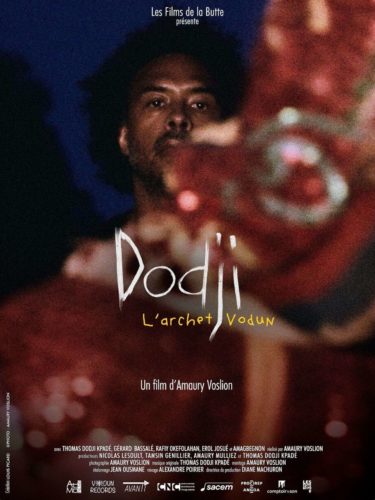
“Dodji”: feature‑length musical documentary broader in scope, more developed initiatory and spiritual narrative, set primarily in West Africa with a strong focus on Vodoun rituals, identity, and ancestry.
“Réveille-toi”: Guided by the call of ancestral rhythms, Thomas Dodji Kpadé journeys to Benin—the birthplace of Vodun—to reconnect with the sounds and spirit that have always lived within him. With director Amaury Voslion, he undertakes a voyage that transforms them both and inspires Dodji, l’archet vodun.
Dear Shaded Viewers,
From the first frame I felt that Dodji, l’archet vodun was not just a film, but an encounter – with a man, a music, a land, and a spiritual force that quietly took over the entire auditorium tonight at the musée du quai Branly – Jacques Chirac.
Amaury Voslion crafts a musical road-movie that feels at once intimate and epic, following the journey of cellist Thomas Dodji Kpadé as he travels to Benin, on the lands of Vodun that have been calling him since childhood. The way his cello dialogues with traditional rhythms and sacred ceremonies creates a powerful, almost trance-like weave of sound and image that held the room in absolute silence.
What moved me most is how the film never exoticises Vodun: it listens, it watches, it lets us sense the invisible that shapes Dodji’s inner voyage as much as his physical itinerary from Cotonou to the sacred spaces of southern Benin. You feel Voslion’s eye is there to reveal the humanity of every face and gesture, turning this “documentary of creation” into a living, breathing ritual of cinema.
When the lights came up at the end of this world-premiere screening within the museum’s biennial “L’Anthropologie va vous surprendre !”, the reaction was electric: a long, generous applause rose from the audience, not polite but heartfelt, the kind that tells you a film has genuinely landed where it needed to.
The force of the film lies in Thomas himself, a Franco-Beninese musician born to a French mother and a Beninese father of Vodun culture, who carries within him this double heritage and the questions that come with it. Trained as a classical cellist in Europe, he has also immersed himself in traditional Beninese polyrhythms, learning their sacred dimension and allowing them to transform his playing from the inside.
On screen, his cello becomes everything at once – key, shield, offering – as he uses it to converse with priests, drummers, landscapes, and ancestors. The article in Libération on Monday 30 March underlines how this quest is not a simple return to roots, but a complex, lucid dialogue between European conservatory training and the Vodun cosmology that has always resonated in him, and the film captures that tension with remarkable sincerity.
Amaury Voslion deserves his own spotlight in this story. A filmmaker deeply attuned to music and the poetics of documentary, he approaches Dodji, l’archet vodun less as an outside observer than as a careful listener, building a cinematic language that lets sound and silence do the heavy lifting. His camera never forces itself between Dodji and the ceremonies he encounters; instead, it finds a tactful, precise distance, allowing glances, pauses, and the grain of the cello to speak. You feel the years of trust, research, and collaboration behind every sequence, from the rehearsals in Europe to the intimate moments in Benin, and this patience is what lifts the film beyond reportage into a true work of cinema. In a landscape where spiritual practices are so often exoticised or simplified, Voslion’s direction stands out for its ethical clarity and aesthetic refinement, offering an image of Vodun and of artistic creation that is at once accessible to the uninitiated and profoundly respectful of its mysteries.
For those of us who arrive uninitiated, it helps to say that Vodun (or Vodún/Vodoun) is not a sensational synonym for “voodoo,” but a profound West African religion practiced notably in Benin and Togo, with its own temples, priesthoods, rituals, and a sophisticated spiritual universe. Rather than the caricatures of pins and dolls, Vodun is a living system of relationships between a creator god, many spirits, nature, healing, and the everyday life of communities, while “Voodoo” or “Vodou” more properly name the creolised religions that grew from Vodun in the Americas, especially in Haiti and Louisiana, through the violent history of slavery and contact with Catholicism. In this sense, the “voodoo” of horror films is largely a colonial fantasy, whereas what the film touches is Vodun itself: a subtle, demanding spiritual language that Dodji’s music translates for us, note by note.
Watching Dodji, l’archet vodun in the very museum dedicated to non-European arts and civilizations felt profoundly right: the film is, in itself, an act of decolonising the gaze, letting a musician reclaim his narrative and spiritual geography. For me, this is not only a portrait of an artist, it is a cinematic ceremony of transmission, where music becomes a bridge between continents, generations, and ways of knowing the world.
I left the theatre with the distinct sensation that we had collectively witnessed the birth of a major work for both documentary cinema and contemporary African diasporic storytelling – and judging from the thunderous applause and the luminous faces around me, I was clearly not alone.
Later,
Diane
