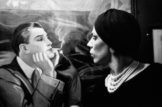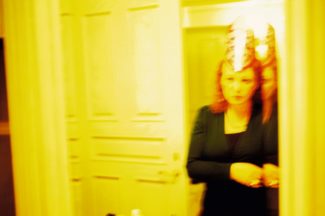
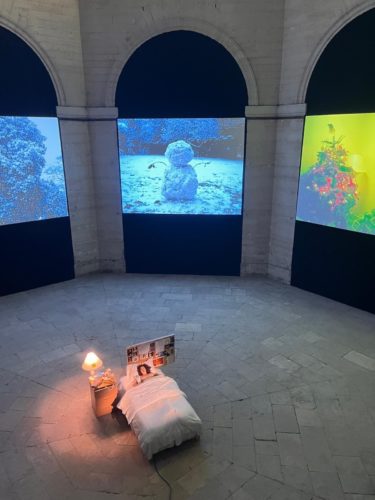
We may be constituted as a collection of memories orbiting around a soul. Photographer and activist Nan Goldin has known this longer than most, since her sister Barbara took her own life at nineteen, leaving behind a wound that never closed and an artist who would spend the next fifty years onwards reaching for what remains : her souvenirs. “This Will Not End Well,” her very first retrospective in Paris, spreads across the Grand Palais and the Chapelle Saint-Louis de la Salpêtrière until 21 June 2026.
.
Then you cross Paris from the hospital chapel on the Left Bank to the Grand Palais on the Right, where the second part of the retrospective awaits. It is darkness. Six pavilions rise from the floor like the chambers of a brain, each one a cave, each one a world. There is no chronology, no caption, no guide. Only the photographs, those portraits, the music, each playlist so precisely constructed it feels less like a soundtrack than a second language, and the uncomfortable recognition that you have seen this before. Not in a gallery, but in your own life. “The Ballad of Sexual Dependency” opens fifty years of work. Before and after parties, bodies in beds, couples locked in the particular tenderness and violence of people who need each other too much. The Velvet Underground, Klaus Nomi, Dean Martin, each song arriving at exactly the right image, the right moment of not knowing whether what you are watching is love or its wreckage. What makes it exceptional is the access: these were her friends, her lovers, her people. To be photographed like this – asleep, undressed, mid-argument, mid-kiss, mid-sex – demands an absolute trust. Goldin never takes it for granted. You smile because you recognise your friends in theirs. You stop smiling because you remember what came next.
Another creation, “The Other Side”, is an homage to Goldin’s transgender friends, photographed between 1972 and 2010. Women who laugh, pose, sprawl across beds, live fully and defiantly in bodies that the world had not yet agreed to see. Goldin saw them. She always saw them. And in seeing them with such completeness: the joy, the melancholia, the glamour. She made an archive of lives that might otherwise have gone unwitnessed. Some of the faces reappear from The Ballad. By now, you remember them as if they were your own memories. You are no longer a visitor. You are inside.
We live in a moment when artificial intelligence generates faces by the millions, plausible, symmetrical, eerily human. What it cannot generate is a look. Not the specific weight of Cookie Mueller’s gaze at three in the morning, not the way two people hold each other when they know it won’t last, not the precise shade of joy and exhaustion on a face that has lived. Nan Goldin spent fifty years in the room. She was trusted with the unrepeatable. No algorithm reaches that.