





















Dear Shaded Viewers,
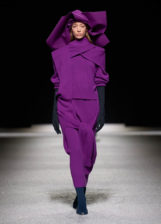
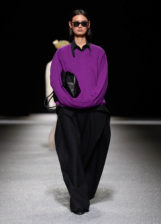
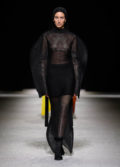
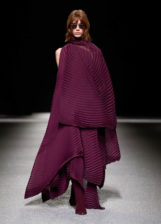
The Issey Miyake Autumn Winter 2026/27 collection arrives at the Carrousel du Louvre as a meditation on power and withdrawal: the will to create, and the equally radical will to allow. Under the title “Creating, Allowing,” the house proposes that design today is not only a matter of adding form, but of learning when to step aside and let materials, bodies and time speak for themselves. In that suspended interval between intention and restraint, the show suggests, lies an inexhaustible field of possibility.
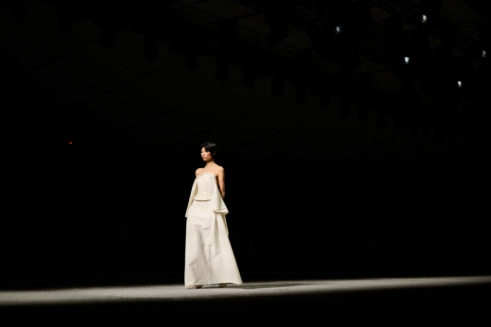
The set makes this thesis tangible before a single look appears. A rectilinear bed of silvery sand occupies the centre of the space, inert and immaculate, like a blank page awaiting its first mark. When the first model steps into this quiet field, the ground begins to register movement: each passage leaves a glittering trail, a calligraphic line in shredded aluminium that gradually turns the runway into a mutable topography. The décor is no longer a neutral frame but an instrument; the collection writes itself into the landscape, and the simple act of walking becomes a form of drawing.
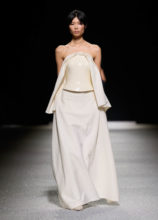
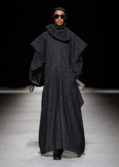
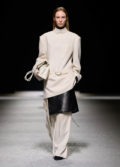
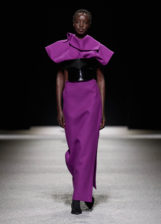
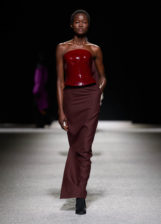
This choreography of erosion and accumulation sets the tone for a collection that continually negotiates the threshold between doing and undoing. ALLOW, one of the key series, starts from a gesture of almost ascetic simplicity: a rectangle of cloth zipped into a tube, pulled directly over the body, from which a three‑dimensional drape emerges on its own. What could read as minimalism becomes something more specific: a refusal to impose a preconceived silhouette, an insistence that form will be co‑authored by the wearer’s movements and the intrinsic memory of the textile. The fabric itself, woven from stretch yarns and washi to suggest a mineral surface, lends the garments an irregular, organic relief that feels found rather than designed.
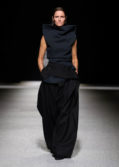
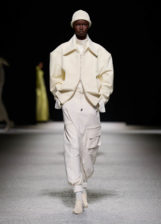
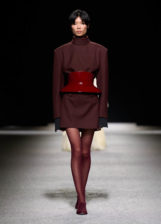
“Found” is not an accident here but a method. FOUND STONE translates the mute presence of a chance stone into knitwear: ribs, garter and openwork coexist in a single, seamless structure, their uneven surface twisting light across the body. It is as though the studio has taken a pebble from a riverbank and stretched its texture into a second skin – soft, perforated, yet stubbornly tactile. HANDSOME KNIT, by contrast, reclaims authorship at the shoulder line: a consciously constructed, almost tailored architecture within the world of knit, built through a double‑layer technique that hides a stretch recycled‑polyester scaffold under a textured wool exterior. In these pieces, Miyake’s team acknowledges that “allowing” does not mean abdicating structure; it means choosing precisely where structure is necessary.
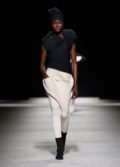
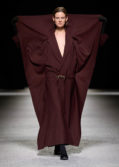
The series titled UNTITLED pushes this logic to its edge. Here, lengths of fine wool, treated for elasticity yet left deliberately in a quasi‑raw state, hover between completed garment and material in process. Draped around the body as if interrupted mid‑gesture, they ask how much decision‑making is needed before we call something finished, and whether beauty might surface more clearly if a piece remains in a kind of cultivated incompletion. The result is a wardrobe of garments that feel perpetually in becoming, like thoughts that continue to evolve after leaving the studio.
Throughout the show, the vocabulary of pleating, wrapping and encasing – from twisted WRING PLEATS to monolithic URUSHI BODY shells and curving CALLIGRAPH dresses – reiterates this oscillation between control and release. Techniques of great complexity are deployed to produce an impression of ease, sometimes even of inevitability, as if these clothes had always existed in the material and simply needed to be revealed. The runway floor, now fully transformed into a shimmering relief of footprints, becomes the final proof of concept: each look alters the space, and each trace refuses erasure.
What “Creating, Allowing” ultimately stages is a gentle but firm recalibration of authorship. The designer is present, but as a quiet conductor rather than a dictator of form, guiding the conditions in which garments, bodies and environments can enter into relation. In a fashion landscape still haunted by the figure of the sovereign creator, this collection proposes another model: one where the will to make is inseparable from the courage to let go, to leave gaps, to trust that in the indefinite relation between action and non‑action, something unexpected will appear. It is in that space – neither entirely drawn nor entirely blank – that Issey Miyake locates the infinite potential of today’s design.
Crédits : © ISSEY MIYAKE INC.
Runway : Filippo Fior (GoRunway)
Details : Salvatore Dragone (GoRunway)
Atmosphère : Matteo Gebbia (GoRunway)
Show images : Thomas Aulagner
Installation : Jules Toulet
isseymiyake.com
@isseymiyakeofficial
Later,
Diane