


For Gaurav Gupta’s previous Paris SS25 collection Across the Fire, the designer’s life partner, poet and author Navkirat Sodhi, served as muse. Many media outlets referred to Sodhi as Gupta’s wife. This false assertion of binary relationship became the impetus for the SS26 collection’s inquiry: “Why must relationships be defined through rigid structures? Why must identities be fixed within social hierarchies? Why must energies be named before they are felt?” This tension coalesced into a collection that expanded across the breadth of time and space, whilst circulating the ancient Indian philosophy of Advait, or non duality.
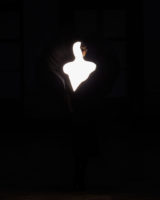
The opening look pierced out of the dark: a self illuminated bust perched on a bouncing plume of structured fabric that mimicked a vortex of dark matter. Like the birth of a star, everything in its vicinity was sucked into orbit. What followed was a series of garments shaped by a distant civilisation from the far future, as though they had acquired antiquated relics from earth to construct outfits for a high sacral-cosmic ceremony.
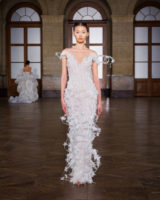
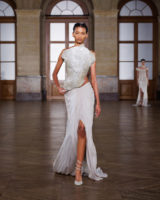
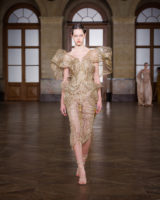
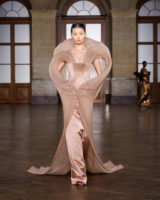
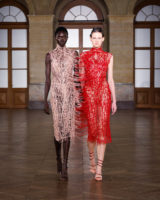
The collection is anchored by a new embroidery technique developed within the atelier, using thousands of fine threads to build web-like structures that trace the body’s internal architecture. Fleshy conjoined twins walk the runway in perfect unison. Delicate translucent flowers orbit a dress, uncontained yet held by an invisible force. Structures draw from orbital trajectories, spooling loops of fabric around the body. Mogra, Indian jasmine used in daily devotional practice, is worked directly into structures.
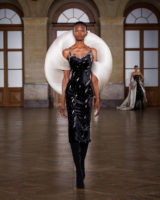
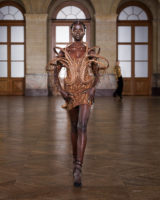
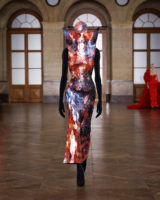
One dress is composed of over 2000 iridescent resin pieces, its surface shifting like Jupiter’s roiling gases. Pitch-black gloves and shoes make the form float, as though the uncontained body dissolves into the black of space. A statue bust, shaped over 700 hours using a fibre moulding process, is pressed against a model’s chest: a stone-bound, relic counterpoint to the earlier glowing bust. A different translucent dress billows like mineral-rich fluid escaping from a deep-sea hydrothermal vent.
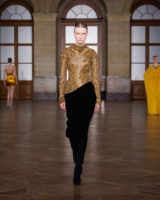
Crystals, developed in collaboration with Preciosa, refract light across the collection. One look drifts past like shimmering space debris, nodding to Gaultier’s gold couture corset and his science-fiction work, most notably The Fifth Element. Metal accoutrements are pinned to the skin like dermal piercings, reading as astral parasites clinging to celestial bodies. Long metallic acrylic nails are worn in reverse. The multiple arms of a Hindu god caress the ear as an earring.
The collection refuses rigid structure by taking the form of biological and cosmic entities that can exist without edge or body. It is a sci-fi fantasy, grounded by antiquated relics and materials from the earth. It vibrates, as a situational attempt, refusing to resolve in reality. Instead it drags us into another time-space, where bodies begin to dissolve. Where the individual is identical to the universal consciousness and the perceived separation between self, world, and God do not exist. Strength is found in this wholeness.
