







Dear Shaded Viewers,
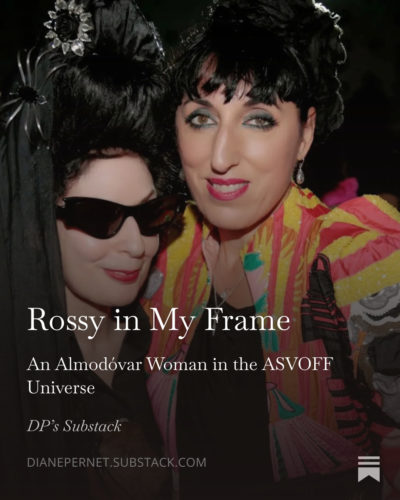
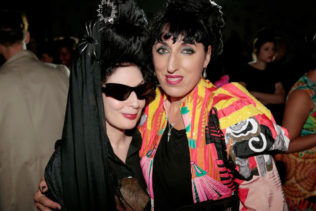
Rossy de Palma entered my life like a jump cut in an Almodóvar film: sudden, inevitable, bathed in color and cigarette smoke. She was at Barcelona Fashion Week, decades ago, when I first saw her—not as the remote Almodóvar icon from the cinema screen, but as a woman standing just a few meters away, close enough to touch. For once, shyness lost. I crossed the invisible proscenium between spectator and star and simply told Rossy how much her work meant to me. It was not a networking move, not a professional strategy—just one woman recognizing another who had already lived several lives on camera.
Our paths crossed again in Lucerne, where Rossy served as master of ceremonies, a brief scene that played like a flash-forward: the same face, the same voice, but now framed by a Swiss lake instead of a Spanish runway. The real plot began in Bilbao in 2009, when ASVOFF joined ZINEBI at the Guggenheim. I was there with my festival; Rossy was there with her children, a mother and a legend sharing a cramped backstage, the hum of a documentary festival vibrating through the walls. Later, in the rain and mud of Bilbao, on my last day in Bilbao I wandered toward Azkuna Zentroa, the contemporary art museum, thinking the day was over, only to find Rossy again, giving a radio interview to launch her perfume. It felt scripted: the star framed by microphones, I was watching from the shadows, waiting for the crowd to thin so I could step in and ask for an interview for Zoo Magazine’s film issue. She gave me her contact..
From that interview grew a shared mythology. I learned Rossy’s origin story: the young woman from Palma de Mallorca, baptized by the fun & fantasy of an underground club and by the band Peor Impossible, inventing herself out of music, color, and the refusal to be ordinary. Rossy described a Madrid youth both hungry and exuberant, where there was not enough money for the subway but enough imagination to invent new selves nightly, even as drugs and AIDS took friends away. That mix of joy and danger, glamour and precarity, was pure Almodóvar territory—and perhaps that is why I felt, from the start, that Rossy was not just an actress but a kind of living script, a character who writes herself scene by scene.
I was a Cannes virgin prior to that first edition of ASVOFF on the Croisette.
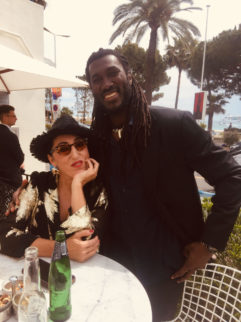
The ASVOFF chapter of our story opens like a festival within the film. Cannes, May 2011: I commissioned both Pam Hogg and Rossy as DJs for ASVOFF’s night on the Croisette, a casting worthy of a delirious closing sequence. Rossy in the booth, Pam screaming “I fucking LOVE YOU” over the crowd, Konstantinos Menelaou and David Herman orbiting like side characters in a divine chaos of sequins, sweat, and possibility. When Rossy swept us all to a private party on the Croisette
Afterward, the night turned into farce: Konstantinos trying to take a selfie, security convinced he was stalking Owen Wilson, who happened to be sitting just behind us—an Almodóvar extra who didn’t even know he was in the shot. Later, an aspiring Indian director insisted to me that I was Isabella Rossellini and refused to believe otherwise, announcing that he had written a role for me. In any other context it would have been absurd; in this one, it was just another layer of mistaken identity in a life already written like a screenplay.
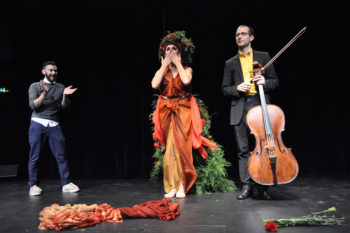
The partnership intensified in 2011 with ASVOFF 4. Rossy joined the jury and then, in Paris, performed for ASVOFF again 2012 at Silencio, David Lynch’s private members’ club, newly opened and still wrapped in velvet secrecy. This was the first time Rossy had been introduced to David Lynch. It was my birthday, October 8, and the ASVOFF 4 wrap party: Mike Figgis and Rossy Chan performing on that little stage right out of a David Lynch film followed by Jewels the sword swollower friend of Rossy’s then Rossy, masked and in see through lace performed, the cameras officially forbidden, as if the night were too cinematic to be recorded. Of course, cinema found its way in: Beautiful Jewels, Rossy’s sword-swallower friend, filmed the rehersal earlier in the day on her phone while David Lynch captured Rossy performing a song she had written for him—an illicit, grainy relic of a scene that should never have escaped Silencio’s walls, but did, thank you Jewels. That video, secret and iconic, is our bootleg sacred object, proof that some of the best cinema never passes through a projector.
By 2012, our collaboration had grown into a full ensemble cast. In Barcelona, at CaixaForum, Rossy became ambassador and master of ceremonies for ASVOFF Barcelona, the first Spanish edition, hosting with the generosity and theatrical instinct that had seduced Almodóvar decades earlier. In Paris, ASVOFF 5 at the Centre Pompidou staged one of our most unforgettable shared scenes: the screening of “Who Are You, Polly Maggoo?” followed by a conversation with its director, William Klein. Klein, brilliant and difficult, had refused a wheelchair so as not to appear old, then demanded one upon arrival after the long walk inside Pompidou to the cinema, and insisted a pretty young woman escort him from home to the museum. David Herman and I scrambled, finding a wheelchair on a Sunday night, while Klein made crude remarks—including a xenophobic insult from the stage to Luisa, dismissing Mexicans as addicts and whores.
Into this volatile frame stepped Rossy, calm and combustible at once. She and Luisa helped Klein onto the stage; Rossy moderated the conversation with her usual mix of humour, tact, and firmness, holding space for his stories about Diana Vreeland and the fashion world he loved to parody, without letting his bitterness become the whole narrative. It was a perfect Rossy moment: the clown and priestess combined, navigating ego, genius, and bad behavior in front of a full house at Centre Pompidou, while I watched from the dark, quietly deciding I never needed to work with Klein again even though I will always refer to Who Are You Polly Magoo as the first real fashion film. Rossy, by contrast, remained firmly in the ASVOFF “family,” the muse who made even the most difficult men survivable.
In 2014, the film shifted continents. ASVOFF returned to Mexico City for the third time, this chapter set against the haunted backdrop of the Ayotzinapa disappearances, when 43 students were abducted and are widely believed to have been murdered. The city pulsed with grief and anger, marches and symbolic graves, red “blood” pouring across streets and banners, the trauma of 1968’s Tlatelolco massacre echoing in every chant. Into this charged atmosphere stepped Rossy and Adan Jodorowsky, not as entertainers decorating a festival, but as artists channeling mourning. Before their performance, they lit 43 candles—one for each missing student—transforming an ASVOFF evening into a vigil, a minor-key ritual inside a world that normally runs on glamour and speed. It was Almodóvar again, but stripped of irony: melodrama as a language for real pain
And then there is the future meeting the past: Rossy as president of the ASVOFF 10 jury in 2018, the festival itself now an institution, no longer the “outsider” experiment it was when I started it at Jeu de Paume in 2008. Rossy presiding over ASVOFF 10 is the natural outcome of a decade-long script: the woman who began as a distant idol at Barcelona Fashion Week now seated at the center of my cinematic universe, helping judge the work of a new generation. Our story runs parallel to my later encounter with Willy Chavarria—another soul cut from the same rare cloth of talent, warmth, and radical authenticity—so that, in my mind, Rossy and Willy exist almost as two poles of the same constellation. Both are proof that the people I love most in this world are those who can be, at once, larger-than-life and profoundly kind.
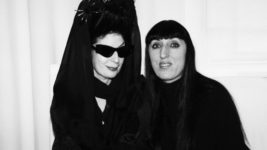
If this were an Almodóvar film, the final shot would not be a grand farewell, but a backstage moment: Rossy and I in half-shadow, laughing at something that will never be written down, sharing a secret before walking toward the light of another screen, another audience, another night. Our relationship is not one scene or one collaboration but an ongoing script: Barcelona, Lucerne, Bilbao, Cannes, Paris, Mexico City, back to Paris again. Each city another reel; each festival another act. Behind the programming decisions, the juries, the line-ups, there is always the same image: two women who recognized each other across a crowded room and never stopped finding ways to meet again, to make cinema together—even when there is no camera in sight.
Later,
Diane