


Dear Shaded Viewers,
There is a particular shade of blue that Georgians claim as their own — not the blue of the flag nor of the sea, but the blue a poet once found in the sky above Tbilisi and could not stop describing. Nikoloz Baratashvili, dead at twenty-seven, left his country fewer than forty poems, and one of them, ცისა ფერს — “L’Iris du Ciel” in its French rendering — has outlived every fashion the world has produced since. It begins as a hymn to a colour and ends as a meditation on the soul’s longing for something beyond the visible. It is this poem, written around 1841 by a young Romantic who never saw thirty, that Irakli Nassidze carried across an ocean of decades and turned, this season, into his third haute couture collection for the house of Zarapkhana.
Zarapkhana was founded in 1939, one of those houses whose name is older than fashion itself — a word that in Georgian once named the mint where coin and ornament were struck by hand, a place of precise, patient craft. It is fitting, then, that the maison should have found, decades later, a couturier for whom embroidery is not decoration but devotion: a man who was taught, long before he ever threaded a needle, that beauty is made stitch by stitch, and that a house’s savoir-faire is a language to be honoured even as it is reinvented.
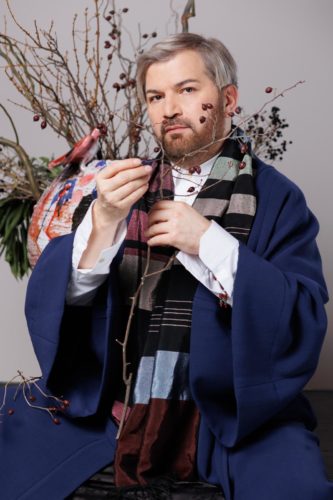
Irakli Nassidze was born into an aristocratic Georgian family for whom French was not a foreign language but a kind of inheritance — every child learned it, as a matter of course, from the age of six. He grew up already certain, in the quiet way that children sometimes are certain of large things, that Paris was where he would have to prove himself. In 1990 he arrived, young and essentially unknown, and set about doing exactly that. He worked with Christian Lacroix. He worked in the orbit of Monsieur Saint Laurent. And he brought to the grand houses of the Faubourg something they had not quite seen: an embroiderer’s eye trained not on tradition but on painting, self-taught, instinctive, closer to brushwork than to convention.
It was that eye that led him, in the customary manner of the era, to seek a godfather — because in Paris haute couture, then as now, no one enters alone. He went to see François Lesage and showed him his embroidery. Lesage looked at the work of this self-taught young Georgian and recognised, immediately, a new way of embroidering — needlework made to behave like paint. He agreed to sponsor him, and wrote to Didier Grumbach a short letter that said, in essence, that this man needed to be allowed to present his work in Paris haute couture. For a young designer with no name yet to his name, to be vouched for by someone of such standing was, Nassidze has said, like being given wings.
For every collection that followed, Lesage embroidered three pieces himself — a gift, freely given, offered simply to support the younger man’s work.
It is a courtesy Nassidze has never stopped being grateful for, and a way of working that, he notes with some wistfulness, no longer quite exists: in those days an artisan could request an appointment with a couture house and be received, quickly, by the designer himself. Today the path runs through assistants and intermediaries before a garment is ever seen by the person who might champion it. Something has been lost in the efficiency.
In 2002, Nassidze presented his first couture collection at the Musée Galliera, having simply called and asked — and been received by Catherine Join-Diéterle, then the museum’s director. He would go on to show in Paris every season until 2016, dressing clients across the Middle East, building a particular reputation for wedding gowns of extraordinary intricacy. Two pieces from those years were selected for the exhibition La Mode à Suivre and now live permanently in the collection of the Musée Galliera — a young Georgian’s handwork, kept in trust by one of the great museums of French fashion.
He was the first Georgian ever to show in Paris, and he has never treated that fact lightly. He speaks with open pride of the generation that has followed him — Demna, David Koma — and of a small country he believes to be disproportionately full of talent. It matters to him, he says, that the world learns to see what Georgians can make.
For his third collection at Zarapkhana, given, as ever, complete liberty within the house’s savoir-faire, Nassidze returned to Baratashvili — to that one impossible blue the poet spent his short life trying to name. “L’Iris du Ciel” is not a poem about clothing, but it is a poem about looking upward and wanting to pour one’s whole soul into a colour, and that, perhaps, is closer to the task of couture than anything written about fashion itself. The collection translates a nineteenth-century Georgian’s ache for the infinite into the vocabulary Nassidze has spent thirty-five years perfecting: hand embroidery worked like brushstrokes, silhouettes cut with the discipline of a maison founded in 1939 and the freedom of a man who has always answered, ultimately, only to his own eye.
The season also carried him home. Nassidze recently mounted an exhibition in Georgia alongside his wife, pairing his garments with her artwork — two vocabularies of the same sensibility, shown together in the country that shaped them both before Paris ever entered the picture.
Their story, like the poem, insists on being told. They met in Paris fifteen years ago, when Nassidze was casting models for a haute couture collection through an agency; she was modelling then, still a student. He fell for her instantly and could not stop thinking of her afterward — and then, as these things sometimes happen, they lost touch. One day, years later, with her still on his mind, he ran into her on a Paris street, entirely by chance. He asked for her number. It was the beginning, he says simply, of a beautiful love affair. Their first child, George, was born in the city where they found each other twice.
It is not a bad way to understand a designer’s third collection for a house called Zarapkhana: a man who learned French at six because his family always had, who crossed a continent at nineteen to prove something, who was handed wings by an old master embroiderer, who found love by accident twice in the same city — and who now, thirty-five years later, looks up at the sky the way a dying young poet once did, and tries, one embroidered thread at a time, to answer him.
Later,
Diane
