


Dear Shaded Viewers,
There is, for many of us, a sense of déjà‑lumière with Jean‑Charles de Castelbajac. Over the years, a dialogue has unfolded: from writing the introduction to one of his books to welcoming him, more recently, as président d’honneur of ASVOFF alongside jury president Caroline de Maigret, our paths have crossed at the precise intersection of fashion, film and art. That shared history makes “Jean‑Charles de Castelbajac. L’Imagination au pouvoir” at Les Abattoirs in Toulouse feel less like a museum event and more like the next chapter of an ongoing epic, one that invites the public to step inside his universe rather than merely observe it.
The story begins in 1968 with a rebellious gesture: a coat cut from his boarding‑school blanket, a makeshift armour against a rigid world and the spark of an entire vocabulary of “poor” materials. From serpillères, survival blankets and SNCF sacks to shower curtains and bandages, Castelbajac anticipated upcycling long before it became a buzzword, fusing Arte Povera instincts with the irreverence of street culture. With his mother at the worktables in Limoges, he forged a silhouette that was at once rural and knightly, kimono and djellaba, designed to protect as much as seduce.
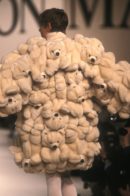
Very early on, he decided that a garment could be a house, a banner or a moving fresco. His poncho à deux places for Créateurs et Industriels in the 1970s, later stretched to six seats for K‑Way, his “premier secours” and “état d’urgence” collections in survival materials, and one of the first duvet coats for Fusano all pushed function to the edge of fiction. In the 1980s he radicalised volume with accumulation: teddy bears, gloves, hats, socks, ravioli and “pâtes” cascade into coats that are both exuberant sculptures and a sly mirror of overproduction.
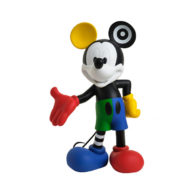
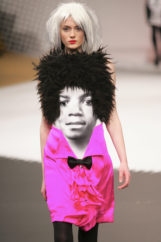
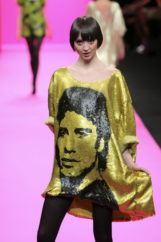
Castelbajac’s chromatic trinity – red, yellow, blue – becomes a flag that unites cartoons, hip‑hop, medieval heraldry and pop art on the same terrain. For ICEBERG, he revolutionised knitwear by inviting Mickey, Bugs Bunny and other icons of mass culture onto classic pullovers, instantly adopted by the hip‑hop scene as a new urban coat of arms. On his catwalks, portraits of Muhammad Ali, Marilyn Monroe, Coco Chanel and the characters of childhood float like spectral saints for a secular chapel of the 20th century.
The exhibition reveals how he covers bodies with literature, from Cocteau to Proust, transforming robes into pages where cursive phrases undulate with every step. His robes‑livres for Gallimard, graffiti dresses and chalk‑drawn angels extend his work from paper to city walls, folding poetry into everyday life. And when he dresses chaplains at Poissy, Pope John Paul II for World Youth Day in 1997, or designs the vestments for the 2024 reopening of Notre‑Dame de Paris, he imports the language of streetwear—flocking, bold motifs, camo—into liturgy, turning colour into a shared act of faith.
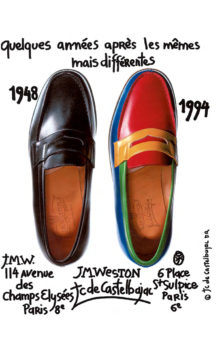
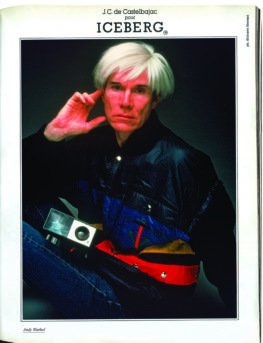
Throughout, Castelbajac refuses to stand alone. The exhibition replays encounters with Robert Mapplethorpe, Keith Haring, Cindy Sherman, Oliviero Toscani, Bettina Rheims, Miquel Barceló, Ben, Robert Combas and many more, as invitations, tableaux‑robes, stage sets and photographic portraits of his contemporaries from Andy Warhol to Vivienne Westwood. Design pieces, from lamps and furniture to camouflaged sculptures and collaborations with brands like Max Mara, Courrèges, Benetton, Palace Skateboards or Pierre Frey, extend his vocabulary into every corner of domestic and urban space.
To walk into “Jean‑Charles de Castelbajac. L’Imagination au pouvoir” is to enter a charged atmosphere where banners hang like battle standards of joy, angels guard textile architectures and childhood toys become talismans for grown‑up revolutions. It is not a retrospective to be politely visited, but an epic to be crossed: a call to young creators, fashion lovers and the simply curious to reclaim imagination as a political force – and to leave Toulouse with colour, words and a few toy bears still buzzing in their minds.
Later,
Diane