



















All photos by Sonnyphotos
Dear Shaded Viewers,
Rick Owens’s SS26 show at the Palais de Tokyo rewrote the script for Paris Fashion Week, transforming a press release’s industrial poetry into a living, cinematic tableau of tenacity and rebirth. By nightfall, as guests crowded the monument’s fountain, the runway was no longer merely walked—it became an altar, each model emerging as a high priestess of Owens’s “Temple of Love.”
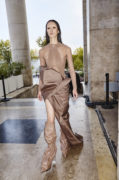
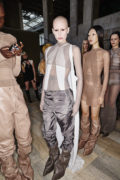
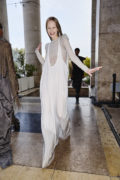
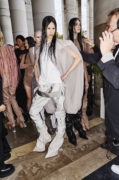
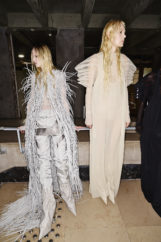
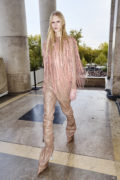
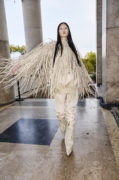
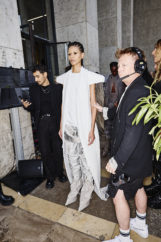
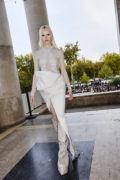
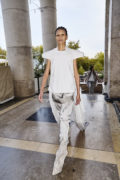
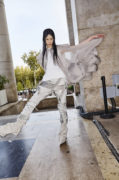
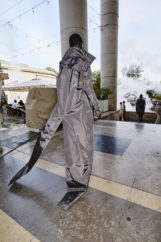
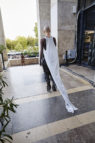
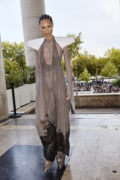
This season’s collection, “TEMPLE,” mirrors Owens’s retrospective exhibit across the street at the Musée Palais Galliera—a choreographed pilgrimage through glamour and bluntness. The clothing summoned the raw electricity of Hollywood Boulevard sleaze, grafted to the dense rigor of European aesthetic sophistication, then stripped with American audacity. Skirts and dresses came in industrial GR-certified nylon, some draped, some whipped up haphazardly, others executed in recycled tulle embroidered with sequins and dipped in latex by Paris’s own fetish mistress. The effect is crusty, yet ethereal—a tactile invitation to approach and recoil in equal measure.
Owens’s unorthodox staging pushed conventional fashion theatrics to their brink. Models first processed across an elevated runway built above the Palais’s fountain, then descended into the water, all platform boots and leather trailing behind. In that baptismal gesture, drenched garments clung to sculpted bodies—both veiling and exposing their architectural seams, suggesting nudity while suppressing it. It was a living preview of his “Temple of Love” exhibit, where every splash belonged to both ritual and rebellion.
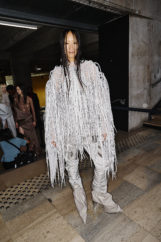
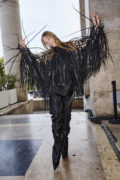
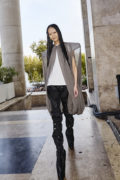
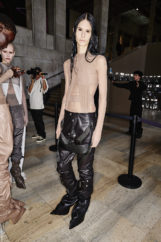
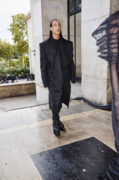
Owens played a symphony with materials: micro-cropped trench coats in airy nylon, paired with long matching vests; dracu-collared biker jackets with weeping leather fringe, or flight jackets as cotton candy armor. Heavyweight leathers, hand-slash woven in Tuscany, moved with choreographed resistance—a dance of slashed, fringed textures. Architectural sheer layers rigidly traced the form, lines as severe as veins. And those hard metallic shoulders supported drooping globs of silk chiffon, open tank dresses revealing exquisite Parisian lingerie beneath, a collaboration with Livy.
A Rick Owens show is never merely spectacle—it’s an immersion. Tonight, the Palais de Tokyo resembled both a temple and a wasteland, the slick marble basin reflecting the chaos and control embedded in Owens’s vision. Models rose and fell, drenched in the luminous spray, their silhouettes simultaneously monumental and fragile. Owens’s leathers—some bearing the devastation of punk band Suicide’s legacy—seemed ready to absorb or repel every note of the throbbing soundtrack, as if music and clothing alone could resurrect a fallen age.
From the gallery, the entire performance recalled a sequence from an avant-garde film: the heroines submerge, reemerge, and ascend, clothing forging new skin over their vulnerability. Each garment was choreographed for tenacity, not escapism—“tough clothes for tough times.” The audience understood: Owens is not offering solace, but the possibility of resilience under fire, punctuated by a quote from Jefferson Airplane, echoing through the marble, “Don’t you want somebody to love?”
Tonight, Rick Owens baptized his audience in raw light and industrial romance—and Paris, as ever, was the city where glamour and sleaze found sanctuary, if only for a fleeting, cinematic hour.
TOUGH CLOTHES FOR TOUGH TIMES.
IN THE IMMORTAL WORDS OF GRACE SLICK FROM JEFFERSON AIRPLANE:
WHEN THE TRUTH IS FOUND, TO BE LIES
AND ALL THE JOY WITHIN YOU DIES
DONT YOU WANT SOMEBODY TO LOVE
DONT YOU NEED SOMEBODY TO LOVE
WOULDN’T YOU LOVE SOMEBODY TO LOVE
YOU BETTER FIND SOMEBODY TO LOVE
Later,
Diane
