


Dear Shaded Viewers,
Introduction
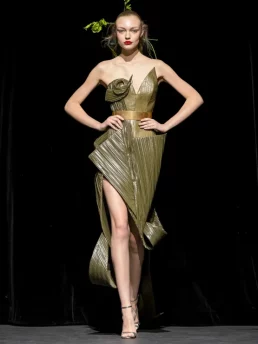
Several elements made this week of haute couture fascinating. The first is the endless discussions taking place amongst the audience. Never have so many chatted to each other about the all consuming subject “The State of Fashion.” The contrast between the dramas in luxury big names and the health of the less obvious and famous names, the importance of vintage, the vast differences between serious Instagram voices with facts and research such as @ideservecouture or @stylenotcom and the me, me me, reviewers whose personal opinions are two a penny. In serious times fashion is about seriousness. Surviving, making beautiful things, selling, talking to clients, making money, seeing your pieces being worn, offering a personal and individual vision of how to dress, allowing creativity to surround the collection, but not be its sole raison d’être. There was also clearly this season a wonderful balance between the established, and the new and across the four main days a global and cultural mix which showed why Paris remains strong. The word “sustainability “seems to be as popular as the word “teaching,” we need to discuss, inform, update, and engage, and we need to think about clothes at every level in every way. However, it is obvious that in their different couture approaches to thoughtful couture Ronald van der Kemp, Julie de Libran, Aelis, and Germanier and now Glenn Martens, perfectly illustrate how there is many answers to a question. By welcoming diverse cultural approaches to couture, by offering a calendar of options, and by mixing big names with the niche, it is exciting on so many levels.
Although stories did appear throughout the days, the idea of “trends” or must haves are no longer of major importance. Clients have been educated to not buy a look, item, colour of print just because its labelled “hot.” So, scream orange is a must all you like the savvy customer nowadays says “no.” Therefore, I’m going to simply discuss show by show, day by day, hour by hour.
Sunday 6th July
On Sunday Guillaume Henry presented Patou and from the mood board it was clear that Christian Lacroix and his time at the house was an inspiration. Put this together with the name of the fragrance of the house JOY, and the result was enchanting. Prints, bows, flirtatious ruffles, candy stripes, glittery necklaces, and more bows offered a pert Parisienne. Flirty, and lighthearted it never felt over fussy, tricksy, or elaborate, the balancing of proportions, the mixing of the prints was perfectly judged by Henry. It will also work perfectly as pieces worn with denim, or basics, on clients of all ages. Happy applause, happy faces, and a collection remembered days later as strong says it all.
Monday 7th July
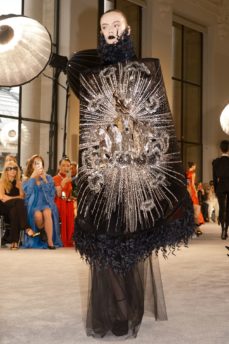
Schiaparelli by Daniel Roseberry now launches the official couture calendar, and this season Daniel Roseberry has stated that this was the last collection in this vein. So, we all wonder what he has up his sleeve? The links between Schiaparelli pieces from the archive and new reinterpretations was especially strong this season, as was much more black. On viewing the collection after the catwalk show there was especially more cocktail and suit looks amongst the pieces than in previous collections, expanding the potential for clients. There were also understated and restrained grand evening looks with dresses that played for glamour over embellishments. Red lacquer, silver beaded stripes, black shimmer and pewter glimmer, plus gunmetal drapery. There was a discrete hint of old couture from the 1950’s and even 1960’s which brought to the collection glamour rather than drama. The famous Apollo Versailles Rococo cape once worn by Elsie de Wolfe, Lady Mendl was reinterpreted and had a modern lightness to it. This was very much in evidence throughout the collection, with less construction, and gave perhaps a hint of where Mr Roseberry might be thinking
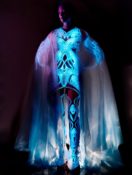
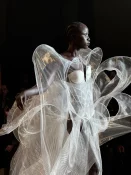
Iris van Herpen pieces belong in a realm of her own imagination, the snow clad mountains of Narnia, the moss and steam filled landscapes of Camelot or on the road to Samarkand. Through the rigorous use of repetition of segments overlaid and joined, through the undulations of opaque and transparent and through her technical daring she has literally created a couture style which never existed before. This season she and her team waved their wands and created magic within her chosen signatures in under twenty looks. Contrasting bubble silhouettes with mermaid like sinuous lines, extending the garment into wings, or encircling the body with waves, nothing is impossible for her. She offered her vision from Loie Fullers late Victorian dances as seen on flickering silent films through to experimental modernity with algae. Now it is possible to see these clothes actually appear on clients as the technical developments and ideas so conceptual they once seemed totally unreal have become possible. It’s a huge challenge that only a visionary like Iris van Herpen will remain focussed and dedicated enough to pursue. In any couture she shows her collection it is a truly special moment.
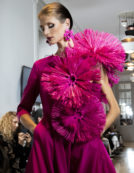
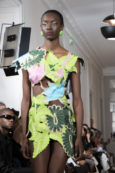
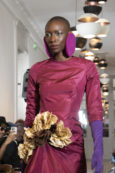
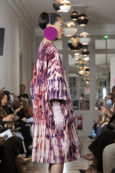
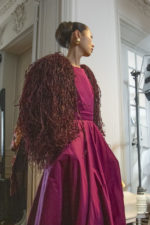
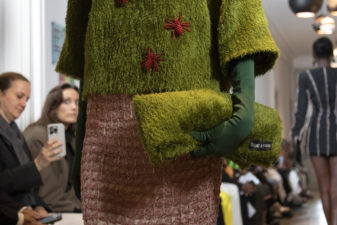
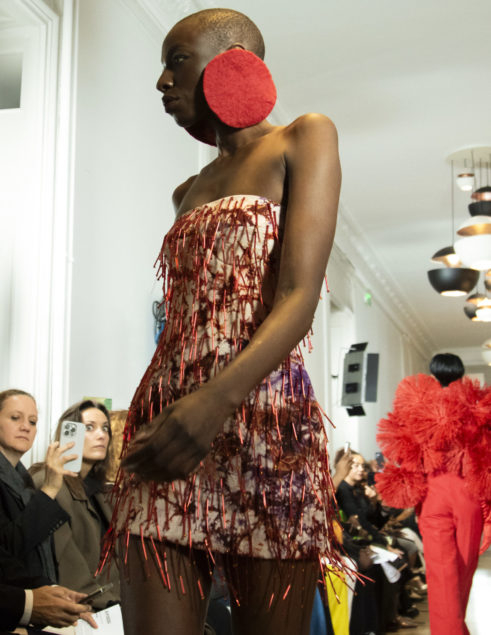
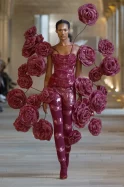
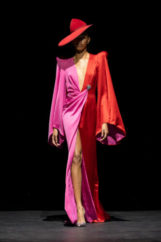
Imane Ayissi was next on my schedule. I’ve been lucky enough to see this Cameroonian designer since his debut at couture and this season was a humdinger. Hair and makeup were 1950’s/60’s couture immaculate and polished, models posed and presented in true couture fashion and the clothes themselves distilled the designers’ signatures across the collection. Duchesse sarin with raffia fringe, long languid printed dresses, short sexy looks, created out of overlapping leaves and flowers, there were some lovely takes on very restrained beading fringes shimmering and dancing in the lights, there was a stunning dark fuchsia draped taffeta dress fastened with a cluster of pale ecru roses. My two stand outs were both with wide trousers. A scarlet top to toe, including gloves look with an explosion of raffia rosettes framing the shoulders and face, stunning and a sateen top and trousers in an ashes of rose kind of colour, which draped and knotted across the torso that made such a couture statement in its refined grace and elegance it remains a highlight of the week. Congratulations Imane Ayissi on a truly lovely collection.
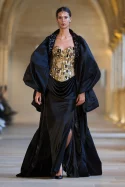
Rahul Mishra has an exceptional sensitivity in his inspirations and thoughts behind each season’s collection. Yet his great passions for nature and emotion remain constant in pieces designed to make our hearts beat faster. This collection referenced his superb flower embroideries, his extraordinary three dimensional constructions and the glittering embroideries he and his ateliers do so beautifully. The stand outs for me were the deep, deep red flowers on stems surrounding the models and quivering as they paraded. The draped black taffeta bustle coat was a couture wonder over Gustav Klimt golden sequins and a coat and a skirt in a voluminous bubble silhouette looping back under the hem were beautiful as they swayed past looking like some from ancient Persian miniatures. Black used by Mishra always seems a colour, if that’s not an oxymoron, this time in a variation of the roses in drenched in glittering dewy drops surrounding a slender dress and the look completed by a Stephen Jones dotted veil. Shown in long arched space the show and collection succeeded in enchanting and fascinating the audience whilst offering beautiful pieces to be worn at memorable events.
Tuesday 8th July
Tuesday always opens with two showings of the Chanel couture collection. This season was the last time the studio team had an opportunity to offer their ideas. Trained and working with Karl Lagerfeld and Virginie Viard there appeared many great classics and many beautiful pieces, and the workrooms of the house were clearly in evidence in many pieces. It demonstrated very clearly that the survival of a house needs more that great professionalism or the ability to make beautiful clothes, it also needs a creative vision. So, a lovely show of beautiful clothes all bearing the Chanel shadows and label, but in honesty more of a collection marking time or providing an interval, before the entrance of Mathieu Blazy. This collection will enable clients to remain well dressed in Chanel; it will keep the workrooms busy but the frisson we expect was missing.
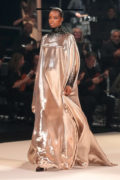
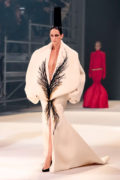
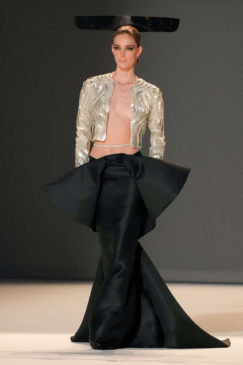
Stephane Rolland showed at the Theatre des Champs Elysees, where Diaghilev and the Ballets Russes first shocked Paris with Le Sacre du Printemps. He use Ida Rubinstein and Maurice Ravel and Bolero as his initial inspiration, both artists had worked with Diaghilev, although Bolero was first performed at the Opera Garnier.We had a live orchestra, and its Rolland clad conductor Zahia Ziouani, making it a truly special show.What made it beautiful for me was that Stéphane Rolland didn’t use direct referencing of Ida Rubinstein at all, very slender, over six foot tall, often dressed by Leon Bakst, she was not a fashionable dresser. What the designer distilled was a long line elegance, a dramatic flourish of couture at its hautest. He offered a red so zinging and so perfect in its pitch, there are thousands of reds, many of the “wrong,” and he presented many pieces where it was literally possible to see the sketch and the journey through the atelier and fittings to the final piece.
A tiny bolero top seemingly composed of shattered mirror, worn with a black silk fails skirt formed of a giant bow and a siren skirt trailing behind, a huge black bubble of silk taffeta, a slender ecru tabard dress with broad shoulders shimmering with embroidery and worn with scarlet long gloves and a single shaft or quill of red in the hair. A liquid silver robe style dress, a huge white coat forming a figure of eight around the model with filigree tree branches layered across the heart of the piece. If there was any reference I could pin to the collection it might be Paul Poiret the first modernist. Stephane Rolland seems to use sculptors like Constantin Brancusi or Barbara Hepworth as linear craftspeople to look to rather than fashion. His confidence in line and silhouette, often with surface decoration used either to point up the shapes he is forming or to balance them, is masterly.
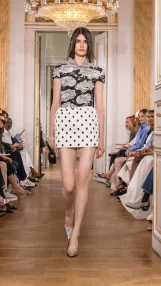
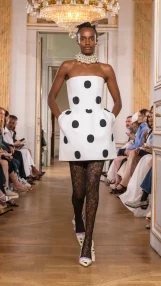
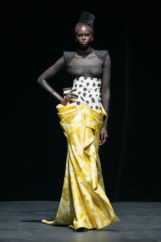
Ronald van der Kemp offered as always, a masterclass in how to offer a wardrobe and a selection of looks, styles, lives, and moods to his clients. Nature was importantly this season, but themes are never the true thrust of his creative work, it’s the dexterity of the pieces. Across the season he’s offered us everything from jeans to ballgowns, but everything it underpinned, strengthened, and offered with his mastery of couture construction from sharp tailoring to languid drapery. Yellow brocade draped onto a long line spotted corselet bodice with a black lace top section turned on exit to reveal a black and white striped bow, a touch of the Christian Lacroix’s? A seemingly rewoven from a thousand strands looked like it wouldn’t be out of place at the court of Kumla Khan, and a long flowing patchwork knitted coat also had a fairytale or legend quality to it. A long flowing print dress and a jacket apparently made by throwing miles of knitting wool until it assembled itself into a garment was worn with black silk taffeta pantaloons. I adored the black and white look using spots, houndstooth, mousseline, crepe de chine, yet offering the chicest, most elegant, most couture, look possible even to two strings of pearls. The two green opening looks were a tutu silhouette and a slender bamboo shape showing Ronald van der Kemp can take you dancing in feathery fronds or to the embassy in fern like tendrils.
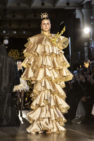
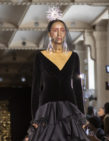
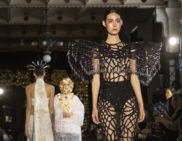
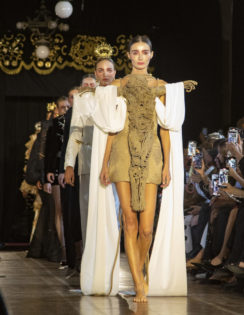
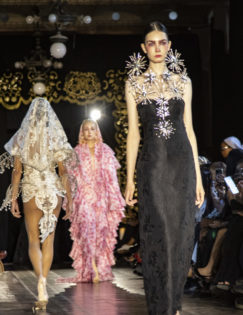
Juana Martin is Spanish, and this marked this firmly collection from the Madonna tear drops on the models’ cheeks to the flamenco ruffles. It’s offered some wonderful ideas which to this observer had a strong cultural and historical reference. Stylish, detail and accessories told a story but like all good designers there was clothes under the catwalk narrative. Two key themes both reflecting Spanish taste and culture; black and ruffles, and a third story of colour. Black came in a slim dress with a diagonal drape, a short sexy with rope twists, in spangled mousseline with a deep draped cowl and in flamenco ruffles, it came in wonderful fabrics like luscious velvet pierced with golden pins or in heavily beaded silk mousseline, all with tactile surfaces and all brining to mind the darkness of El Greco or Velasquez. The ruffles cascaded in featherweight gold, in classic black and in pink, the colour story. Pink for a cascade of overlapping ruffles like petals as ruffles to the floor, or a veiled princess whose veils were covered in scattered individual rose petals. The star for me was a dress of heavy white organza covered in a pattern I took to be clouds but was actually abstract flowers. The dress was panelled and shaped like an infanta and for the show was embellished with a golden filigree necklace, and surrounding the models face a golden frame of baroque curlicues. Golden “ropes” and other religious references were dramatic as was the soundtrack, but at the heart of the collection was a designer whose heritage without directly referencing it showed Spain and haute couture has a noble lineage.
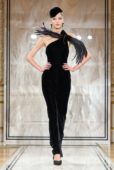
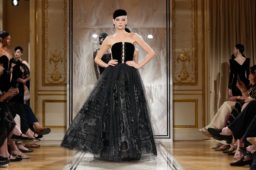
Giorgio Armani has been a huge innovator, a major talent in fashion, one of the few people whose clothes literally changed fashion, yet he’s not a confrontational revolutionary. He is a designer who’s work, and vision is important to him and if that proves controversial, as back in the day it did, he continues, like Balenciaga, to do what he wants. Armani Prive is his couture and from day one it’s had an elegance and a glamour which clearly reflects Italian cinema and the great ladies of the Cinicitta, Sophia Loren, Claudia Cardinale, Monica Vitti and Silvano Mangano, to name a few. Black, slender, and sexy silhouettes, swaying fringe and beading, sheer used sparingly and in layers, some tailored looks, and often top and skirt for evening all these are signature elements he returns to with love. Plus, he does also love a cocktail hat, a tiny accent at the top of the silhouette. This season Mr Armani was at home watching online, but his fingerprints were visible in every look. Out of over seventy looks most were top to toe black, there were a lot of quietly and subtly sexy evening gowns some strapless or asymmetric, the tailored pieces featured sharp clean shoulders, but they were never over exaggerated. There were two strapless ballgowns, very opening night at La Scala, and some feathered fringe details of great refinement with not a hint of Saloon. Many red carpet veterans return to Mr Armani again and again and this collection showed exactly why, not safe, not boring, but flattering, elegant and with just enough sexiness, oh and yes, there were tiny hats worn with every single look.
Later,
Tony Glenville
