
Dear Shaded Viewers,
A wood-panelled hall, a pulpit in the corner, phones raised like votive candles. Uma Wang chose the right church for a collection about faith in things that shouldn’t hold together.
The starting point is sculpture, but sculpture that has been set in motion. Calder’s mobiles are the obvious reference, and they work: mass turns into something that sways, and gravity becomes a mere suggestion. A boxy tailored jacket drags a silk drape behind it like an afterthought. A skirt and trousers merge into one garment. Heavy draped cotton is set against a chiffon trench so weightless it seems to be leaving the room. Dry cotton jacquard sits next to liquid viscose, and you want to touch every surface, which is the only honest test of a fabric.
The real subject is what happens after the clothes leave the atelier. Trousers are knotted, fastened or left open. Wraps are tied at the waist, loosened and shifted. A ruffled collar spills over the chest. A black cocoon dress holds its collar with a single oversized safety pin, a kind of couture that is half pinned together and fully aware of it. The garment is deliberately unfinished until a body gets involved, and the wearer makes the final call. In fashion, that is the most seductive thing a designer can hand over.
Because here is the quiet erotic logic of the collection: nothing is fully fastened, and everything could slip. A deep V opens on a kimono-sleeved top. A sleeveless piece slides off one shoulder. A skirt is knotted high enough to show a flash of leg, then closed again. These are clothes that conceal and reveal in the same movement, modest in silhouette and loose in intention. Even the sunglasses are part of the argument: tiny wire-framed ovals worn indoors, which keep the model’s gaze to herself.

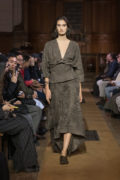

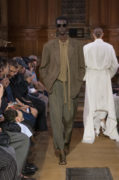

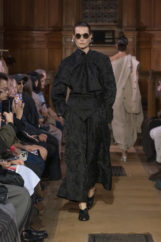


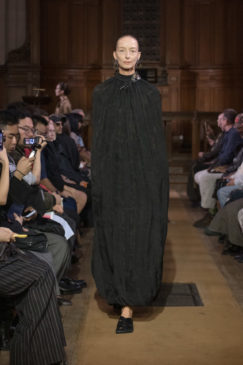
The palette keeps it grown-up. Bone, khaki, olive and herringbone grey give way to a long black passage of damask and satin, with one burst of mustard in a bag and sandals, like a note held a beat too long. Styling here is construction, not decoration. Spontaneity is the method, and movement is built into the pattern.
Uma Wang continues last season’s story rather than repeating it: elegant clothes stripped of formality, worn with the ease of someone who knows exactly how much she is showing. Weight and lightness, precision and accident, all in suspension. The best outfits are the ones that look one gesture away from coming undone.
