
Dear Shaded Viewers,
At Fondazione Sozzani, Gabriel Figueiredo pushed De Pino into a more expansive territory — where late-2000s nostalgia, editorial glamour and obsessive craftsmanship collide.
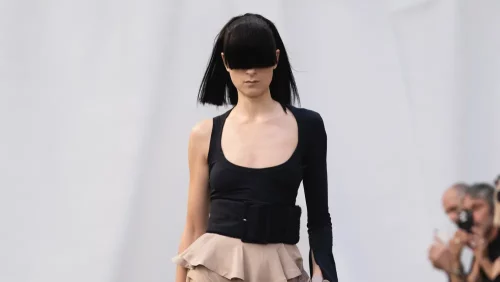
There was something deliberately theatrical about the way De Pino’s Spring/Summer 2027 collection entered the room. On October 5, at Fondazione Sozzani in Paris, models emerged through a vast white curtain in oversized bob wigs and white-painted pumps, walking into an industrial setting as Michel Gaubert’s soundtrack supplied the pace. The effect was immediate: part fashion fantasy, part memory of the charged runway culture of the late 2000s.
But nostalgia is only the starting point.
For Gabriel Figueiredo, SS27 is less about looking backwards than about taking the codes that shaped his formative years and making them useful again. The designer, who founded De Pino in 2020, has spent the past few seasons testing the boundaries between glamour, irony and everyday dressing. Now, that vocabulary is beginning to look less like a series of experiments and more like a fully formed wardrobe.
The shift is significant.
The De Pino Woman Gets a Wardrobe
During his run as a finalist for the 2026 LVMH Prize, Figueiredo spoke to a broader ambition for De Pino: to move beyond isolated fashion statements and construct a complete world around the wearer.
SS27 makes that ambition visible.
Here, the evening gown does not exist in opposition to the T-shirt. A jersey top can sit alongside elaborate embellishment; tights become distorted into something almost surreal; a casual silhouette can suddenly acquire the drama of eveningwear.
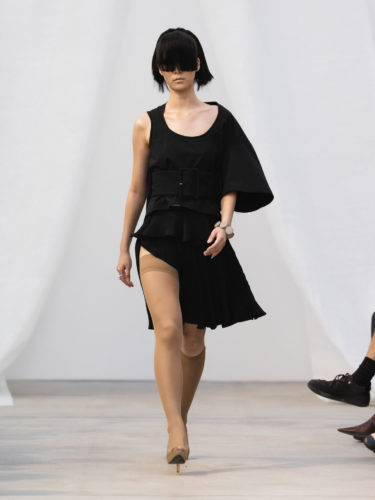
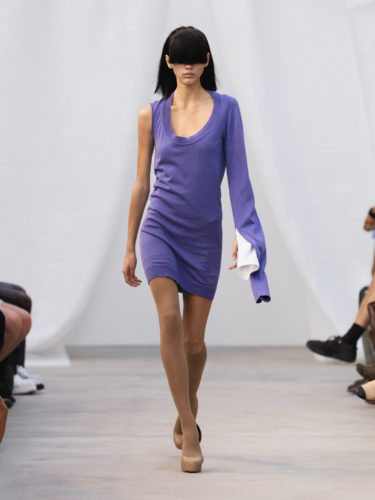
Figueiredo seems less interested in defining where one category of clothing ends and another begins. Instead, he allows them to interfere with one another.
That tension gives the collection its energy.
Glamour With a Sense of Humour
The designer’s references are rooted in the visual culture of his adolescence. One is the highly stylised universe of American Apparel in the late 2000s — a period when the most basic pieces could become loaded with sex appeal, attitude and image-making.
The other is the French fashion editor, embodied here by the unmistakable presence of Carine Roitfeld.
Both references understand glamour as something constructed through styling as much as through clothing. Figueiredo takes that idea and twists it. His woman can wear something overtly glamorous without behaving as though glamour is a serious business.
That is perhaps where De Pino feels most contemporary.
The clothes flirt with excess while maintaining a certain deadpan quality. Neutral clothing suddenly gives way to a sharp hit of colour. A familiar garment is made strange by proportion or construction.
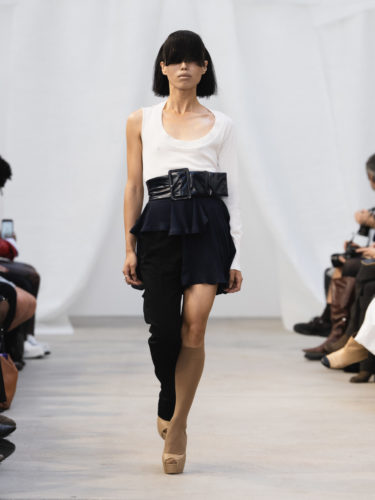
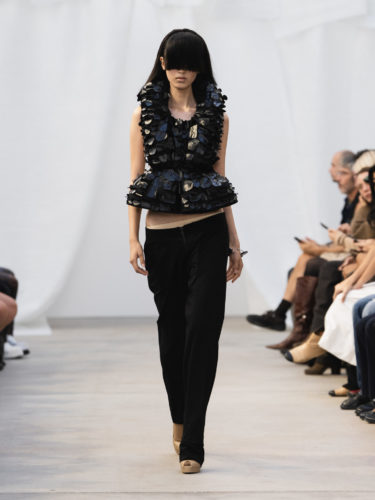
Nothing is quite as innocent as it first appears.
One Sleeve, One Leg, One Unexpected Move
Asymmetry is central to the collection.
A viscose crepe peplum skirt is cut with a dramatic high slit. Shift dresses and lightweight jersey tops lose one sleeve. Skirts are placed over tights that cover only one leg, transforming a recognisable styling gesture into something slightly uncanny.
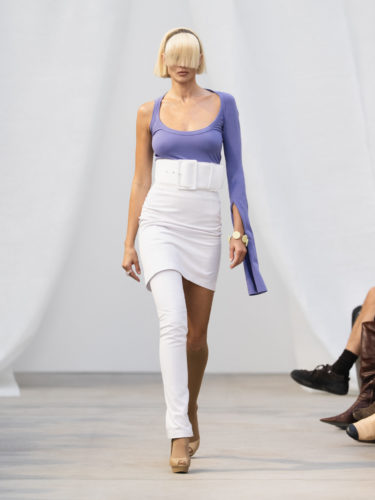
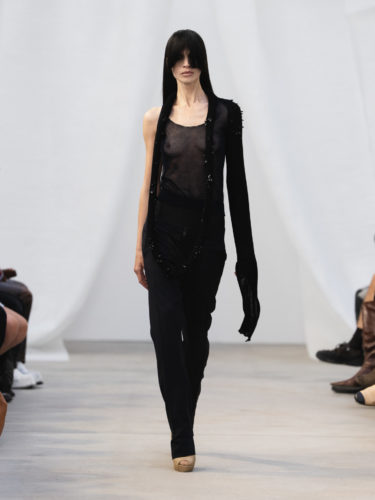
These interventions are small, but they change the psychology of the clothes.
Figueiredo also brings back heavy cotton gabardine outerwear and papery leather treated with hand-cut crocodile-scale effects from the previous season. Rather than functioning as signatures frozen in time, they become recurring elements in an expanding De Pino vocabulary.
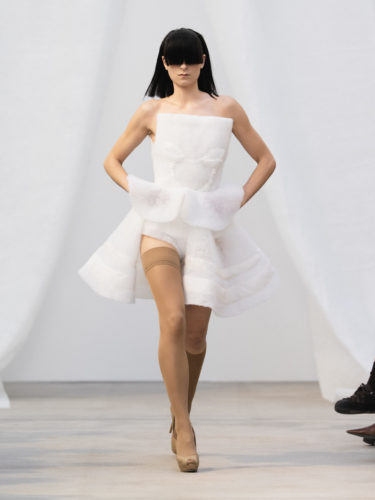
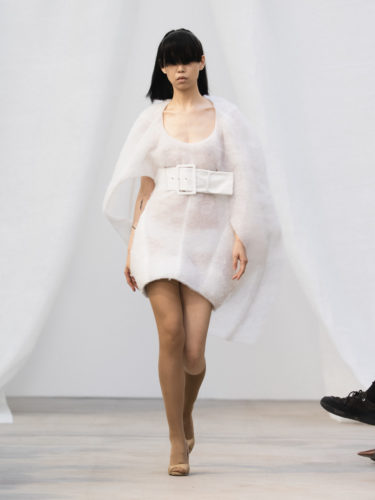
The collection feels built through repetition and disruption: establish a familiar shape, then take something away.
When Embroidery Becomes Knitwear
For a designer whose professional background includes embroidery at Maison Margiela Artisanal, craftsmanship has always been central to Figueiredo’s practice. At SS27, however, technique becomes particularly experimental.
One of the collection’s most striking developments comes from the meeting of knitwear and embroidery. Working with knitwear designer Céline Breton and with Swarovski support, De Pino developed a technique that integrates crystals directly into the knitted stitches.
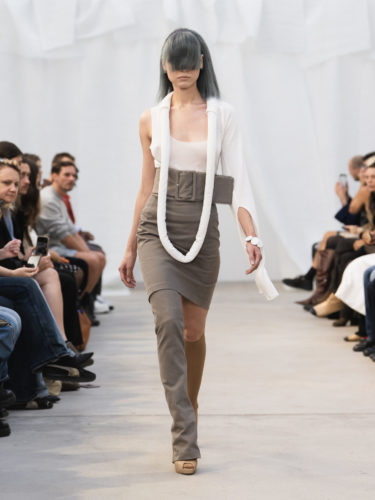
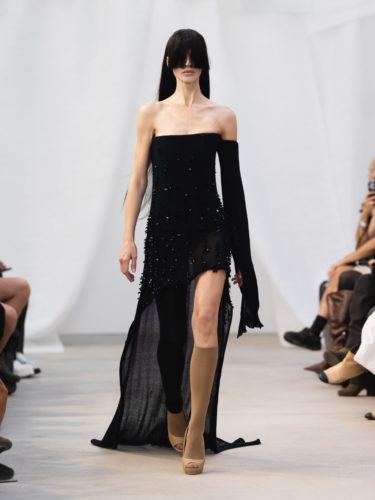
The result mimics the visual richness of hand embroidery while remaining inseparable from the knitted structure itself. Seen on an evening dress and a sweater, the technique collapses the distance between something traditionally considered casual and something associated with couture.
Then comes the wadding.
A material rarely granted this kind of attention in high fashion is transformed into sculptural, almost fur-like outerwear. One particularly demanding jacket was made from hand-stitched wadding fringes and then covered with thousands of tiny embroidered chiffon squares. The surface shifts gradually through a dégradé effect, turning an unconventional material into something tactile and unexpectedly luxurious.
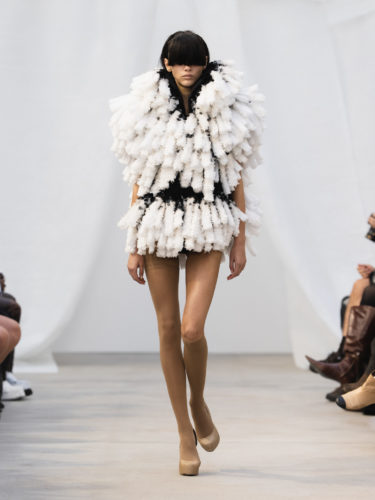
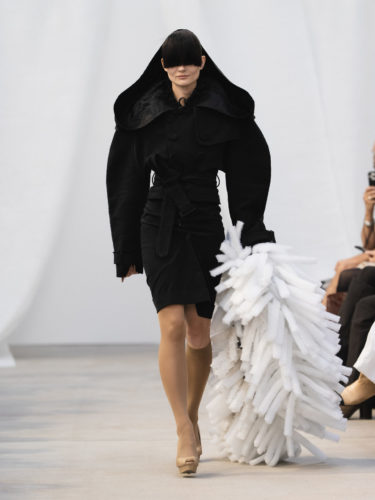
The piece demanded around 250 hours of work and a five-person team.
It is the kind of detail that changes how the collection reads. What might initially appear playful or spontaneous is, underneath, the result of an extraordinary amount of patience.
From Brussels to Paris — and Back to Portugal
Figueiredo’s relationship with craftsmanship is inseparable from his trajectory.
After completing a master’s degree in fashion design at La Cambre in Brussels in 2017, he joined Maison Margiela Artisanal in 2019, working as an embroiderer first under John Galliano and later Glenn Martens. Since November 2025, he has also been working freelance within Christian Dior’s womenswear atelier, across ready-to-wear and haute couture.
That experience explains something fundamental about De Pino: even when the clothes appear irreverent, their construction is anything but casual.
SS27 also strengthens the label’s connection to Portugal. Jewellery from MESH, a Gondomar-based Portuguese jewellery brand, enters the collection as another expression of the designer’s interest in local creative and industrial expertise. The collaboration further develops De Pino’s relationship with Portugal Fashion and places that connection within the label’s increasingly international trajectory.
Fashion, Without the Stiffness
The most compelling thing about De Pino SS27 may be the contradiction at its centre.
The clothes are technically demanding, but they do not look burdened by their own craftsmanship. They reference fashion history without becoming archival. They embrace glamour without becoming solemn.
Figueiredo is building a woman who knows exactly what she is wearing — and is still capable of laughing at it.
That balance is becoming De Pino’s strongest proposition. After years of exploring individual archetypes of fashion and glamour, Figueiredo is now assembling something more difficult: a complete wardrobe with a distinct point of view.
One where the everyday can become extravagant, where couture techniques can inhabit a sweater, and where a fur-like jacket can begin with humble wadding.
De Pino is taking fashion seriously.
Just not itself.
Credits
- Styling — Joel Traptow
- Music — Michel Gaubert
- Images — Colin Savercool
- Hair — Olivier Noraz
- Make-up — Rebecca Wordingham
- Production — Angels Production
- Casting — Conan Laurendot
- Movement Direction — Fransiska Paula
- Knitwear Collaboration — Céline Breton
- Jewellery — MESH
- Organisation — Portugal Fashion by ANJE
- Co-funded by — Compete 2030, Portugal 2030, European Regional Development Fund Supported by — Dower Business
Lately,
Eva
