




Dear Shaded Viewers,
The New Zealand designer who calls himself a romantic pragmatist on knots, kilts, chosen families, and why the clothes he makes are meant to be lived in.
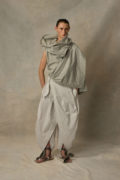
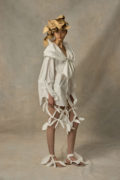
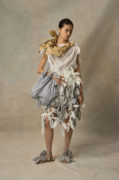
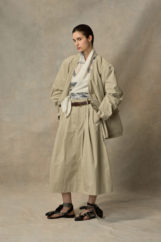
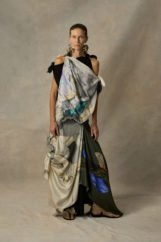
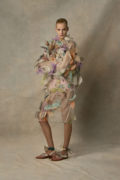
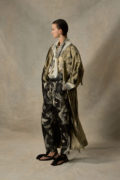
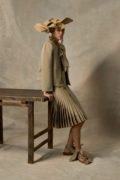
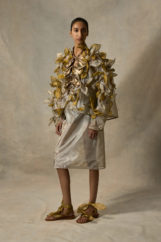
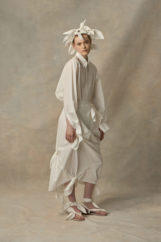
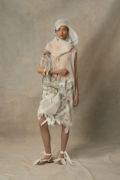
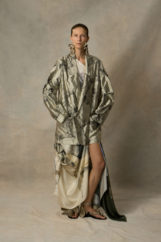
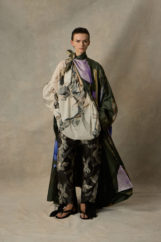
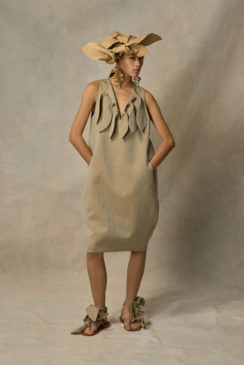
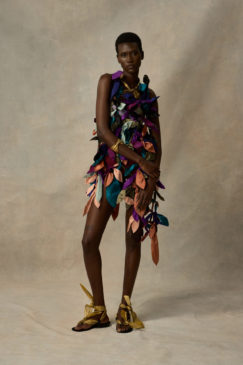
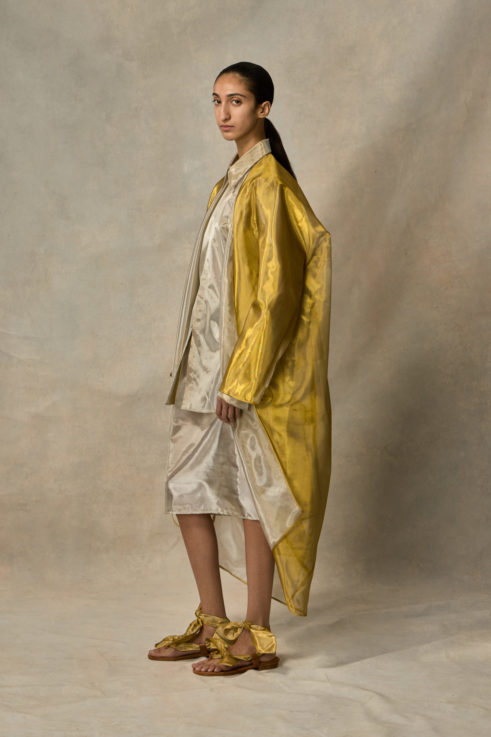
Look at Rory William Docherty’s latest collection and the first thing you notice are the knots. Silk and organza tied into leaves until a jacket becomes a garden. Raffia headpieces twisted like windblown bows. Ankle ties on flat sandals. It looks pure poetry, which is why it surprises you when he says that half of it is built for real life.
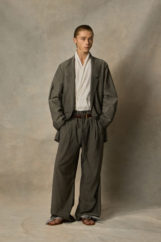
Docherty calls himself a romantic pragmatist, and he doesn’t see the two sides fighting. “It’s not a battle or an internal struggle,” he says, “rather a balance, a harmonious marriage, where each compliments the other.” Every collection has a core of practical pieces that he and his customers wear every day. Even the more poetic ones can be dressed down: the knot-leaf jacket in linen lurex, worn over a hand-sewn kilt, works as a full suit or simply thrown over a pair of the label’s Re-work jeans.
What we call romantic and what we call practical can change with time. His bestseller is the Multi Tie Painters Shirt, first shown in his second collection. Back then it looked enormous, with ties running all the way down the front, and it didn’t sell straight away. Now it is the piece the label is known for, and customers collect it in different colours and signature prints. After the shirt, the strongest sellers are the crushed silks printed with his original artworks and the easy skirts. At the other end of the scale, some runway and one-off pieces have gone to private art collectors and public institutions.
He talks about “one collection for a lifetime” and has no interest in the seasonal cycle, so why show on the London Fashion Week calendar? For Docherty the runway is about reach: press, new audiences, and the chance to build a presentation with like-minded collaborators, including Samuel Drira, Barbara Grenet, Cozette McCreery and Leonard Corfu. For him, slow fashion means continuity: ongoing styles, silhouettes and fabrics, so that a customer buying something new knows it will work with what they already own. “There is a conscious, mindful continuation,” he says.
He doesn’t pretend London is cheap. “It always costs more than you’ve budgeted for, been quoted or expected.” He never expected orders from London, or before that from Australian and New Zealand Fashion Week, to cover the costs right away. It is a long-term investment, and he believes it’s working. Stockists are growing, direct online orders are up, and editorial requests keep coming.
“If my language shares phrases with Yohji’s and can communicate together in some ways, I’m delighted with that.”
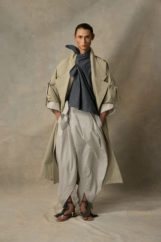
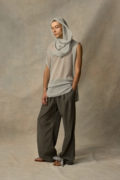
Draping, volume and genderless cutting inevitably bring Japan to mind. Docherty worked in retail for Yohji Yamamoto in his early twenties and says that time taught him about quality, cloth, craftsmanship and how a brand presents itself. He admits they share a love of wrapped fabric and the ease of volume, “but for any similarity, there are many more differences.” His own language comes from drawing, painting and sculpting, the starting point of every collection. From there it becomes draping, cutting, his own prints, embroideries, jacquards, fabric manipulation and bespoke jewellery. He has always championed gender-inclusive clothing and tries on every piece himself.
He gets the inevitable question too: with Dries Van Noten gone, is he stepping into the space left for painterly prints and poetic tailoring? He says no. He has always worked from his own artwork, and RWD becoming more visible internationally just happens to coincide with Dries leaving his house. “There is not a conscious, calculated move to try to fill anyone’s shoes.”
He grew up drawing and painting but trained in fashion, so he calls himself a designer. More and more, people tell him he works like an artist, letting the process lead instead of starting from a mood board or a muse. As interest in the original artworks grows, he will “reluctantly and very modestly” accept the title. He adds, with a smile, that running a small business also makes him a reluctant accountant, production manager, sales manager, e-commerce administrator, HR department and dispatch team. If the label stopped tomorrow, he would keep painting, but he suspects it would turn into a textile, a garment or a construction detail sooner or later.
“What Ties Us Together” follows his previous collection, “Identity,” which looked at people, place and provenance. Afterwards he found himself thinking about chosen families, the tribes we gravitate toward and share our lives, work and values with. The new collection is about shared values, mutual respect, a care for craftsmanship and “the collective subconscious that echoes through creatives.” He sees it as a response to the times: “Political unrest, terrifying global movements inciting hatred and othering. We are all seeking security and connection.”
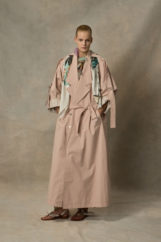
Docherty began at Swanndri, designing farm workwear in rural New Zealand, and that common sense hasn’t left him. He uses hard-wearing fabrics you can wash without ironing, chinos with elastic backs, and crushed silks that travel well. On a camping trip with Jordan last summer he lived in an old flannel shirt and thought a soft brushed-cotton check version of the painters shirt would become his everyday favourite. So the label made one.
The kilts are a nod to his Scottish heritage, reworked in papery cotton and linen lurex. “To anyone who hasn’t tried on a kilt,” he says, “they are incredibly comfortable and practical.” With four metres of pleated fabric, they move however you move.
In an industry full of greenwashing, Docherty insists on transparency. The label shares where its pieces come from with retailers, customers and press, and he says everyone is paid very fairly. Last year it took part in “I made your clothes,” a campaign during New Zealand Fashion Week that put makers on billboards, social media and in print.
His customers range from 18 to 80: women, men, non-binary and transgender people from many backgrounds. Most are women, but more men are buying, and the label is stocked at Ware-Mo-Kou, an exclusive men’s designer boutique in Japan. What they share, he says, is a love of craftsmanship, quality and creativity. He has dressed people for the most important moments of their lives, and he is just as happy to see someone still wearing a painters shirt years after it came out. “I make clothes to be worn.”
The most moving request came from a dear friend. He had dressed her for her daughter’s wedding. A year or two later he visited her in hospice, and she chose a Rory look to wear in her open casket, to wear forever.
“I don’t think of my clothes as costume. Unless we consider all clothes costume for the characters we play in life.”
He has designed for ballet, but he doesn’t see his clothes as costume. And the harshest thing anyone ever said about his work? A stylist once called one of his dresses “a sack of shit.” Docherty disagreed then and still does. “I think he simply didn’t understand it at the time,” he says. “If he saw the same dress now, he’d eat his words.” That stylist no longer works in the industry. Docherty is showing in London.
Later,
Diane
